Voice-First Tools as ADHD Executive Function Supports
Voice input cuts through the friction that stops ADHD brains before tasks begin.
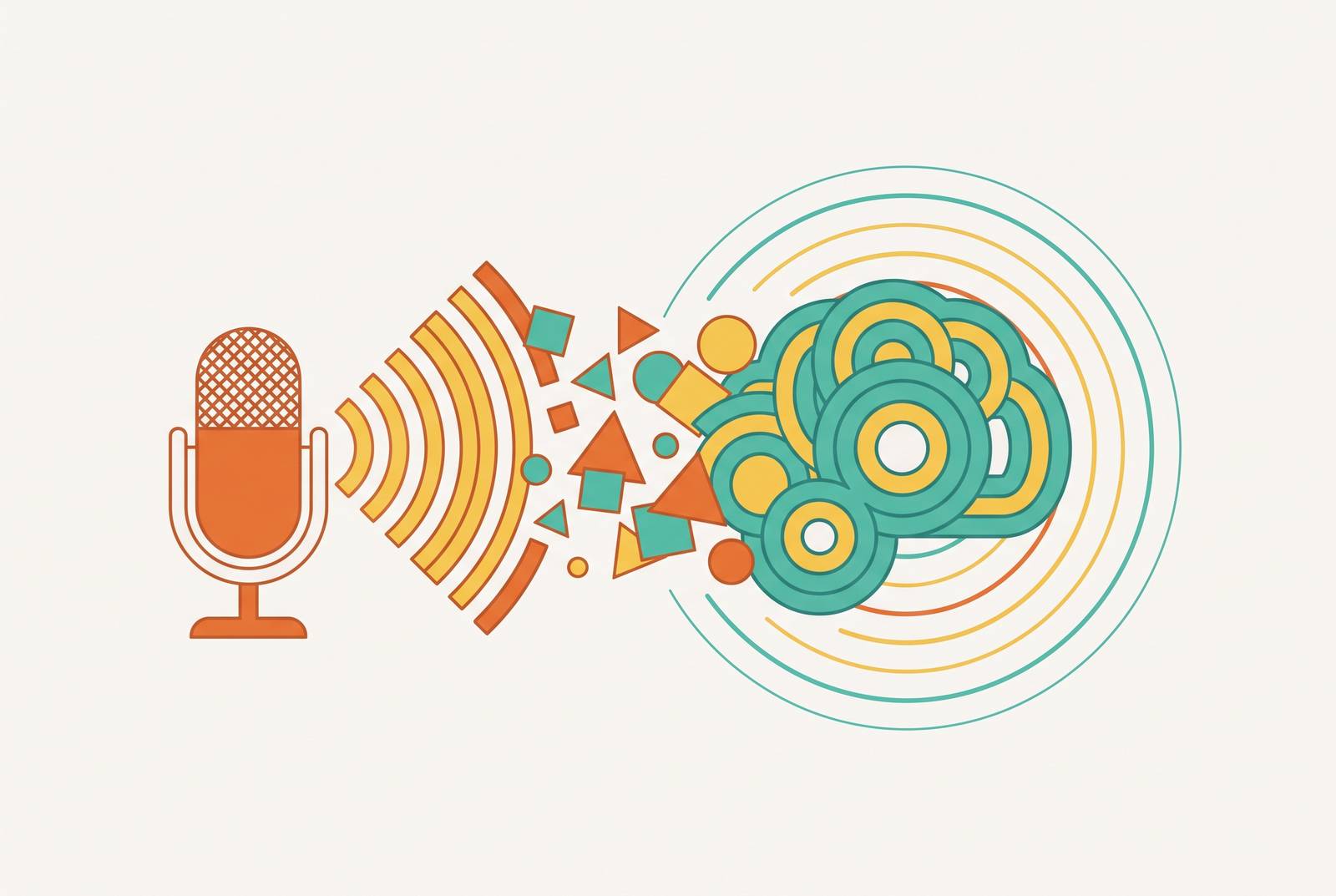
ADHD is less a disorder of attention and more a disorder of self-regulation and initiation. That's the reframe Russell Barkley has pushed for decades, and it matters here because it changes what "productivity help" is supposed to look like. This piece looks at voice-first tools, the ones that let a person talk instead of type, and asks why that single shift in input method does something that thirty years of app design hasn't managed: it gets used at the exact moment executive function collapses.
Where traditional productivity tools fail before the first task gets done
Most productivity systems assume a brain that can hold focus, direct itself, and keep a multi-step sequence in mind while executing each step of it. That's the whole model behind a to-do list, a calendar block, a visual task board. Executive dysfunction breaks precisely that chain, so the tool built on top of it inherits the same break.
Knowing what to do isn't the same as being able to start doing it. That gap, between intention and action, is the actual mechanism behind ADHD paralysis, and it explains why "just make a list" advice keeps failing the people who need it most. A list assumes the hard part is remembering. For many ADHD brains, remembering was never the hard part.
Every screen adds a small tax. Open the app, find the right project, tap the field, type the words, hit save: each of those is a tiny demand on working memory and initiation, and they stack. By the time the task is actually logged, the executive function budget that existed thirty seconds earlier might already be spent. Nothing dramatic happened. The brain just ran out of the specific fuel that step required.
This is where app-hopping comes from, a symptom rather than a habit. Novelty briefly lowers the activation cost of trying something new, so a fresh app can feel usable at first. Then the same friction reappears, and the brain moves to the next thing. Running multiple systems at once doesn't multiply the odds of success. It multiplies the decision load, and decision load is exactly the resource in shortest supply.
Generic advice makes this worse. Rigid schedules, dense to-do lists, discipline framed as a matter of willpower: all of it demands sustained, self-directed executive function as a precondition for using the tool that's supposed to compensate for the lack of it. The moment someone with ADHD needs their system most is often the exact moment that system feels the most unreachable.
The externalization principle: why moving cognitive load outside the brain works
One well-established answer to this problem has a name: externalization. Instead of asking a weak internal system to perform better, move the function outside the brain entirely. A sticky note on the door, a phone reminder tied to a location, a smart speaker set to nudge at 7 AM: the medium isn't the point. The point is that the information now lives somewhere other than an unreliable internal buffer.
External supports, reminders, structured routines, and fewer decisions to make in the moment appear consistently in research on adults with ADHD as genuine boosts to daily functioning. But the design detail that gets skipped over is this: the tool has to keep working on the days when engagement is inconsistent. A system that only functions when the user is already organized enough to use it correctly is still leaving the user to supply the organization it claims to replace. It's just moved the same demand somewhere else and called it a feature.
That real design question drives this interaction: what does externalizing as much cognitive load as possible while asking for as little effort as possible actually look like, and why does the answer land on speaking? If the goal is externalizing as much cognitive load as possible while asking for as little effort as possible, what does that interaction actually look like? And why does the answer land on speaking instead of typing?
What makes voice the lowest-friction input for an executive-function-impaired brain
Typing a task requires opening an app, tapping a field, picking a category, and spelling out a thought in a structured format the tool understands. Voice skips essentially the entire stack. There's no app to locate, no field to select, no keyboard to manage. The act of saying a thought out loud externalizes it in one motion, at the exact moment the thought exists in the first place.
That timing detail matters more than it sounds like it should. A spoken capture happens before the thought has time to decay. Typed capture asks the brain to hold the thought steady in working memory long enough to open the tool and get it down, and working memory is one of the specific systems ADHD compromises. So the format that requires more working memory is the one being handed to the population with the least working memory to spare. That's backwards, and voice fixes it by removing the holding period almost entirely.
There's also no "getting ready to start" phase with voice. No warm-up, no mode-switch, no mental preparation before the actual task begins, which matters because that preparation phase is where initiation stalls happen. The cognitive cost of beginning drops close to zero, and zero is roughly what's available at the exact moment paralysis sets in.
Natural language removes something else too: the translation step. A structured productivity app wants categories, tags, priority levels, due dates. An ADHD brain mid-thought doesn't naturally produce any of that. Voice lets the raw, unsorted version out first, sorting can happen later, or get handled by the tool itself. Capture and organization become two separate steps instead of one combined demand, and that separation is itself the relief.
Typing, by contrast, is a sequential motor-cognitive task. It asks for attention, working memory, and initiation all at once, which means the very act of using a typed tool draws on the same deficits the tool is supposed to help with. Voice-first design meets the same demand from a different angle, built to work with attention, working memory, and initiation rather than around them. It's closer to an accessibility feature, built to meet the brain exactly where its architecture gives out.
How voice-first tools map onto the specific EF domains where ADHD shows the largest delays
A meta-analysis in Nature Human Behaviour, pulling from 180 studies across seven executive function domains, found children with neurodevelopmental conditions including ADHD show a moderate-to-large delay compared to controls across executive function domains (effect size g = 0.56, climbing to g = 0.72 when comorbidities are present). Among the domains showing notable delays were attention, response inhibition, planning, and working memory. Those four happen to be almost exactly the domains voice-first capture and structuring are built to serve.
Take planning. A voice tool can take a messy, unordered spoken description of what needs to happen and hand back something sequenced. The user supplies the raw intention. The tool supplies the architecture. That's the sequencing burden, moved off an impaired internal system and onto an external one that doesn't tire or lose track.
Working memory works the same way. Speaking a thought gets it out before the internal buffer drops it, and retrieval afterward is the tool's job, not a matter of trying to recall five things at once from memory.
Initiation gets served too, maybe most directly. No setup, no app navigation, no switching mental gears before the actual task starts. Voice's low activation cost is exactly why it's the format most likely to get used in the moment it's actually needed, rather than the moment three days later when energy briefly returns.
Task decomposition tools sit right at the intersection of planning and initiation. Goblin Tools' Magic ToDo, free and browser-based, takes one vague goal and turns it into a concrete checklist with a single click. Reducing the friction of getting started and reducing the cognitive load of planning turn out to be the same operation when the tool is designed correctly. They're not two separate features bolted together.
A neurological layer produces this pattern too, as a meta-analysis in Psychiatry Research shows. A meta-analysis covering 57 studies and 1,062 children with ADHD across 2,231 total participants identified measurable differences in neural activation in regions associated with working memory and executive control. That finding reframes what these external tools are actually doing. They're not shortcuts or crutches. They're routing around a network that measurably runs at reduced capacity, which makes them a genuine support rather than a workaround for the undisciplined.
The dopamine dimension: what must accompany voice-first alone
Removing friction solves getting started. It doesn't solve coming back tomorrow, and that second problem runs on a completely different mechanism.
ADHD is associated with differences in reward processing, which means ordinary tasks can generate less internal motivational signal than they would for someone else. An underactive reward pathway makes a flat, undifferentiated task list feel inert almost by design, no matter how easy it was to create. One might argue that removing friction alone should be enough. It isn't, because friction and motivation are two separate problems with two separate neurological causes.
Immediate feedback isn't a nice-to-have here. It functions as a requirement. A reward that arrives in three weeks doesn't register the same way to a dopamine-underactive system as a reward that arrives in three seconds.
Gamification is the design response built around that specific fact. Points, streaks, visible progress bars, level-ups: these aren't cosmetic flourishes, they trigger the kind of fast, externalized reward signal the ADHD brain is chemically underserved on otherwise. Research on gamification has found it can meaningfully increase motivation, learning, and persistence, particularly for people who don't respond well to traditional incentive structures. And a more targeted trial matters even more here: an 8-week randomized controlled trial published in Frontiers in Education in 2025, with 80 children with ADHD split evenly into gamified and non-gamified groups, found the gamified group showed significantly greater gains in sustained attention and academic performance.
So the two pieces have to work together. Voice-first removes friction at the moment of initiation, so entry never stalls. Gamified progress tracking gives the brain a reason to open the loop again tomorrow, so re-engagement never stalls. Neither one alone closes the gap. Together, they cover both failure points that generic productivity tools miss.
Morning routines as the highest-stakes application of voice-first and low-friction tools
Mornings compress every executive function challenge into a single hour: planning, initiation, time management, sequencing, impulse control, all required before the day has generated any momentum of its own. If there's one place a low-friction, voice-first tool earns its keep, it's here.
Some of this traces back to circadian biology. ADHD is associated with biological differences that mean early rising can carry a real neurological cost, not a discipline failure dressed up as one. Chronotype research has indicated that chronotypes have a biological basis and are not easily overridden by effort alone. That reframes what "just wake up earlier" is actually asking someone to override.
Sleep data adds another layer of context most morning-routine advice ignores entirely. A prevalence study found up to 83% of adults assessed for ADHD self-report sleep difficulties, and research from ECNP puts the figure at up to 75% for both children and adults with ADHD. Mornings, in other words, tend to start from an already-depleted baseline before a single task gets attempted.
That's exactly why neurotypical morning advice tends to fail here. It assumes a felt sense of time passing, assumes knowing the steps is enough to start them, and assumes a multi-step sequence can be held in mind while working through each piece of it. None of those assumptions hold up well against executive dysfunction. Two or three anchor habits, done consistently, beat a polished ten-step routine that collapses by day three.
Voice fits this moment almost exactly. Instead of opening an app and scanning a schedule, a single spoken prompt can surface the next anchor task directly, no screen, no decision, no friction, right when EF reserves are at their lowest point of the day.
Night-before preparation extends the same logic backward. Laying out clothes, prepping what's needed, stacking a new habit onto an existing one: these move planning to the least depleted part of the day. A spoken note the night before ("tomorrow I need to...") does the same thing voice does every other time. It offloads the thought before it has a chance to vanish, and it does it while the brain still has something left to give.
A morning routine built for an executive-function-impaired brain is a systems design problem before it's a motivation problem. The tool that asks the least of the brain at 7 AM is the one that survives past the first week.
Building a minimal tool stack that doesn't become its own source of friction
Adding tools to fix a productivity problem is itself an executive function demand, and that's the trap most people walk into with good intentions. Every new app brings its own setup, its own decisions, its own maintenance, and all of that draws from the same depleted resource pool the tools were supposed to protect.
A workable stack stays small: one tool for sensory or focus regulation, one for planning or capture, one for habit or progress tracking. Past that number, the stack starts competing with the actual tasks it exists to support.
Sequencing matters as much as the count. Fully adopting one tool before touching the next beats running two or three in parallel, which for an ADHD brain tends to guarantee that none of them stick.
A few named examples show what this looks like in practice. Goblin Tools' Magic ToDo, free and browser-based with no sign-up, turns a vague goal into an actionable checklist in a single click, addressing initiation directly rather than assuming it away. Brain.fm uses a patented AI system to generate soundscapes aimed at specific mental states, Focus, Relax, Sleep, Meditate, with an interface deliberately kept minimal so it doesn't add its own overwhelm. Habitica applies RPG mechanics, points, levels, in-game rewards, to everyday tasks, and while it wasn't built specifically for neurodivergent brains, it's popular among ADHD users precisely because of that reward structure. Recallify uses AI to pull tasks out of recordings and notes automatically, cutting manual entry out of the capture pipeline almost entirely.
Beyond these, a newer category has emerged specifically for this population: voice-first AI companions built on behavioral science rather than borrowed productivity frameworks, layering in XP rewards, milestone tracking, and habit scaffolding designed around how ADHD motivation actually works rather than how conventional productivity advice assumes it should. That's the piece generic tools tend to skip. It's not just low friction at the front end. It's a loop that keeps giving a reason to return.
The selection test that overrides everything else is simple to state and harder to apply: pick the tool that gets used at the hardest possible moment, not the one that looks best on a features page. That means the tool asking the least of the brain before it delivers anything back. Everything else, the design, the price, the feature list, is secondary to that one condition.
Sources
- Neural correlates of executive function and attention in children with ADHD: An ALE meta-analysis of task-based functional connectivity studies - ScienceDirect
- researchgate.net
- Executive function in children with neurodevelopmental conditions: a systematic review and meta-analysis | Nature Human Behaviour
- Frontiers | Effectiveness of a gamified educational application on attention and academic performance in children with ADHD: an 8-week randomized controlled trial
- "Not Just Me and My To-Do List": Understanding Challenges of Task Management for Adults with ADHD and the Need for AI-Augmented Social Scaffolds
- frontiersin.org
- ncbi.nlm.nih.gov