ADHD Time Management Apps vs General Productivity Apps
ADHD-specific apps combat executive dysfunction in ways generic to-do lists simply cannot.
An estimated 15.5 million adults in the country. About 6% of the population, or adults, carry a current ADHD diagnosis; Staley et al. as cited by CHADD. Combined with children, the figure for that country. figure climbs to roughly 22 million. More than half of adults with a current diagnosis, 55.9%, got that diagnosis after childhood, which means a huge wave of people spent years, sometimes decades, building work habits and coping strategies with no idea why the standard advice never stuck.
Globally, symptomatic ADHD is estimated to affect 404 million adults. That number alone should retire any lingering idea that this is a niche concern or a trend confined to a short-video platform. And yet 36.5% of adults with ADHD in that country. adults with ADHD received no treatment, medication or counseling, in the past year. So a lot of the burden of managing attention, time, and follow-through falls on tools, not treatment. Which raises the real question this piece sits inside: when someone in that untreated majority downloads a to-do list app, why does it so often fail within a week? The answer has less to do with willpower than with what the app assumes about the brain using it.
What executive function is and which parts ADHD disrupts
Executive function is the term clinicians use for the set of mental processes that let a person regulate emotion, thought, and action toward a goal. ADDA describes executive dysfunction in exactly those terms in its published guidance. But "executive function" isn't a single switch that's either on or off. It's a bundle of separate skills, and ADHD doesn't disrupt them uniformly.
Working memory is the ability to hold instructions in mind while acting on them, like remembering "grab the mail, then start dinner" without writing it down. Inhibitory control is what lets someone resist a distraction or an impulse mid-task, the mental brake pedal. Cognitive flexibility governs shifting attention when circumstances change. Time management covers estimating how long something will take and sequencing steps accordingly. Task initiation is the internal spark needed to actually begin. Planning and organizing means building a multi-step plan and holding it together. Emotional regulation handles the frustration that builds when a task feels harder than it should.
A systematic review covering dozens of studies found that a high percentage of adults with ADHD show measurable deficits or lower performance on executive function testing. This isn't anecdotal territory. Research estimates suggest 80 to 90% of adults with ADHD deal with executive dysfunction on a daily basis, which makes it close to the norm within the diagnosis rather than a subset of it.
A 2025 editorial in Frontiers in Psychiatry (Petrovic, Skoglund, and Sonuga-Barke) points out a nuance: only some ADHD individuals show objectively measurable EF deficits on formal testing. A 2025 editorial in Frontiers in Psychiatry (Petrovic, Skoglund, and Sonuga-Barke) points out that only some ADHD individuals show objectively measurable EF deficits on formal testing. Others present with motivational or emotional dysregulation as the main driver of their struggle, not a clean deficit in working memory or planning. ADHD is heterogeneous. Two people with the same diagnosis can struggle for almost opposite reasons, and that fact matters enormously once the conversation turns to which app or system might actually help. It means there's no single fix, only a matching problem.
The three assumptions built into every general productivity app, and why they collapse with ADHD
Every to-do list, calendar app, and planner encodes assumptions about the person using it, whether the designers meant to or not. Three assumptions in particular appear almost everywhere, and each one runs straight into how ADHD actually works.
The first assumption: you'll remember to open the app. Sounds trivial, but it depends on working memory staying reliable enough to recall that the app exists and holds the day's plan. When working memory is inconsistent, the most beautifully organized list in the world does nothing if nobody opens it.
The second assumption: you can estimate how long a task will take. This one collides directly with time blindness, the well-documented ADHD struggle with prospective time sense. Kiolo.com states that this isn't a minor quirk, it distorts duration estimates badly enough that a "quick email" reliably eats forty-five minutes, and a calendar block built on that estimate is wrong before the day even starts.
The third assumption: writing a task down is enough to make you do it. This ignores the space between knowing a task exists and actually starting it, which is a motivation and dopamine problem, not an information problem. As kiolo.com frames it, ADHD hits all three assumptions at once, and the gap between knowing and starting is often the real barrier, not memory or scheduling at all.
The result is a pattern documented across ADHD communities: adults bouncing between four, five, six productivity apps in a year, feeling like each failure is personal. Lifestack.ai frames it as not a willpower story but a design mismatch playing out over and over. Notion is a clean example. ADD.org notes it requires real setup time and a learning curve before it pays off, and for someone with ADHD, setup friction is frequently the exact point where the tool gets abandoned, not because the person gave up, but because the on-ramp itself demanded the executive function that was missing to begin with.
The cost isn't abstract. A survey by the WHO across ten countries, published in Occupational & Environmental Medicine, linked adult ADHD to around 22 lost days of work performance each year for each affected worker. And a pattern noted by blabby.ai shows the same thing from the product side: slick, feature-dense apps impress in a demo and then sit unused within a week, because there's too much setup and too many choices. The tools that actually stick tend to be fast and close to frictionless. None of this is a character flaw. It's a mismatch between what a tool asks of a brain and what that brain reliably has on hand.
Time blindness, task paralysis, and dopamine: the three mechanisms that demand purpose-built design
Time blindness deserves a more precise definition than "bad at estimating time." Audhdpsychiatry.co.uk describes it as involving difficulty predicting task duration, sequencing steps, and pushing through the emotional resistance that occurs right before starting. None of that is laziness. It's a working-memory and prospective-time-sense deficit: the brain genuinely does not model the future the way a neurotypical brain does.
Task initiation trouble gets confused with procrastination constantly, and treating them as the same thing leads to solutions aimed at the wrong problem. Procrastination implies choosing to delay. Task paralysis is closer to a freeze response, something that happens to a person rather than something they decide. Tiimoapp.com describes it well: someone might actively want to start a task and still feel mentally locked out of it, especially when the task feels large or emotionally loaded. Unlike ordinary procrastination, audhdpsychiatry.co.uk notes that ADHD task paralysis often triggers a genuine stress response, and rejection sensitivity compounds it, turning a small mistake into something that feels catastrophic. People with ADHD are up to six times more likely to experience anxiety disorders, drsharonsaline.com reports, so the emotional stakes of "just start the task" run higher than they appear from outside.
Then there's dopamine. The ADHD Centre reports that research links ADHD to lower dopamine activity in the brain regions responsible for motivation, attention, and reward processing. Practically, that means tasks with payoffs sitting weeks or months away feel weightless in the moment, even when the person knows, intellectually, that the task matters. Tiimoapp.com reports that the ADHD brain runs on novelty, feedback, and stimulation, and a tool offering none of those three will lose engagement fast, no matter how logically sound its structure is.
Decision paralysis is one more piece to name: too many options, or too much uncertainty about which option is right, can freeze someone entirely, and Research on executive dysfunction ties this directly to its effect on prioritizing and weighing choices. Too many options, or too much uncertainty about which option is right, can freeze someone entirely, and that same body of research connects the pattern directly to executive dysfunction. Ask someone with ADHD to pick "the most important task" from an unranked list of twelve, and watch how often the list itself becomes the obstacle.
What purpose-built ADHD apps do differently at the design level
Here's the distinction that actually separates a general productivity app from one built specifically for ADHD. It's not extra features bolted onto a standard task manager, it's a different starting point entirely. Toolfinder.com reports that ADHD-specific apps are engineered around particular failure points: the paralysis before starting a task, the thought that gets lost between having it and writing it down, and the need for more encouragement than a plain checklist provides.
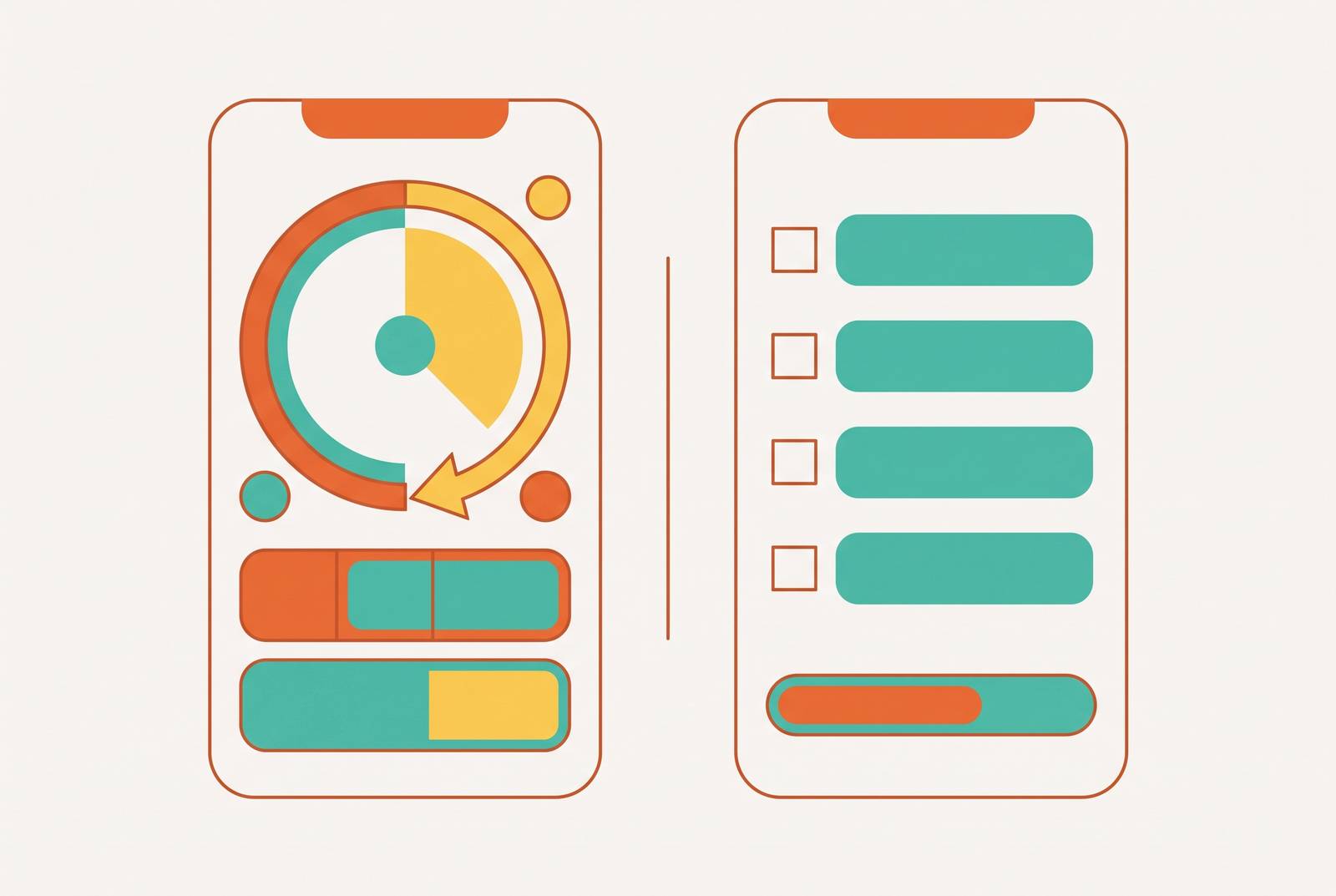
Four design patterns appear repeatedly across these tools. Visual time-blindness tools make time something you can see, a shrinking bar or a color block, rather than something you have to calculate in your head. Low-friction task capture cuts the gap between having a thought and recording it down to almost nothing. External accountability and structure replace internal motivation with scaffolding built into the environment. Simplified, sequenced reminders remove the "what do I do next" decision entirely, so the brain never has to generate that judgment call on its own.
Morgen.so frames the underlying principle well: these apps let someone externalize the executive functions they can't reliably access internally. The app holds the working memory, handles the sequencing, and supplies the dopamine hit the brain isn't generating on its own schedule.
Gamification fits into that same logic and should be taken seriously rather than dismissed as childish. Given a lower dopamine baseline, XP points, streaks, and visible progress bars aren't decoration, they're a functional substitute for a reward system that isn't firing reliably on its own. Voice input and other low-friction entry points matter for the same reason: friction at the moment of capture is where ADHD users most often lose a tool for good. And milestone-based goal structure addresses one of the most common paralysis triggers directly. An overwhelming goal like "clean the kitchen" freezes the brain; "put three plates in the dishwasher," the kind of granular breakdown described by collinspsychology.com, gives it something small enough to actually start.
The apps worth considering and what each one does for ADHD users
Visual time management. Routinery builds sequenced routine timers for mornings, evenings, and the transitions in between, the moments that tend to swallow time invisibly. Rather than asking a user to guess how long "getting ready" takes, it breaks the routine into visible steps that run in order, so the brain doesn't have to hold the sequence in working memory.
Focus and time-boxing. Forest uses a simple mechanic: tap "plant tree," and a tree grows for the length of the focus session. The low-friction start (one tap, no setup) matters as much as the payoff, since starting is often the hardest part, mainquest.net and blog.saner.ai report. Checking the phone mid-session kills the tree, which functions as a surprisingly effective deterrent, though the tool's usefulness mostly stops at time tracking. TickTick takes a different angle, building its structure around actually finishing tasks rather than just logging time, zapier.com reports.
Task capture and breakdown. One tool offers free automated task breakdown for exactly the moment when starting feels impossible, supporting what's often called a brain dump, clearing mental clutter by getting it out of the head and onto a screen (lifestack.ai, audhdpsychiatry.co.uk). Amazing Marvin sits in a sweet spot between simplicity and flexibility, letting users adapt it to whichever productivity method actually fits their brain rather than forcing one methodology on everyone, zapier.com reports. Todoist, used by more than 25 million people, keeps its interface minimal and fast, which lowers the barrier to getting a task into the system in the first place. Its Karma feature, a gamified point tracker that rewards completed tasks and streaks, adds a real dopamine loop on top of a tool that could otherwise feel flat.
Gamified accountability. Habitica runs on RPG mechanics, turning tasks into quests with experience points and levels (its guild feature was permanently removed in August 2023). Mainquest.net reports that the interface can feel cluttered for some ADHD users, and the social mechanics can trigger shame when tasks go unfinished, so it tends to suit people who respond well to game-like social structures specifically. MainQuest was built around ADHD accountability from the ground up: instant XP for completing tasks, HP loss for missing them, and no traditional guild structure, mainquest.net reports.
AI scheduling and time tracking. Lifestack.ai describes Motion as running an aggressive AI auto-scheduler that decides what to work on next, removing the prioritization decision entirely rather than just organizing a list for a human to sort through. According to help.timecamp.com, TimeCamp tracks time automatically in the backgroundoicy.com notes that TimeCamp tracks time automatically in the background, so it doesn't rely on a user remembering to start or stop a timer, which sidesteps the working-memory demand that manual time trackers quietly assume everyone can meet.
Voice-first, ADHD-specific AI companion is one newer category to name directly: voice-first AI companion apps built specifically for ADHD, grounded in behavioral science and executive function research, that combine XP rewards, guided milestone tracking, and goals broken into small, sequenced steps. This kind of tool addresses several friction points at once: low-effort voice input instead of typing or menu navigation, external scaffolding instead of relying on internal memory, gamified motivation instead of a flat checklist, and structured habit-building instead of an open-ended list. One such app has earned a 4.9-star rating and reports more than 100,000 users, which suggests real staying power rather than a one-week novelty download. For someone who has already burned out on both generic productivity software and other tools marketed toward ADHD that just slapped a badge system onto a standard planner, this category represents something closer to a genuine redesign.
How to match the right tool to your specific ADHD pattern
Given the heterogeneity described earlier, the honest answer to "which app is best" is that it depends on which part of executive function is actually giving someone trouble. That's not a dodge, it's the whole point of everything above.
If time blindness is the dominant problem, meaning duration estimates are consistently wrong and transitions between activities get lost, visual timer tools like Routinery address that directly by making time something visible rather than something calculated. If task initiation and overwhelm are the real bottleneck, meaning tasks sit untouched not from disinterest but from a freeze response, breakdown tools like Goblin Tools or a voice-first AI companion reduce the decision load right at the point where paralysis sets in. If motivation and follow-through are the core struggle, gamified systems, MainQuest's XP and HP mechanics, Todoist's Karma, TickTick's achievement tracking, supply an external reward loop the brain isn't generating on its own. If decision fatigue around scheduling itself is the problem, an AI auto-scheduler like Motion removes the prioritization step rather than asking a tired brain to rank twelve tasks by hand. And if friction at the moment of input is what kills tools before they get a fair shot, voice-first or ultra-minimal capture apps get used consistently while feature-heavy alternatives get abandoned before that friction is overcome.
The app-hopping pattern described earlier deserves a second look here, because it's easy to read as a personal failing when it's really diagnostic information. Bouncing from Notion to a bullet journal to a habit tracker and back isn't evidence of an inability to commit. It's a signal that each tool's built-in assumptions didn't line up with the specific EF profile doing the choosing. Read that way, the pattern isn't a source of shame but useful data about what to try next.
A few practical habits help regardless of which tool ends up sticking. Breaking any task down to the smallest version that still counts as progress, the "three plates in the dishwasher" version rather than "clean the kitchen," short-circuits a lot of paralysis before it starts. Setting a timer for a task that feels too big, even five minutes, makes the emotional wall in front of it noticeably smaller, since the commitment is just to start, not to finish. And treating a tool that gets abandoned within a week not as a failure of the person but as fast, useful information about what design pattern isn't working keeps the search moving forward instead of turning into another reason to feel behind.
Sources
- Executive Function Disorder & ADHD | ADDA
- (PDF) Executive functioning in adults with attention deficit hyperactivity disorder: A systematic review
- drsharonsaline.com
- Frontiers | From brain circuits to self-regulation: an integrative neurocognitive model of metacognition and emotion regulation in ADHD
- ADHD Apps: We tested 44 Apps and Here're the Best 9 in 2026
- morgen.so
- blabby.ai
- adhdcentre.co.uk