Using Voice Prompts to Automate ADHD Evening Wind-Down
Voice prompts bypass the executive dysfunction that derails ADHD wind-downs.
By nine or ten at night, the ADHD brain has been managing, sequencing, and initiating for fourteen hours straight. The transition away from work should be simple: close the laptop, brush teeth, sleep. Instead, a familiar impasse arrives. The person knows wind-down should begin. The starting mechanism will not fire. This is not a failure of discipline or intention. Evening is the structural low point of executive function in the ADHD day, and the collapse is neurological, not motivational. It arrives on schedule, every day, and it carries consequences that compound into the next morning.
Executive function is the brain's task manager. It sequences, prioritizes, and initiates. In ADHD brains, this system is underpowered, and its capacity drains across the day at a rate that neurotypical brains do not experience. The edges of the day are the most depleted. Morning is hard because the system has not yet come online and must perform its first acts without momentum. Evening is harder because the system has spent every reserve it had, and the tasks that remain are precisely the ones with the least external structure holding them in place. There is no inbox to open, no inbox at all. There is only the demand to generate sequence from nothing, at the hour when generation is most expensive.
The effect compounds. A failed wind-down degrades sleep. Sleep loss impairs working memory, inhibitory control, and cognitive flexibility. Those degraded capacities make the next evening's wind-down harder still. What begins as a single difficult hour becomes a feedback loop: each bad evening pays interest into the following day, and the following day returns a more depleted brain to the next evening. The problem is that evenings are where the deficits the brain carries all day become impossible to route around.
What is actually failing: internalized speech, sequencing, and the reward gap
The evening failure is not general tiredness. What collapses in the ADHD brain is something narrower and more specific: the three functions that a wind-down sequence demands most heavily, and which the ADHD brain cannot supply on demand. Those functions are internalized speech, sequencing, and reward prediction. Each fails in a distinct way, and each failure maps directly onto what a voice prompt can replace.
Internalized speech is the inner monologue that tells a person what to do next and in what order. Barkley's unifying theory of ADHD identifies it as one of the four core domains of executive dysfunction. In a neurotypical brain, the evening sequence runs on an internal narrator: finish this, write that down, prepare tomorrow, then rest. The narrator works silently and for free. In the ADHD brain, that narrator is unreliable, and at the end of the day it often goes silent entirely. But there is no internal voice dictating the next move, which means the sequence has no conductor and does not begin.
Sequencing failure compounds the loss. The ADHD adult can hold each evening task in mind, often with painful clarity: the loose ends at work, the empty to-do list, the dishes, the morning alarm. What is missing is not knowledge but order. The brain cannot reliably arrange the tasks into a sequence, and it cannot initiate the first step without an external cue. This is why lists help. This is also why text-based lists fail at night: by the time the brain has generated the sequence to open the app and engage it, the initiation capacity that task requires has already been spent.
The reward gap makes every one of these failures worse. Neurotypical brains reinforce routine through a feedback loop: perform the behavior, receive a small dopamine signal, repeat until automatic. In ADHD, that signal is weaker and habituates faster. Behaviors that felt worth doing two weeks ago lose neurological traction. The wind-down routine that worked in January stops working in February, not because the person lost commitment but because the reward signal faded, and without that signal the brain no longer registers the routine as worth the effort. The cognitive cost of evening tasks never fully amortizes. Every night asks the brain to pay full price.
Why the day never feels finished without a deliberate stopping point
Without an explicit closing ritual, the ADHD brain treats the day as perpetually unfinished. An open day keeps the mind aroused and scanning rather than settling toward sleep. There is always another email, another half-remembered obligation, another item that surfaces the moment the lights go down. The browser tabs stay open, literal or mental, and the brain keeps rehearsing them. The rehearsal matters because it is functional. Fear of forgetting keeps active rehearsal mode running. The brain repeats the reminder precisely because it does not trust that the reminder will survive until morning. The repetition is the brain's only storage system when working memory is depleted, and the cost is a mind that cannot close.
A shutdown protocol addresses this directly. It works by giving the brain permission to stop rehearsing. The 2026 scoping review in Behavioural Sciences confirmed where the pressure sits. The field's formal understanding is still catching up to what practitioners and ADHD adults live with every evening.
Why routine is an external scaffold, not a habit the ADHD brain builds on its own
Routine works for ADHD not because it becomes automatic, but because it relocates the sequencing question out of the brain and into the environment. The sticky note on the fridge is the paradigm case: externalizing working memory works because the note holds what the brain cannot. A routine says, in effect, "I made a list, you don't have to think of what's next." Knowing what comes next dials down cortisol and frees up working memory for the task itself rather than the question of what the task is.
This stability also creates the "I did it!" moments that matter for dopamine regulation. A small completion, recognized and confirmed, reduces the brain's need to seek novelty or stimulation as a way of self-regulating. Building the routine itself requires the executive function the routine is meant to replace. A brain that cannot sequence tasks at nine p.m. cannot be expected to design, install, and remember a nine p.m. sequencing system. The environment holds the routine from then on. The brain does not have to.
Why voice specifically solves the initiation problem that text-based tools create
Voice prompts are not a preference. They are structurally better suited to ADHD evening executive failure because they eliminate the initiation cost that causes text-based tools to be abandoned at exactly the moment they are most needed. The friction tax is steeper for ADHD than for neurotypical users. Adding even a small delay to an unwanted or effortful behavior meaningfully reduces its frequency in ADHD populations. Every intervening step between intention and action is a barrier, and in the evening those barriers stack. The list tool was never unusable. It simply costs more to start than the evening brain can pay.
Voice dictation sidesteps the blank-page freeze. The question is not which tool has the best features. The question is which tool requires the fewest decisions at nine p.m.
What AI voice tools can do that a simple reminder alarm cannot
A timed alarm tells the ADHD brain it is time to wind down. That is the full extent of its function. The alarm says when. The exhausted ADHD brain hears the alarm and is left with the same sequencing problem it had before the alarm rang. An AI voice prompt can actually conduct the wind-down. It can handle the sequencing, capture, and organizational steps that the brain cannot generate on its own. The distinction is between a cue and a scaffold. A cue points. A scaffold holds.
AI assistants, including Google Gemini, Alexa, and Microsoft Copilot, now tailor reminders, scheduling, and decision support to individual needs. They reduce cognitive load by structuring tasks, surfacing relevant context, and offering low-friction interaction. A voice prompt to an AI tool can accept rambling, unordered, incomplete speech and return a structured next-day task list. The practical result is that the voice prompt becomes the internalized speech the ADHD brain is missing. It narrates the sequence, confirms completion, and closes the loop the brain cannot close on its own.
Building the shutdown protocol: what the voice prompts actually say
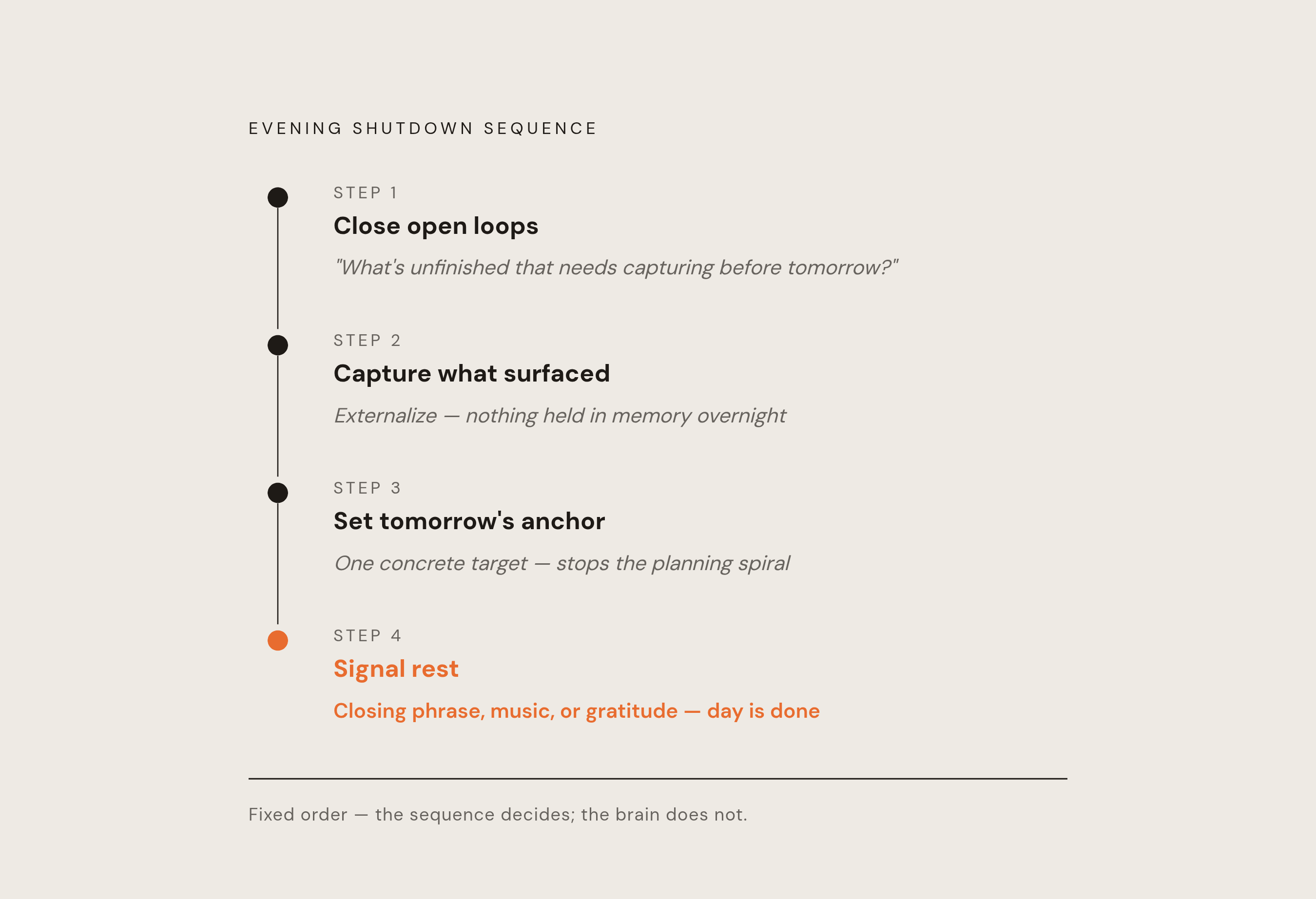
An effective voice-based shutdown protocol covers four moves in a fixed sequence. Each is delivered as a prompt that does the sequencing work. The user only has to respond. The fixed order matters: at no point does the ADHD brain have to decide what comes next. The prompt decides, and the user answers.
Step 1: Close open loops. The prompt asks, "What's unfinished that you need to capture before tomorrow?" This single question allows the brain to externalize the items it has been actively holding. The rehearsal loop releases because the items now exist outside the brain.
Step 2: Capture what surfaced. Nothing depends on memory overnight. The capture is the storage.
Step 3: Set tomorrow's anchor. A concrete target replaces the open-ended planning spiral that keeps ADHD minds active at night. The brain stops generating possibilities because one has been chosen. Step 4: Signal rest. A closing phrase or cue, music, a lighting change, or a brief gratitude prompt gives the nervous system a clear environmental signal that the protocol is complete and the day is closed.
Consistency matters more than length. The shutdown protocol is the evening anchor. A version consisting of one prompt, one response, and one confirmation will do more over time than an elaborate ritual that requires decisions to maintain.
Why gamification keeps the protocol running past the novelty window
Gamification is not decoration on an ADHD tool. A voice system that confirms task completion with "noted, you're done for tonight" delivers a micro-reward at the precise moment of effort. It substitutes for the dopamine signal the ADHD brain cannot reliably generate from the behavior itself.
Tools that apply this mechanic are already established. Llama Life structures tasks one at a time with a visible timer to encourage single-tasking and focus. Each operates on the same principle: external reward, immediate delivery, behavior reinforced at the moment it happens.
The critical caveat is that ADHD brains habituate to gamification novelty faster than neurotypical brains. A well-designed gamified prompt will eventually lose its pull. This is a neurological fact, not a design failure. The structure stays constant. The surface rotates: varied prompt wording, different voices or personas, new micro-rewards, or escalating XP milestones. Maintenance is the design, not a repair.
The tone of the prompt is not a soft detail — it shapes whether the system works
A voice prompt that confirms what was done rather than cataloguing what was missed participates in the psychological conditions that make self-management possible. Internalized shame is a clinical finding in ADHD adults. A 2026 qualitative study in Emerging Adulthood found that university students with ADHD chronically internalized a sense of being "not good enough" and experienced self-compassion as cognitively difficult. The single facilitator of more self-compassionate responses to setbacks was understanding and acceptance of ADHD, from others and from themselves.
Acceptance of ADHD identity is directly linked to self-management outcomes. A 2025 study in Children found that the total diagnosis identity score was strongly associated with self-management ability. A prompt designed around self-compassion, one that confirms what was completed, frames the capture step as care rather than correction, and closes with something affirming, works with the neurology rather than moralizing at it.
The two versions sound different in practice. The other treats the shutdown as care. The design of the prompt is infrastructure, and infrastructure is fixable.
The real objection: adding a new habit to a brain that struggles with habits
The most legitimate objection to a voice-based wind-down protocol is this: it requires building a new habit on top of a brain that already struggles to build habits. The objection is not a rhetorical foil. It is the lived experience of every ADHD adult who has abandoned a system after two weeks. Answering it honestly is what separates a practical tool from aspirational advice.
The answer has two parts. A specific time alarm. Second, keep the first version as short as possible: one prompt, one response, one confirmation. The activation cost stays below the threshold where ADHD paralysis kicks in. The University of Arizona is now running an ongoing clinical trial, NCT06682949, studying whether adjusting daily or nightly routines improves executive functioning and sleep in adolescents with ADHD. This is an active area of clinical investigation, not only self-help convention.
The framing that holds all of this together is simple. Evening wind-down is not a willpower problem. It is an infrastructure problem. The fix does not require the ADHD brain to perform functions it cannot reliably generate. It requires building the scaffolding once, at low cost, and letting the scaffolding do the work the brain cannot. Infrastructure, unlike willpower, can be designed. It can be installed. And it holds.