Reducing Routine Decision Points for ADHD Mornings
Eliminating morning decisions saves depleted ADHD brains their scarcest resource.

A person stands in front of an open closet, holding one shirt in each hand, unable to choose between them. Ten minutes pass. This is not indecision about fashion. Clinically, it is the visible output of a brain whose decision-making infrastructure was already running a deficit before the closet door opened. Three executive functions drive every choice a person makes: working memory, which holds multiple options in mind at once; cognitive flexibility, which lets a person shift between those options without getting stuck on one; and inhibitory control, which filters out what doesn't matter so a decision can actually get made. All three are measurably impaired in adult ADHD, and that impairment becomes visible to an outside observer in the closet.
The prefrontal cortex handles planning, organizing, initiating, and inhibiting, and in ADHD brains it runs underactivated. Tasks a neurotypical brain executes on autopilot, like picking a shirt or deciding what to eat, require deliberate and effortful management in a brain where the command center is operating below its needed capacity. That is a structural fact about cortical function, not a character trait.
Waking up compounds the problem, because waking is not a single event for an ADHD brain the way it tends to be for others. ADHD involves dysregulation in the dopamine and norepinephrine systems that govern arousal, alertness, and motivated action, making the climb from sleep to a functional baseline often slow and uneven. Cortical activation runs measurably different at the exact moment the morning is asking the most of it. European Psychiatry's 2025 analysis found that 82% of study participants with ADHD reported frequent decision-making difficulty, a figure that lines up with what the closet scene looks like from the inside.
Mornings load every one of these vulnerabilities at once. Waking, remembering obligations, choosing clothes, preparing food: each is a discrete executive function demand, and they fire in rapid succession with almost no recovery time between them. Each one requires initiation, and initiation is the single place where the ADHD brain struggles most. A morning is a sequence engineered, by accident of timing, to hit the exact weakness the condition produces.
How small morning decisions stack into a cognitive debt that colors the whole day
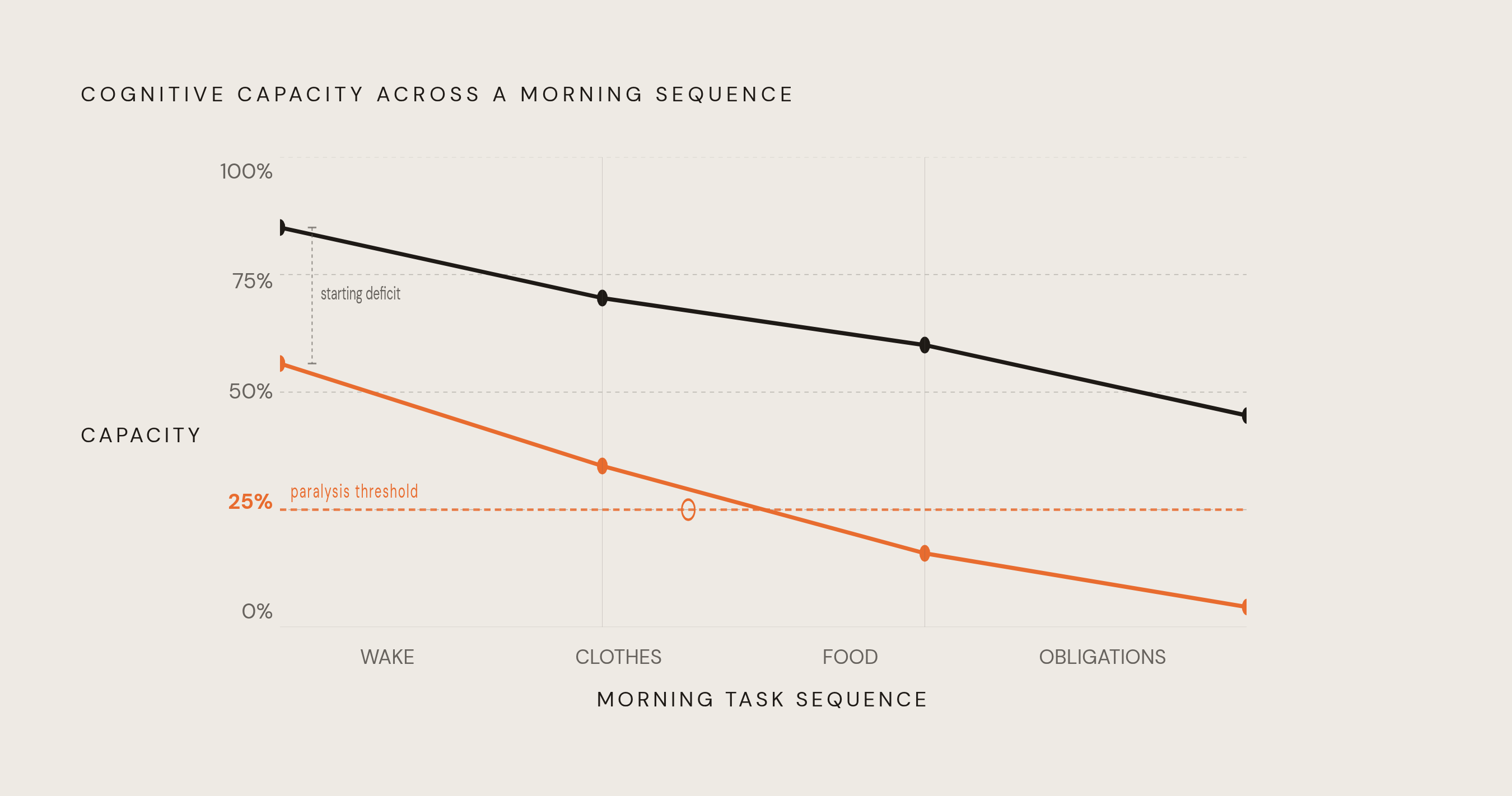
No single missed task wrecks an ADHD morning. The damage comes from the accumulation of many small decisions, each one draining a system that was already running low before the first alarm went off, and each one compounding until a shame response sets in that makes recovery harder for the rest of the day. The accumulation of small decisions, not any single failure point, is where the real cost lives.
Decision fatigue is not a figure of speech here. It describes documented deterioration in decision quality after repeated choice demands, and an ADHD brain reaches that deterioration point faster and earlier than a neurotypical brain does. Dopamine depletion makes each individual decision cost more cognitive energy than it would otherwise, so the same number of choices simply burns through capacity at a steeper rate.
The decisions that add up are rarely dramatic. What to eat, which alarm to dismiss, what to wear, what order to tackle the morning in: none of these looks like much in isolation, but each one draws from a pool that started the day already low. Spending twenty minutes staring down a wardrobe choice is decision fatigue landing on a brain that has not finished booting up. The same volume of choices that would mildly tire a neurotypical person can fully exhaust someone with ADHD, because the starting balance was never the same.
Many people with ADHD also experience Rejection Sensitive Dysphoria, an intense emotional response to rejection, criticism, or perceived failure. A morning built around a strict, minute-by-minute schedule sets up a near-guaranteed failure point, and failing at that schedule can trigger a shame cycle that colors the rest of the day. One might argue the schedule itself was the mistake, not the person who couldn't follow it. That reframing matters, because the consequence of all this gets misattributed constantly: poor choices, avoidance, and emotional dysregulation read to outside observers, and often to the person experiencing them, as laziness or carelessness. What's actually happening is a system depleted before it had a chance to function, responding exactly as a depleted system would.
Why willpower-based morning advice fails ADHD brains
The fix is not a better schedule or more discipline applied to the same schedule. The fix is reducing the number of decisions that have to be made live, by making them in advance. That single shift in framing changes what every tactic in this piece is actually for.
Standard productivity advice assumes a brain that transitions smoothly from sleep to wakefulness and can execute multi-step sequences at low executive cost. That assumption breaks immediately for an ADHD brain because the advice was never built for this particular starting condition. Telling someone to just wake up earlier, or just lay out a routine and stick to it, asks a depleted system to supply exactly the resource it doesn't have in the morning: willpower.
The working principle instead: rely on pre-planned habits and environmental cues to carry a person through the day, rather than relying on in-the-moment willpower that is often in short supply. This is not a soft suggestion. European Psychiatry's 2025 analysis found that 68% of adults with ADHD report decision paralysis significantly affecting their work performance, pointing to a structural necessity. If more than two-thirds of adults with ADHD are losing work output to paralysis, the problem sits upstream of any single day's effort.
The architectural logic follows directly from that. Every decision removed from the morning is cognitive capacity freed for something that actually matters. Every decision made the night before is one the depleted morning brain never has to generate from scratch. This is why a launch sequence works better than a timetable. A timetable anchors tasks to clock times, which collides directly with ADHD time blindness and sets up failure before the day starts. A launch sequence anchors tasks to other tasks instead: movement happens after coffee, rather than a workout scheduled for exactly 7:00 AM. The clock disappears from the plan entirely, and with it disappears one more place the system can fail.
Night-before decisions that eliminate the highest-cost morning choices
Pre-deciding has a clear implementation point: the night before, when cognitive resources are still available to make decisions a depleted morning brain will not have the capacity to make later. These are architectural moves that remove a decision from the morning.
Clothing is the clearest case. Laying out a full outfit the night before eliminates the single most common morning stall point, the closet decision, before it has a chance to happen. On nights when that pre-planning doesn't happen, a simplified capsule wardrobe or a uniform system shrinks the decision surface anyway: fewer options on the rack mean fewer choices available to exhaust the system in the morning.
Breakfast works the same way. Limiting the options to two rotating choices, or prepping components the night before, removes a second high-friction decision point from the sequence. Meal prep done this way is not a meal-planning strategy so much as it is a cognitive load strategy, aimed less at nutrition than at keeping one more decision off the morning's plate.
Automating what can be automated reduces the demand on initiation specifically. That is where the ADHD brain struggles most to begin with. A coffee maker set on an automatic timer removes a micro-decision and replaces it with a sensory anchor, the smell of coffee, that pulls a person toward the day rather than requiring them to push themselves into it. Placing the phone or alarm across the room converts a decision (does a person get up now?) into a physical requirement instead, which matters most at the exact moment executive function is at its lowest.
The alarm setup itself carries weight. Multiple alarms train the brain to tune out the sound and fragment sleep in its final hour, producing mixed effects on cognitive performance right at wake-up. A single alarm at a consistent time holds up structurally better than a cascade of snoozes.
A bathroom checklist with visual cues externalizes the hygiene sequence entirely, so the brain reads the next step instead of retrieving it from working memory that is already compromised at that hour. Habit stacking extends the same principle over time: linking a new behavior to an existing one, like putting on deodorant immediately after brushing teeth, encodes the sequence into something closer to automatic behavior, further lowering the active decision cost each morning requires.
Designing the morning environment itself to reduce live decision points
Pre-deciding the night before handles one layer of the problem. The physical space a person wakes into can handle another, doing active cognitive work so the brain doesn't have to generate that work itself. Environment here functions as design, not as background decoration.
Initiation is hard for an ADHD brain partly because of dopamine dysregulation, and partly because initiating any task requires generating the next step from scratch, a process that itself draws on the same depleted executive resources. Environmental cues offload that generation work. A visual checklist taped inside a bathroom cabinet means the brain reads what comes next instead of retrieving it from a working memory system that is already running short. Objects placed in deliberate positions, a water bottle by the bed, a bag already packed and sitting by the door, function as physical prompts that substitute for the internal reminder system ADHD routinely disrupts.
Building in a small dopamine hit right at the moment of waking, a favorite upbeat song or a podcast set to start with the alarm, makes getting up more enticing.
Body doubling extends this logic into another person's presence, and that presence doesn't have to be physical to work. Many adults with ADHD find tasks easier to start when someone else is simply there, and a virtual version of that presence counts. A smart speaker set to start an engaging podcast at a fixed time can supply exactly that external stimulation, giving the body a reason to move before the brain has consciously decided anything. One documented instance involved a college student who could not get out of bed in a quiet room, but stood up the moment a high-energy podcast began playing at 8:00 AM. Virtual coworking sessions or a scheduled check-in with an accountability partner work on the same mechanism, supplying enough external structure to cut through paralysis and move a person into action.
Hydration belongs in this same category of environmental design, because dehydration measurably worsens brain fog, irritability, and fatigue, all of which make an already-depleted morning worse. A water bottle pre-filled and left by the bed removes the decision of whether and when to drink water and turns hydration into an automatic first action instead of one more thing a tired brain has to remember to choose.
Voice-first and low-friction tools that preserve the pre-decided structure when mornings go live
The right tool for an ADHD morning asks the least of a brain operating at its lowest daily capacity.
On a low-capacity morning, pulling out a phone, unlocking it, opening an app, and typing out a task is a chain of several discrete actions, and each link in that chain is a place the sequence can stall. Voice input collapses that chain down to one step. That makes it a genuine accessibility feature for an ADHD brain, not a convenience layered on top of an already-working system.
Smart speaker automation applies this directly to a morning sequence. Voice-activated routines can carry a person through activation prompts, medication reminders, transition warnings, and departure checklists, each one a pre-decided cue the environment delivers on schedule rather than something the brain has to generate under pressure.
Specific tools build on the same principle. Focus Bear was built by a founder who identifies as both ADHD and autistic (AuDHD), and it guides users through morning and evening routines step by step, blocking distracting sites during dedicated focus sessions. It is deliberately opinionated in how it structures a routine, which is precisely the point: it supplies structure at the moment a user's own brain is not generating that structure on its own. Goblin Tools, through its Magic ToDo feature, takes a different single-task approach, breaking an overwhelming task down into small, manageable steps without requiring a sign-up or any setup cost. It runs free in any browser, which matters on a morning when even the friction of creating an account would be enough to stall the whole sequence before it starts.
None of these tools fix the underlying neurology, and none claim to. What they do is remove links from the chain between waking up and moving through a morning, which is the same job every night-before decision and every environmental cue in this piece has been doing from the start. The morning does not need a person with more willpower. It needs fewer places where willpower was ever required.
Sources
- ADHD Decision Fatigue: Why Making Choices Feels Exhausting
- Decision Fatigue with ADHD: A Practical, No‑Fluff Guide to Fewer Choices and Better Days
- ADHD and Decision Paralysis: Overwhelm in a World of Choices
- ADHD Paralysis: What It Is & How to Overcome It
- Beat the Blanket Paralysis: Morning Hacks for ADHD Brains
- ADHD and Decision Fatigue: Why Simple Choices Can Feel Overwhelming
- ADHD and Overwhelm: Why It Hits Harder and What to Do
- ADHD and Decision Paralysis: Why Small Choices Can Feel Overwhelming