Streak Psychology and ADHD Habit Continuity
ADHD brains need visible reward signals to build habits, not willpower.
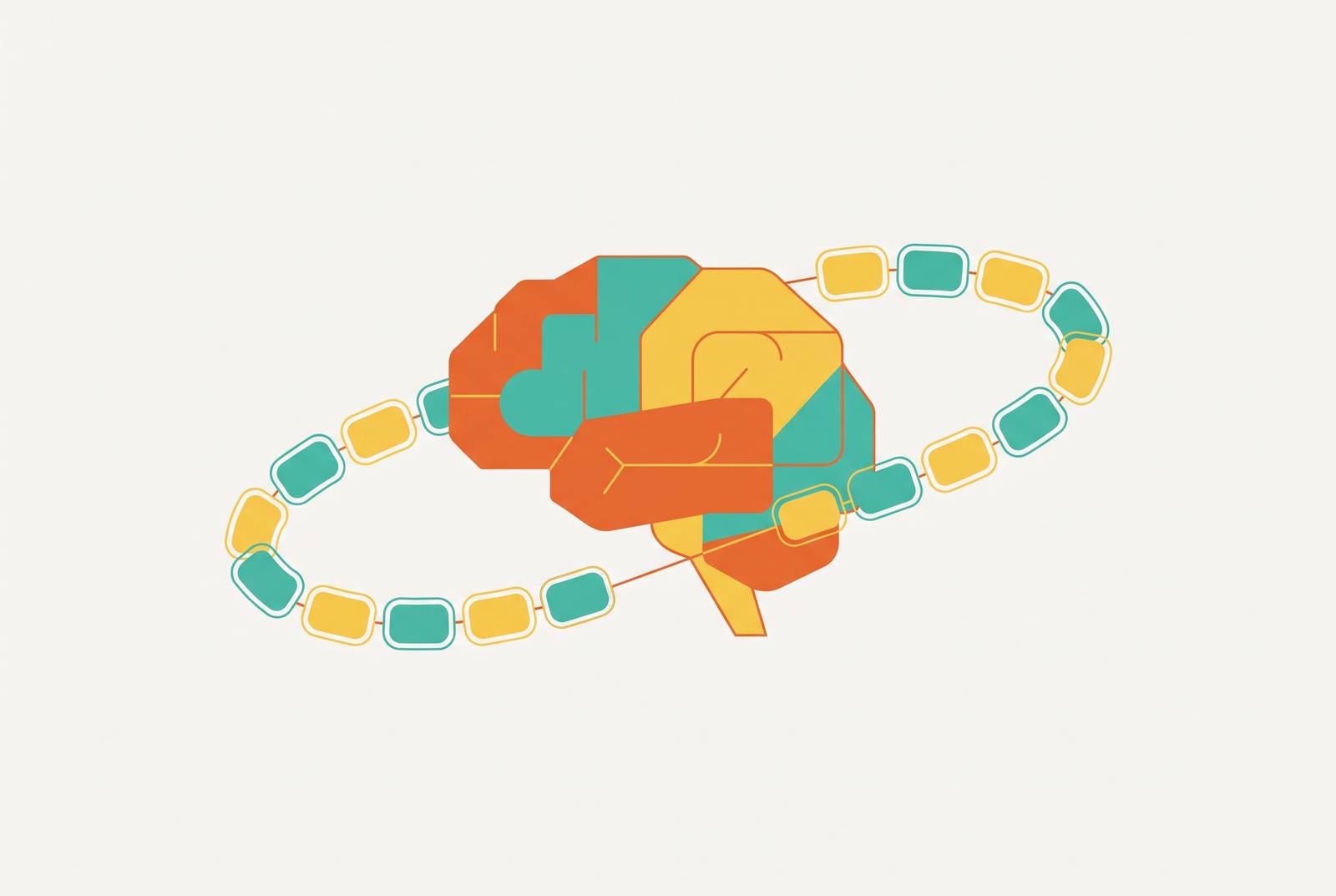
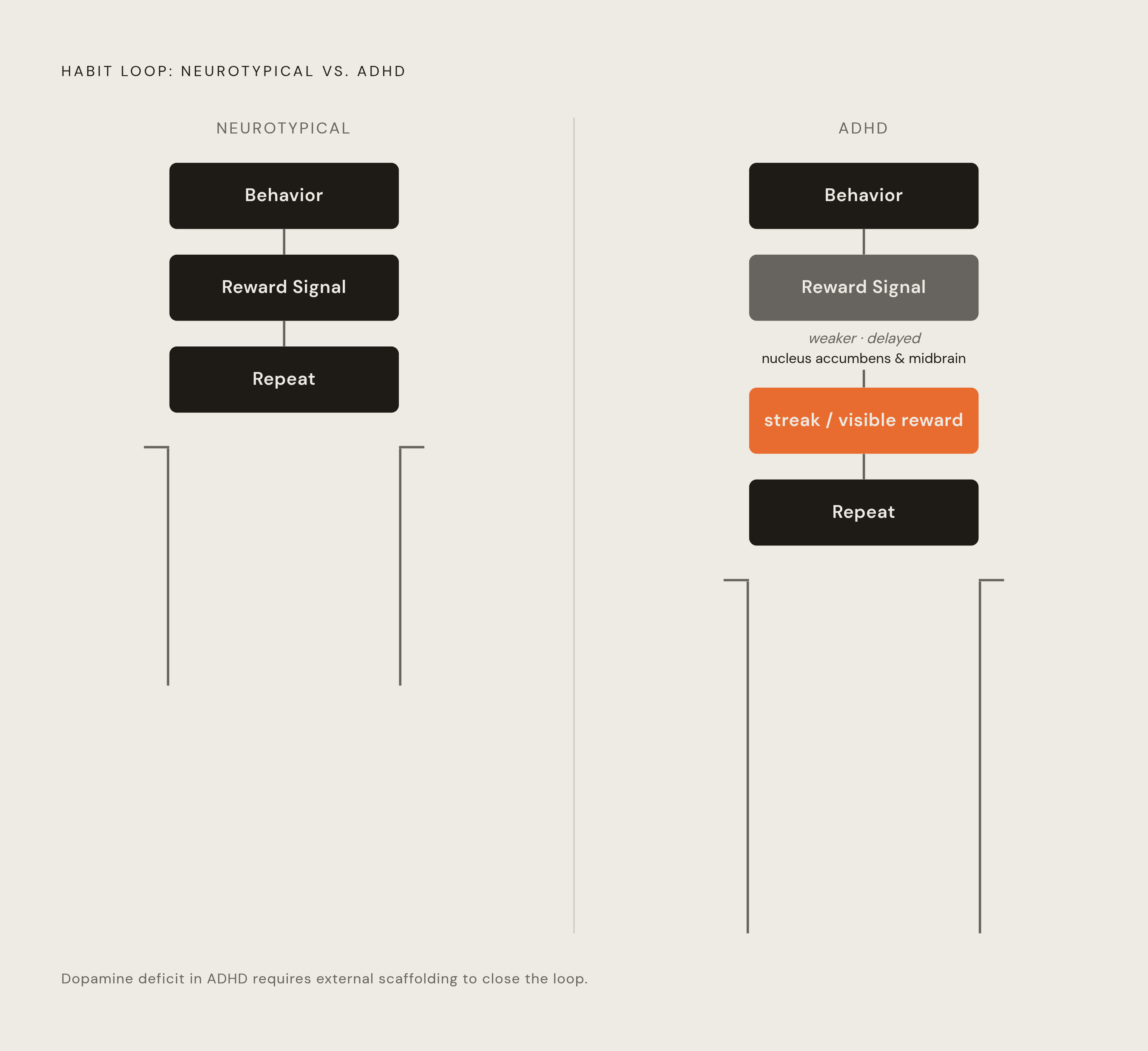
A streak counter works on an ADHD brain through a different chemical pathway than it does on a neurotypical one, and that difference is the reason this piece exists. PET imaging from a study scanning never-medicated adults with ADHD found lower-than-normal dopamine receptors and transporters in two specific regions: the nucleus accumbens and the midbrain. Those are the circuitry that processes motivation and reward, the same circuitry every habit-formation model assumes is running at full strength. When it runs at reduced strength, the problem is not a shortage of willpower. The reward signal that ordinary habit loops depend on arrives weaker and later, so for an ADHD user, external scaffolding around that signal is not a nice-to-have add-on, it is load-bearing structure holding the habit up.
Picture the standard habit loop: a person does the behavior, gets a reward signal, and repeats the sequence until it becomes automatic. That loop assumes the reward signal lands with enough voltage to reinforce the behavior on its own. In ADHD, the loop runs at lower voltage throughout, raising how often, how immediately, or how visibly the signal must show up to keep momentum going. A 2026 paper by Horowitz-Kraus and colleagues looked at executive function as a mechanism that cuts across ADHD and learning disability, but it focused on reading, math, and cognitive skill, not motivation or reward regulation. That gap in the literature points to something specific: the motivational and dopaminergic side of ADHD does not get absorbed into the general executive-function conversation. It needs its own explanation, because it is driving habit continuity directly rather than sitting in the background.
This is where streaks become interesting rather than gimmicky. Once a streak is established, the brain starts releasing dopamine in anticipation, before the behavior is even completed, just from the thought of keeping the chain going. For a dopamine system that underreacts to ordinary reward signals, that anticipatory hit is disproportionately valuable. It gives the brain something to respond to before the task is finished, which compensates, at least partially, for a reward system that would otherwise barely register the task's completion. Everything that follows in this piece, the heterogeneity of ADHD profiles, the failure of generic habit advice, and what makes a streak psychologically functional rather than destructive, traces back to this one mechanism: a weaker reward signal that needs a different kind of scaffolding to do the same job.
Executive function heterogeneity and the limits of a single streak design
The dopamine mechanism described above is shared across people with ADHD, but the executive function profile layered on top of it is not, and that is where a single streak design starts to fall apart. Research distinguishes three separate patterns: globally reduced functioning, where deficits spread across inhibition, attention, and working memory all at once; verbal-mnestic executive vulnerability, where verbal memory and attention regulation are weak but other capacities stay relatively intact; and selective executive control deficit, where inhibitory control and self-regulation are impaired without a broader cognitive reduction. They are three different problems that happen to share a diagnosis.
One might ask whether any of this matters for a streak counter, which seems like a simple enough tool to be profile-agnostic. Petrovic, Skoglund, and Sonuga-Barke note that only a subset of people with ADHD show objectively measurable executive function deficits. Others present with motivational or emotional dysregulation as the main driver of their difficulty rather than a deficit in cognitive control. A streak system built to compensate for inhibitory control problems does nothing useful for someone whose actual obstacle is emotional regulation. Pavlou Papagianni and Theodorou found that inhibitory control is the most consistently impaired function across ADHD populations and that it cascades into working memory, emotional regulation, and adaptive behavior. For a user who fits that profile, the bottleneck is the moment of starting the task, not remembering it later. A 2025 systematic review of EEG studies in adult ADHD by Su and colleagues found consistent impairments in error detection, cognitive control, and attention allocation, which points toward something concrete: streak systems need a low penalty for error if they are going to serve the portion of the ADHD population whose central difficulty is response inhibition.
A long daily checklist punishes the globally-reduced profile, because it demands sustained working memory across many steps at once. A streak that depends on verbal logging punishes the verbal-mnestic profile specifically. A streak with zero-reset rules lands hardest on the inhibitory-control profile, because that user already struggles most with the shame that follows a lapse. That raises an obvious objection: if the profiles diverge this much, how can any single claim about streak design hold across all of them? All three profiles share the same dopamine architecture described in the first section, so they respond to the same basic motivational levers, visibility, immediacy, and reward strength. The differences appear in where the friction sits, not in whether the underlying mechanism works. That distinction is what makes the rest of this piece possible: a design principle can be general even when the people it serves are not uniform.
Standard habit advice and ADHD streak failure
Most popular habit advice was written with a set of assumptions baked in, and those assumptions happen to target the exact functions ADHD leaves least reliable. Standard advice asks you to hold a plan in working memory while you juggle other tasks, to sustain a routine through moderate and steady effort, and to resume calmly after a missed day. Each of those three demands maps onto a function that is impaired across one ADHD profile or another. When a streak breaks under those conditions, the honest description of what happened is not that the person lost motivation. The system's friction exceeded what that person's brain could reliably supply on a given day, and the counter reset anyway.
Take the morning checklist as a concrete case. A routine with many sequential steps needs the entire sequence held in working memory while it competes against every other demand on attention that morning, and working memory is precisely where ADHD often loses that competition. The fix implied by the evidence is a much shorter checklist: a small number of non-negotiable daily anchors instead of a comprehensive list that assumes a working-memory budget the user does not reliably have.
Implementation intentions offer a specific way around this. An if-then plan, structured as "if X happens, then I will do Y," ties the behavior to an external trigger rather than to memory or willpower. Research on this intervention shows something unusual: it can bring ADHD performance on executive function tasks up to neurotypical levels, which is one of the few documented cases where a behavioral strategy closes that gap directly, particularly on tasks involving response inhibition. Applied to streaks, the translation is straightforward. A streak tied to a fixed trigger, such as "if I sit down with coffee, then I open the app," survives a working memory failure because the trigger, not the person's memory, carries the responsibility to act. The environment does the reminding. A short, structured morning routine, a consistent wake time, breakfast, naming the first task of the day, builds exactly the kind of stable context that if-then planning needs to fire reliably. Once that trigger is in place, the streak stops measuring willpower and starts measuring whether the trigger fired, which sets up the next question directly: what separates a streak that works with this structure from one that undermines it?
Functional versus destructive streaks
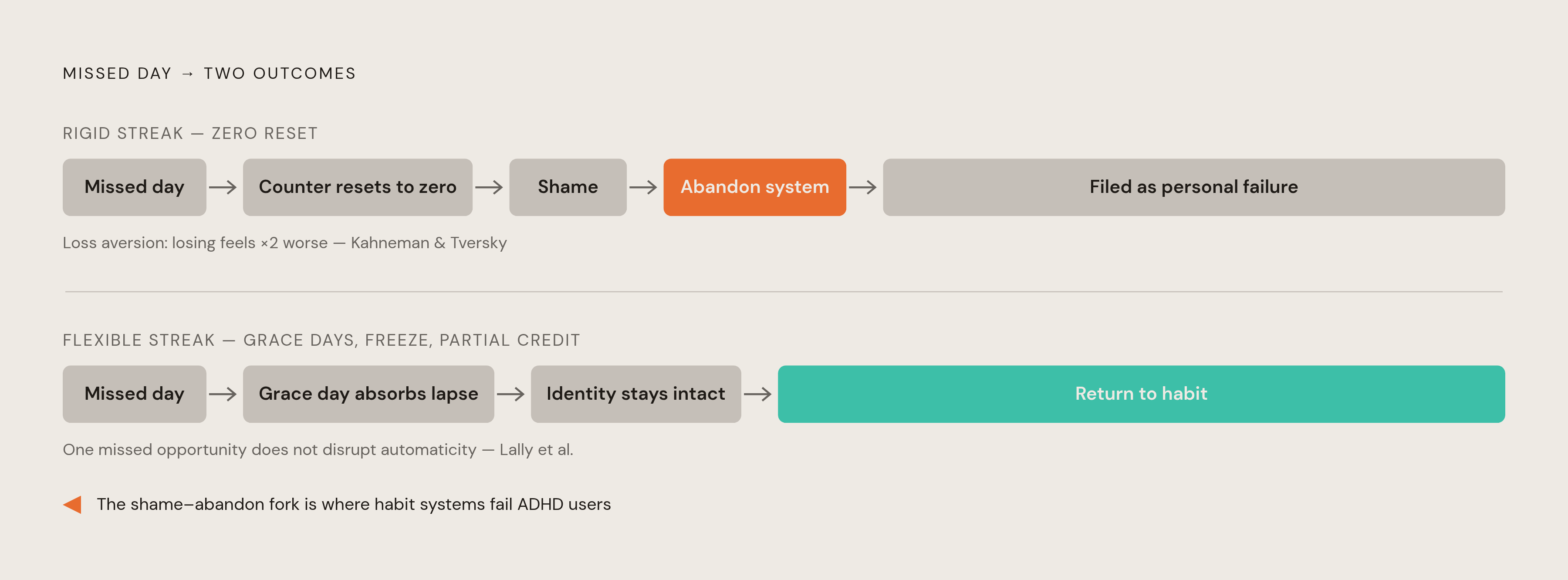
The mechanic itself, counting consecutive days, is neutral. Whether it sustains a habit or wrecks one depends on how forgiving the design is, how fast the feedback arrives, and whether the streak ties into a sense of identity, or whether it runs on rigid zero-reset rules that punish exactly the failure modes ADHD produces most often. Two psychological forces make streaks compelling for any brain, ADHD or not. Loss aversion, a core finding from Kahneman and Tversky's prospect theory, shows that losing something hurts roughly twice as much as gaining the equivalent amount feels good. Anticipatory dopamine, discussed earlier, means the brain starts rewarding you for maintaining a streak before you even finish the behavior. A third force, identity, comes from research by Jackie Silverman at Vanderbilt University, which found that streaks motivate because they attach individual behaviors to a larger sense of self. A 30-day streak accumulates into something that says who the person is, not just a record of actions.
In a rigid, zero-reset streak, the design turns structural rather than cosmetic: loss aversion stops functioning as a nudge toward consistency and starts functioning as a catastrophizing trigger instead. For someone with ADHD, one missed day can set off a shame spiral that ends in abandoning the entire system, not just losing a day's progress. Lally and colleagues, in a study on habit formation, found that automaticity builds asymptotically over a period of weeks to months, and that missing a single opportunity does not meaningfully disrupt that process. That finding carries a sharp implication for streak design: a rigid counter that zeroes out after one missed day is not just harsh, it is measuring the wrong thing, because it treats a single lapse as catastrophic when the neuroscience of habit formation says it barely registers.
Flexible streak mechanics, grace days, freeze options, partial credit for a smaller version of the behavior, track the actual biology of habit formation more accurately than a rigid counter does, and they do it without giving up the motivational force the counter provides. For ADHD specifically, three design priorities follow from everything established so far: feedback has to be immediate and visible, through heatmaps, counters, or XP, because the ADHD brain discounts rewards that arrive later. The minimum commitment has to be low enough that a bad day does not break the chain. Grace days need to be part of the default design, not an exception a user has to dig through settings to find.
Shame from streak collapse and ADHD habit abandonment
A broken streak does not just reset a number on a screen for someone with ADHD. It triggers a shame-abandonment cycle that was already primed well before you opened the app, built from years of feedback that framed inconsistency as a character flaw. People with ADHD tend to carry lower self-esteem than their neurotypical peers, shaped by a long history of being told they are "too scattered" or "not following through." That kind of feedback gets absorbed as a verdict on personal worth rather than recognized as a sign that the system around them was mismatched to how their brain works.
The sequence plays out with some consistency. A missed day resets the counter to zero. The reset produces shame. Shame leads to abandoning the whole system, not just that one habit. The abandonment then gets filed away as further proof of personal failure, which lowers the odds the person tries a new system at all the next time around. This cycle hits particularly hard among people who have learned to mask their difficulty and push through without showing strain, because the gap between the effort they are putting in privately and the failure showing up publicly intensifies the shame response instead of softening it.
The way out of this loop is a shift in framing, one supported in clinical practice: moving from treating a missed day as "I failed to maintain the streak" to recognizing oneself as someone who returns to the habit. That reframe interrupts the all-or-nothing thinking that shame runs on, and it keeps the identity anchor from Jackie Silverman's research intact, so a single missed day does not erase 30 days of accumulated self-concept. None of this points to a willpower problem that needs fixing. It points to a problem with the design, which the final section addresses.
What ADHD-compatible streak design looks like in practice
Everything established so far, the weaker dopamine signal, the variation across executive function profiles, the mismatch built into generic habit advice, the mechanics of forgiveness, and the shame cycle that rigid systems trigger, points toward a specific set of design features rather than a vague call for "better" apps. An ADHD-compatible streak system needs immediate visible reward, built-in forgiveness, low-friction capture, and an identity hook, instead of borrowing mechanics that were built with a neurotypical reward system in mind.
Visible feedback has to update the moment a behavior gets logged. Heatmaps, counters, and XP work because the ADHD brain discounts rewards that arrive later, so a visual update that fires instantly is functioning as part of the reward mechanism itself, not decoration around it. Capture speed matters just as much. If logging a completed habit takes more than a few seconds, the thought that prompted the log is often gone before you can save it. Voice input runs roughly three times faster than typing, removing the bottleneck that causes people with ADHD to abandon tracking systems. Todoist's Ramble feature, active as of 2026, takes a spoken thought and turns it into a structured task with a date and priority attached, which shows what voice-first capture looks like when it is built directly into task management rather than bolted on.
Different tools solve different pieces of this problem, and it helps to keep them separate rather than expecting one app to cover all of it. Forest, the app where a virtual tree dies if you leave it, gives an immediate and tangible consequence that works well for ADHD brains responding to concrete outcomes, but it suits single focus sessions more than it suits a multi-day streak. Goblin Tools, still in use as of 2026, breaks a large and vague task into small ordered steps, which addresses task initiation directly, a problem that a scheduling tool cannot solve no matter how well it manages a calendar. Scheduling and initiation are separate obstacles, and treating them as one problem is part of why generic tools underperform for this population. Gamified self-care apps such as Finch and Habitica, the former built around a virtual pet and the latter around RPG mechanics, build consistency effectively for daily routines like morning habits, exercise, or medication reminders, though they are not designed to carry the weight of complex work task management.
What all of this adds up to is a minimum viable streak: one non-negotiable daily anchor, tied to an if-then trigger, logged in a few seconds by voice or a single tap, rewarded the instant it happens. That structure is simple, and the simplicity is the actual design requirement the evidence points to, built from a dopamine system that needs the signal now, an executive function landscape that varies by profile, and a shame response that punishes rigidity far more than it punishes a missed day.
Sources
- The interplay between executive function and learning disabilities: Developmental cognitive neuroscience perspectives on reading, math, and ADHD - PMC
- Editorial: Executive functions in psychiatric science, clinical practice and beyond: A Transdiagnostic Window on Functional Heterogeneity
- Frontiers
- Enhancing Executive Function in Adolescents With ADHD: Preliminary Findings From a Multicomponent Intervention - PMC
- Enhancing Executive Function in Adolescents With ADHD: Preliminary Findings From a Multicomponent Intervention - PMC
- Editorial: Executive functions in psychiatric science, clinical practice and beyond: A Transdiagnostic Window on Functional Heterogeneity