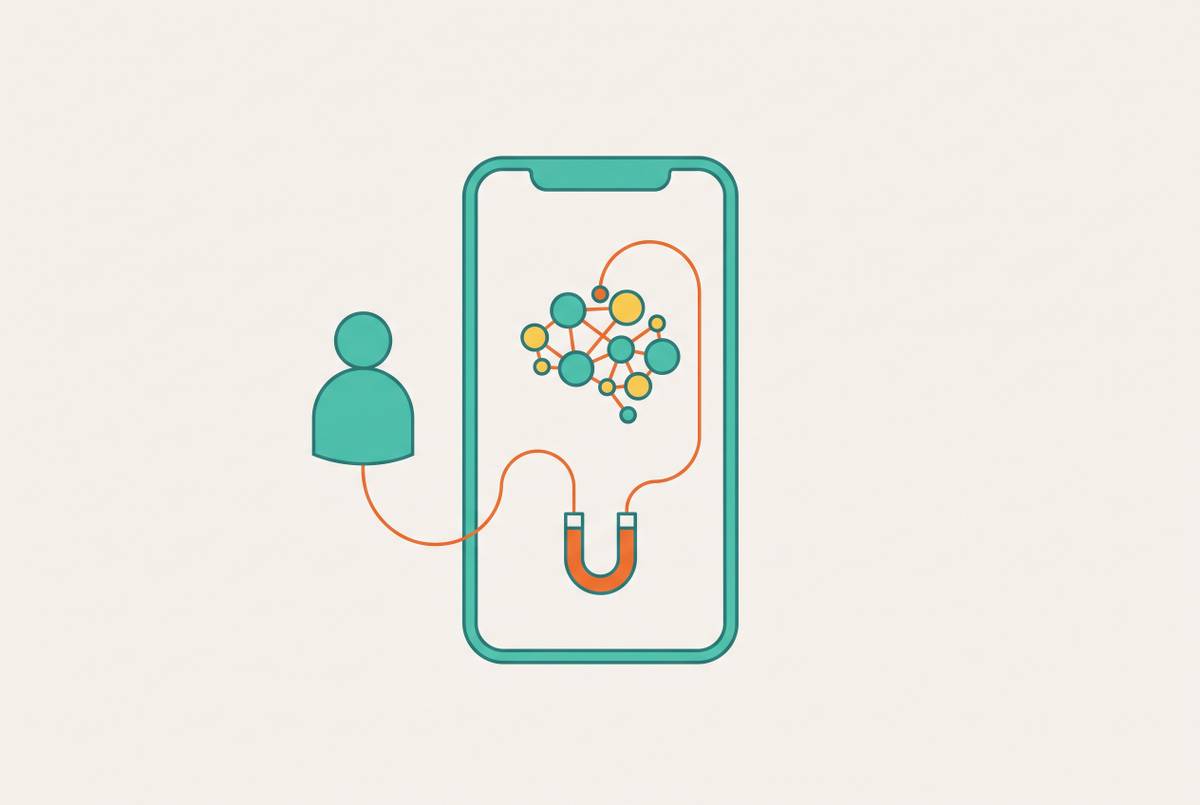
Low-Friction Habit Tracking Methods for ADHD Adults
Standard trackers ignore how ADHD brains struggle with initiation and reward processing.
About 15.5 million adults in the country carry a diagnosed ADHD, and over 404 million adults worldwide live with symptomatic ADHD. Nearly all of them get handed the same habit trackers built for neurotypical brains: streak counters, blank grids, apps that assume a person will remember to open them on their own. That assumption is the whole problem, and it's the wrong one. This piece breaks down why the mismatch happens and which design choices actually close the gap, as a working theory of how friction gets engineered out of a system for a brain that processes initiation differently.
The stakes are higher than they look on the surface. An estimated 36.5% of adults with ADHD received no treatment in the past year, and among those prescribed stimulants, 71.5% reported trouble filling the prescription. For a huge share of this population, self-directed, non-pharmacological strategy is the only support structure actually available to them. It's the only support structure actually available to them. That reality is the lens the rest of this piece uses, and it's why sloppy tracker design is a gap in care. It's a gap in care.
What executive dysfunction does to the moment before a habit begins
Executive function covers the top-down cognitive processes that drive goal-directed behavior: inhibitory control, working memory, and cognitive flexibility, with set-shifting being one facet of that flexibility. Research in cognitive neuroscience lays this out clearly, and it matters here because habit tracking lives or dies entirely inside these processes. Before a habit even starts, the brain has to inhibit competing impulses, hold the intention in working memory long enough to act on it, and shift attention away from whatever it was just doing. That's three separate cognitive jobs stacked before the first physical action ever happens.
A 2025 systematic review in Frontiers in Neuroscience, covering 68 EEG studies, found consistent patterns in adults with ADHD: elevated theta power, along with reduced P3 and N2 amplitudes during inhibition and sustained-attention tasks, marking a measurable neural signature of the disorder. That's electrical evidence of altered neural dynamics. It shows cognitive control and attention allocation running at a measurable deficit.
A meta-analytic review found medium effect sizes for deficits in verbal fluency, inhibition, and set-shifting specifically. The space between deciding to do something and actually doing it runs wider for an ADHD brain, and it runs wider for reasons that show up on a scan, not reasons that respond to a pep talk.
Then there's the reward side of the equation. NIH neuroimaging research led by Nora Volkow found reduced dopamine synaptic markers in the mesoaccumbens reward pathway in adults with ADHD, and separate research has found decreased dopamine receptor and transporter availability in the brain's motivation and reward-processing regions. That circuit is the one responsible for the small internal payoff of having done the thing. When it runs at a deficit, an abstract future reward, better health in six months, a tidier apartment eventually, barely registers as motivating in the present moment.
So what actually happens at the point of initiation? Many people with ADHD describe something closer to a physical inability to start, even for tasks they care about and genuinely want to do. That's the exact moment a tracker with any setup cost gets abandoned: the tracker asked for one more cognitive step than the moment could supply. Every method in the rest of this piece is, in one way or another, an attempt to close that specific gap.
Why habit formation takes so much longer for ADHD adults
Phillippa Lally's research at UCL put the average habit formation timeline around 66 days. That number gets quoted constantly, almost always without the caveat that matters most here: for people navigating executive function challenges, the range stretches to somewhere between 106 and 154 days, depending on the habit's complexity. Nobody tells ADHD users this going in. So they benchmark against 66 days, hit day 40 without automaticity, and conclude the system failed them.
It didn't happen, because the timeline was wrong from the start. The timeline was wrong from the start, and most tracker design never corrects for it.
New systems are exciting, and excitement itself produces a small dopamine hit. That's why so many people start tracking four or five habits at once in a burst of enthusiasm, then two weeks later are logging none of them. Clinicians who work with this pattern generally recommend capping active habits at one to three until at least one has become close to automatic. Pushing past that number turns tracking into its own overwhelming task, stacked on top of the habits it was supposed to support.
Missing a single day doesn't meaningfully disrupt the habit-formation process. What derails the effort is usually the story a person tells themselves about the miss: the narrative that one skipped day voids the whole attempt. That narrative is a design failure in the tracker, not a willpower failure in the person, and getting that distinction right changes what counts as good tracker design.
Rotating strategies gets read as evidence of failure, and that reading is backwards. ADHD brains run toward novelty, and asking one tracking method to hold interest indefinitely asks more of it than is realistic. The method can change while the underlying habit stays intact. A system built on the assumption that its own method must survive forever is fighting a battle it never needed to pick.
Taken together, this sets three requirements for anything that follows: tolerance for missed days, no punishing streak mechanics, and enough flexibility to survive its own novelty wearing off.
The principle of environmental design: making the tracker find you, not the other way around
If a person has to remember to open a tracker, the system asks executive function to do a job the neuroscience above already shows it underperforms at. So the tracker has to move. It needs to sit inside the visual field at the exact moment the habit is supposed to happen, not wait in a drawer or an app folder to be retrieved on request.
Research on ADHD has long pointed to structure and predictability as a form of external executive function, essentially outsourcing to the environment what the brain can't reliably generate on its own. The environment initiates when the brain can't, and that's the principle behind everything in this section.
What that looks like in practice: a water-intake log taped to the coffee maker. A mood check-in card propped against the toothbrush holder. A phone widget on the home screen that logs with one tap, no scrolling through an app to find the right screen. A push notification timed to the actual moment the habit happens. ping that lands regardless of context. A water bottle left on the desk instead of in a cabinet, a yoga mat unrolled instead of folded away, medication sitting next to the kettle instead of tucked out of sight.
The most overlooked version of this happens the night before. Setting up the coffee maker, laying out clothes, placing the tracker exactly where the habit will occur: these are morning habits performed by the evening self, on behalf of a morning brain that will have almost no executive function capacity left to spare. The evening version of the person acts as a kind of proxy executive assistant for the one who wakes up tired.
A beautifully designed planner sitting in a drawer will lose, consistently and predictably, to an ugly Post-it note stuck on the bathroom mirror. Location beats polish, every time this gets tested against real behavior. Anyone still choosing a tracker on aesthetics alone is optimizing for the wrong variable.
Habit stacking: borrowing activation energy from an existing routine
Habit stacking means attaching a new behavior to one that already happens reliably, so the existing neural pathway supplies both the reminder and the momentum the new habit hasn't earned yet on its own.
The established habit already carries its own initiation signal, whatever cue triggers it, and that's why stacking beats a standalone intention. The new habit rides that signal instead of generating a fresh one from nothing: checking a habit tracker right after the coffee finishes brewing, stretching while the evening news plays in the background, logging a mood right after brushing teeth. Applied to an app, the phrasing might read: after making coffee, open the planner and check the day's plan. The trigger there is sensory, the smell of the coffee, the sound of the machine finishing, arriving automatically rather than requiring the brain to conjure a cognitive reminder from scratch.
Keystone habits work as a related variant. One completed behavior makes a chain of other behaviors more likely. Taking medication on schedule can support the behaviors that follow it throughout the day. A small completed task at the start of the day can build momentum that carries into other behaviors. A glass of water first thing in the morning gives the day a fixed anchor point to orient around.
None of this is about building an entire system in one sitting. It's about grafting a single new habit onto a root that's already deep and well-worn.
Why does this beat handing someone a blank tracker? A blank tracker demands multiple cognitive steps: locating it, opening it, and recalling what to record. A stacked habit collapses that down to one trigger and one action, because the existing routine is already doing the reminding for free.
Paper and analog methods that lower friction
Paper trackers get lumped into one category, but they don't all carry the same friction cost, and treating them as interchangeable is a mistake. A dense bullet journal with a custom symbol key and four colors of pen is, in practical terms, a high-setup-cost system closer to a hobby than a habit aid. It looks charming on a shelf and gets abandoned by week three. The paper methods that actually reduce friction are pre-printed, built around a single habit, and physically present at the exact location where the behavior happens.
The single-habit wall chart is close to the simplest version: one behavior, one box to check per day, taped up at the site where the habit occurs. No login, no navigation menu, no battery to die at the wrong moment. It works well for habits that are visible and location-bound: drinking water, taking a vitamin, a short morning stretch. It stops working the moment it gets stored inside a notebook or a drawer, because that reintroduces the exact retrieval problem environmental design exists to solve.
A sticky-note micro-tracker pushes this further still: one habit, written by hand, stuck at the trigger point, marked and swapped out weekly. It's disposable by design, so there's no accumulated streak sitting there generating shame when a week goes sideways.
Pre-printed weekly templates push setup cost close to zero. The user marks a box; nobody designs a system from scratch. Printed once, photocopied as many times as needed, no ongoing decision required to keep using it.
Paper has a real ceiling, though. It can't send a notification. It's passive by nature, waiting to be noticed rather than actively surfacing the way a phone alert can. Paper tends to work best for home-based habits with a fixed location, and worse for something scattered across multiple environments over a day. That's a tradeoff, not a flaw: paper removes app-navigation friction but introduces a different one, the requirement of physically standing in the right room to log anything.
Digital and app-based tracking: which design features genuinely reduce friction
The brand of app matters far less than the specific features inside it, and most reviews of these tools spend their time on the wrong variable. A handful of design choices genuinely cut cognitive load. A handful of others look helpful while quietly adding friction straight back in.
On the useful side: one-tap or one-swipe logging, no form fields, no typed text required. Notifications timed to the actual moment the habit should happen rather than a fixed generic time that ignores context. Forgiveness mechanics, a skip button, a streak "shield," plain language stating that one missed day doesn't erase progress. Home screen widgets that collapse the usual open-app, find-the-habit, tap-to-log sequence into a single motion. A dashboard showing three habits instead of twelve, because a crowded screen is its own friction before a single habit gets logged.
On the other side, features that look thoughtful but tend to backfire: detailed notes fields inviting writing nobody asked for. Elaborate statistics dashboards, genuinely interesting the first time, overwhelming by the fifth. Social comparison features, which read as motivating for a consistent user and as a shame generator for anyone coming off a rough week. Onboarding flows demanding a dozen setup decisions before a single real entry gets logged, front-loading exactly the decision fatigue this whole piece is trying to design around.
Gamification deserves a specific defense, since it gets dismissed as gimmicky more often than it should. Given what the dopamine research earlier in this piece shows about reduced dopamine availability in reward circuits, small immediate rewards, XP, streak recovery, milestone markers, aren't decoration bolted on for engagement metrics. They supply a reinforcement signal in the moment that a delayed, abstract outcome six months out simply cannot provide on its own.
One friction point deserves particular attention: typing. A voice-first interface removes it. Speaking a log entry or a daily intention requires no fine motor engagement, no hunting through a keyboard, no spelling anything correctly. That matters most when executive function is at its lowest, first thing in the morning, or in the middle of a stretch of high stress, which is often precisely when a typed log gets skipped.
An AI-powered voice companion that captures entries conversationally, breaks a stated goal into smaller milestones without being asked, and talks through the day's structure in dialogue rather than a static form, addresses several friction points at once: initiation, sequencing, and the reinforcement loop, inside one interaction instead of three separate ones.
Time-boxing and the Pomodoro method as a parallel tracking structure
Time blindness runs common in ADHD: an unreliable internal sense of whether a task takes ten minutes or three hours. That uncertainty alone makes planning feel abstract, and abstraction is what tends to produce paralysis instead of action.
Timeboxing counters this by assigning a fixed slot to a task or habit, turning an open-ended commitment into something bounded and concrete. The Pomodoro method, a 25-minute focused block followed by a 5-minute break, is the most familiar version. The habit lives inside a defined container instead of floating somewhere in an undifferentiated day. A visual countdown, the kind of physical Time Timer dial that shows a shrinking colored wedge, makes the passage of time visible rather than something to be sensed internally. That visibility matters because it swaps out an internal sense ADHD brains tend to underperform on for an external cue doing the same job more reliably.
Gentle timers beat harsh alarms in a way that isn't cosmetic. A jarring sound at the end of a block feels punishing, and punishing endings train avoidance of starting the next one. The goal is an ending that feels like a natural pause, not an interruption that startles.
A Pomodoro log doubles as a lightweight tracker in its own right. What gets tracked is the number of focused intervals completed rather than task completion, and an interval is a far smaller, more consistently achievable unit than finishing the project. Stacking it with another habit makes it even more efficient: running a morning review during the day's first Pomodoro combines timeboxing with habit stacking in one move, cutting friction from two directions simultaneously.
Breaking the habit into micro-goals to interrupt task paralysis at the point of entry
Task paralysis has less to do with how big or important a task actually is than with how many decision points the brain registers before the first action. A three-hour project and a two-line email can trigger the identical freeze if both get perceived as containing too many steps to sort through before starting.
Breaking tasks into micro-goals is a widely recommended approach for sustaining focus in people with executive function challenges. That number arises because smaller entry points lower the perceived cost of starting, and perceived cost, not actual difficulty, is what the brain reacts to in the moment of paralysis.
The five-minute rule runs on the same logic. Committing to five minutes, not to finishing, drops the psychological cost of starting sharply, because the brain gets asked to consent to something small and reversible instead of an open-ended obligation.
Applied to tracking, the habit being logged should itself be micro-sized, at least at first. Not "exercise," but "put on shoes." Not "meditate for 20 minutes," but "sit and breathe for two minutes." Not "journal," but "write one sentence." The tracker's job at this stage is to capture the smallest unit that still counts as having started. It's to capture the smallest unit that still counts as having started, and any tracker that demands more than that at the outset is asking for a version of the habit that doesn't exist yet.
Mel Robbins' 5-Second Rule, counting backward from five and physically moving before the count ends, works for a related reason: it interrupts prefrontal overthinking before it manufactures a reason not to begin. It inserts a physical action ahead of the mental objection.
The implication for tracker design follows directly: show one micro-step of the whole chain of what the habit eventually needs to become. Seeing the entire chain before the first action is often the exact thing that generates the overwhelm to begin with.
Morning-specific strategies: designing a launch sequence when EF is at its lowest
Adults with ADHD commonly report lower sleep quality and pronounced morning sleep inertia. Executive function sits at its weakest point of the entire day at precisely the hour it needs to be at its strongest, to get a person out the door and into their routine.
A structured launch sequence answers this by cutting decision-making close to zero. Each step in a fixed, repeatable order triggers the next automatically, with no separate decision required at each stage. Every step in that sequence works best when it's already been habit-stacked, or pre-set the night before through the environmental design covered earlier in this piece. The sequence itself belongs somewhere visible, a short printed list stuck to a wall or mirror, never something held in memory where it has to compete with everything else the morning brain is juggling.
Too much unstructured time in the morning tends to produce something close to a waiting mode: the ADHD brain sits idle, expecting some sense of urgency to prompt movement, and that urgency often simply never occurs on its own. A launch sequence substitutes external structure for the internal urgency that isn't reliably available.
That loops back to the thread running through nearly every method in this piece: the real morning habit gets built the night before. Clothes laid out, coffee prepped, the tracker sitting exactly where the habit needs to happen. The evening self does the executive function work in advance, so the morning self, running on the lowest reserves of the day, has almost nothing left it needs to decide.