Physical Workspace Design for ADHD Focus and Habit Compliance
Environmental design can substitute for the executive function ADHD brains lack.
What executive dysfunction does to a person trying to work
ADHD is a regulatory problem, not a discipline problem, and that distinction changes where the fix has to live. A brain that cannot reliably generate its own cues for starting, stopping, or sustaining a task needs those cues supplied from somewhere else. The nearest available somewhere else is the physical space around it. This piece looks at how workspace design, done with real precision rather than vague good intentions, can substitute for the executive function that ADHD brains cannot consistently produce on their own.
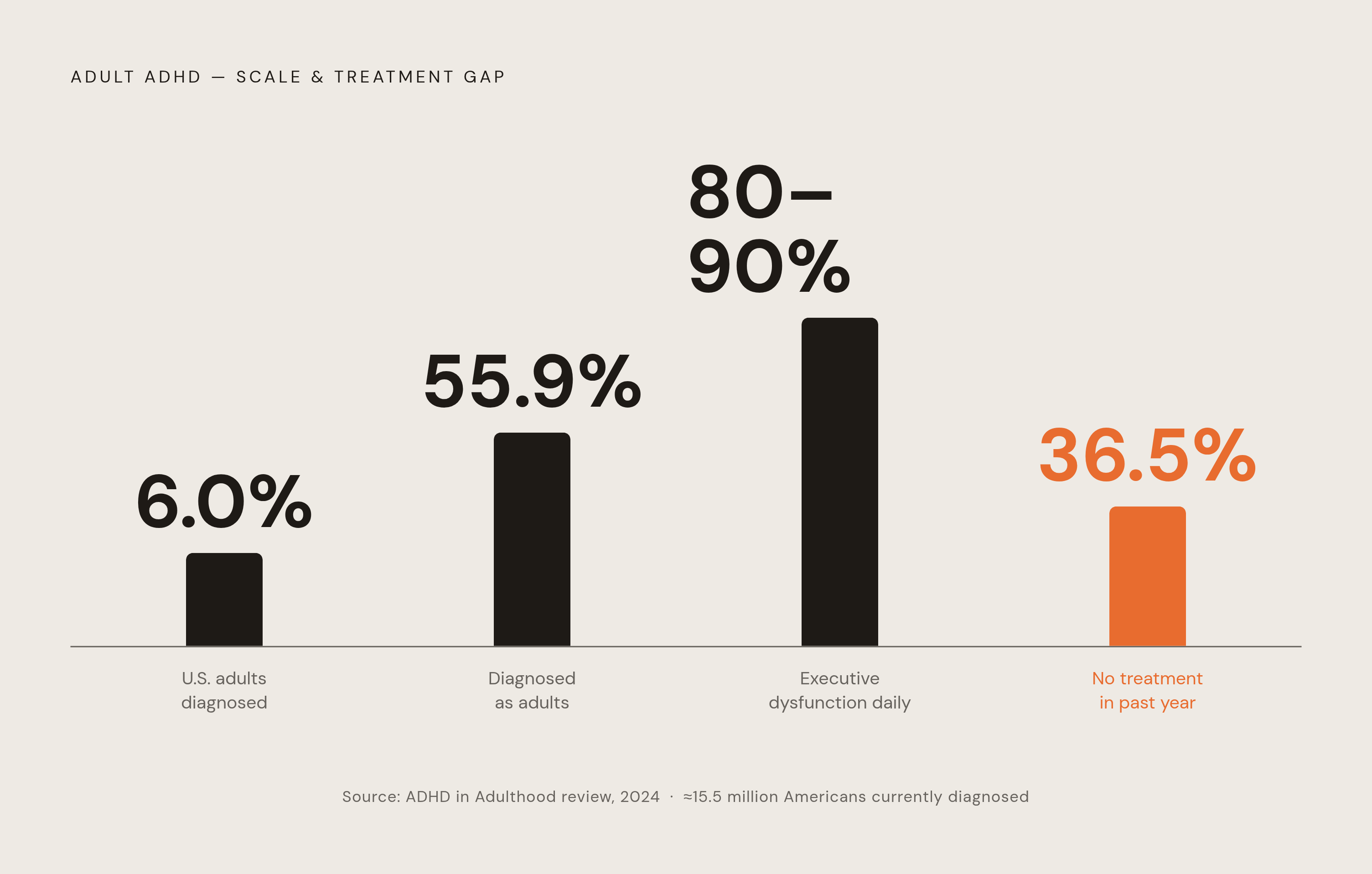
The scale here is larger than most workplace conversations account for. CDC rapid survey data puts current ADHD diagnosis among adults in the country at 6.0%, or roughly 15.5 million people, up from the 4.4% figure that circulated for years. Global projections for symptomatic adult ADHD run past 404 million. Of adults with a current diagnosis, 55.9% were diagnosed as adults. Most of them spent their school years and early careers in environments built for a different kind of brain. And 36.5% of adults with ADHD got no treatment at all in the past year: no medication, no counseling, nothing. For that group especially, the room they work in is the primary lever they have left.
Executive function covers a cluster of top-down cognitive processes: inhibitory control, working memory, cognitive flexibility, the machinery that lets someone set a goal and actually move toward it. These processes track closely with frontal lobe activity, and in ADHD brains they run measurably impaired, not occasionally underperforming. Estimates put the share of adults with ADHD dealing with executive dysfunction daily at 80 to 90%, the baseline condition rather than a bad Tuesday. That is the baseline condition, not a bad Tuesday.
Three impairments do the most damage at work. Time blindness comes first: a consistent tendency to underestimate how long tasks will take, so a ten-minute email eats ninety minutes, or an hour-long task gets abandoned after fifteen because it already feels like it swallowed the afternoon. Working memory failure comes second. Information that most brains hold in place while working simply evaporates for ADHD brains, and without something physical to look at, the task disappears along with the intention to do it. Task initiation failure is the third, and probably the least understood from the outside: a person knows what needs to happen next and still cannot make the first move. That gap between knowing and doing is where the environment either helps or actively works against someone, and most office design has no answer for it.
A systematic review in Frontiers in Neuroscience found a consistent upward trend in resting-state theta power among adults with ADHD, a marker of underarousal in the brain's attentional circuits. The sluggish, hard-to-start feeling that gets mistaken for laziness has a measurable basis in how the brain is idling. That finding reframes the whole design problem. The space has to counteract underarousal directly. Organizing clutter is a side benefit.
The core design principle: reduce friction before the task begins
ADHD brains do not have a productivity problem so much as a friction problem. Every extra decision, every additional step between having an intention and acting on it, raises the odds that the intention just dies there, quietly, without any dramatic failure to point to. Cutting the number of decisions required to start something makes starting easier by a measurable margin. That is close to the entire design philosophy in one sentence.
Workspace ergonomics used to mean lumbar support and monitor height. It now has to include the brain as the thing being supported, and workplaces have not caught up. Research suggests a substantial gap in employer accommodation for ADHD, even though flexible working hours are among the accommodations most commonly extended to ADHD employees in practice. That gap means something concrete: most of the burden of designing a supportive space falls on the individual, at their own desk, with their own money and time.
Here is where most people get it backwards. They assume the fix is a better system, more categories, more apps, a more elaborate tracker. Complexity is where compliance goes to die for this population specifically, because every added step is another decision, and every decision is another chance for the intention to evaporate before it becomes an action. Neurotypical routines can lean on habit formation over time, repetition slowly wearing a groove. ADHD routines work better when they are built on removing decisions. The goal is the simplest system that still gets the job done. It is the simplest one that still gets the job done.
Zone-based layout: giving different brain states different physical homes
Switching between cognitive modes costs executive function, and ADHD brains have less of it to spend than most. Distinct physical zones for distinct types of work cut that switching cost, because the environment itself signals what the brain should be doing next, instead of asking the brain to reset its own state through sheer will.
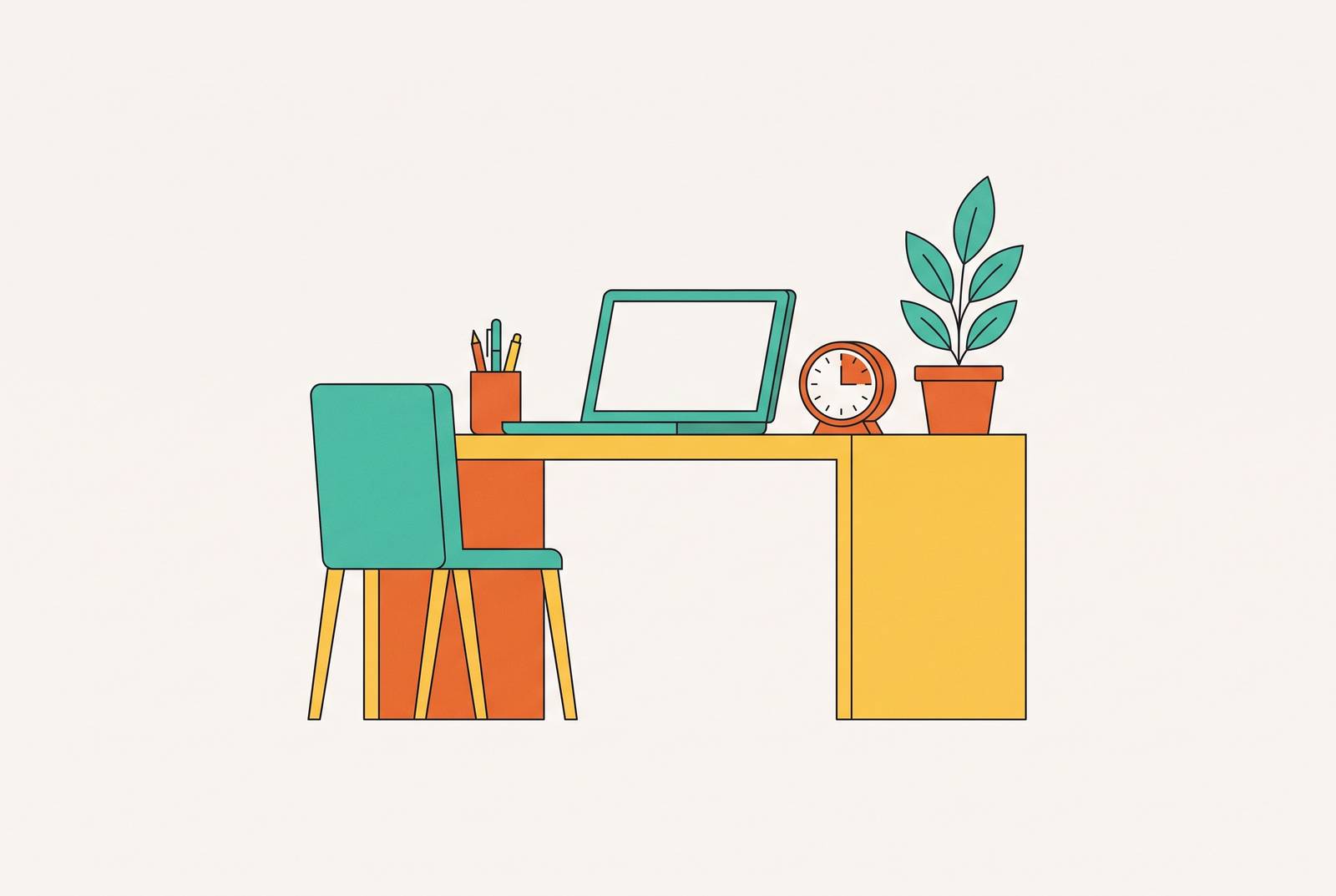
Three zones earn deliberate design attention. A deep work zone should sit close to minimalist: neutral colors, a clear desk, nothing in the sightline unrelated to the current task, because anything visible is something the brain has to actively decide to ignore, and that decision itself burns the resource ADHD brains have least of. A collaborative zone, physically separate, holds calls, brainstorming, anything social or generative, so the deep work zone stays protected from that particular kind of noise. A movement zone, whether it is a real room or just a few feet of open floor, gives the body somewhere to go without leaving the broader work context behind.
None of this needs square footage. A particular chair, a specific lamp, even a consistent sound in one corner of a room can work as a state-setting cue: this chair means deep work, that couch means calls, no negotiation required each time. Carefully built spaces that balance structure with adaptability, quiet corners for focus, separate areas for interaction, room to move, support people with ADHD in a way a single undifferentiated desk never will. One desk asked to do everything ends up doing nothing particularly well.
Sensory control: managing the inputs that hijack ADHD attention
Not every ADHD brain wants the same sensory conditions. Some need ambient noise to stay regulated. Others need something close to silence. The design goal is not a universal prescription, and treating it as one is the mistake most guides make. The real goal is control: giving the individual the ability to adjust inputs rather than locking them into someone else's idea of a focus-friendly room.
Visual distraction deserves attention first because it moves fastest. Phones and tablets can interrupt focus within seconds, and once a device is visible or within reach, resisting it draws on inhibitory control, exactly the resource already running low. Moving the phone to another room, or even just a drawer, creates a small physical barrier that protects attention without demanding willpower to maintain it hour after hour. Labeled bins and anything that keeps surfaces clear cut the load further, because a cluttered desk works as working memory spilled into physical space. Every visible object sitting there is a half-finished thought competing for attention it has not earned.
Sound matters just as much. Acoustic insulation or a genuinely quiet zone helps deep work because background conversation is uniquely hard for ADHD brains to filter out. Speech carries meaning, and meaning pulls attention whether it is wanted or not. Some tools now use AI-generated soundscapes engineered to support focus, deliberately stripped of the melodic or lyrical hooks that grab attention the way a favorite song does. A regular playlist, however enjoyable, risks becoming its own distraction precisely because it is enjoyable.
Lighting rounds this out. Adjustable lighting and access to daylight help regulate sensory input and circadian arousal, and underarousal appears as an elevated theta power measured in the review above, so addressing it through the environment first, before reaching for a behavioral fix, makes more sense than skipping straight to willpower.
Movement built into the workspace, not bolted on as a break
Static seating was built for a rigid 9-to-5 model that assumed stillness equals productivity. That assumption fails ADHD brains specifically, because movement is not a distraction from focus for this population. It is often a precondition for it. Physical activity regulates dopamine and norepinephrine, the same neurotransmitter systems already dysregulated in ADHD. One 12-week study of a specific skill training group found a 15% improvement in working memory, which is not a marginal return for something as low-cost as movement.
Furniture can encode this directly instead of treating movement as an activity scheduled somewhere else. Standing desks allow postural shifts that maintain arousal without forcing a conscious decision to take a break. Wobble stools, frequently recommended for ADHD specifically, let someone move and engage core muscles while staying at the task, satisfying the itch for physical stimulation without pulling attention off the screen. Chairs with some tilt or a wider seat accommodate restlessness instead of fighting it, and a short loop path, even a lap around a room or a hallway, gives somewhere to go during a micro-break that does not require fully exiting the cognitive context of the work.
Office design broadly is starting to treat movement as something that belongs inside the definition of a focused workspace, not something that competes against it for the same block of time.
Visual task management as external working memory on the wall
Working memory in ADHD does not just run weaker than average. It becomes unreliable at the moments a person needs it most. If the brain cannot reliably hold the plan, the plan has to live somewhere else: on a wall, on a desk, somewhere the eyes land without effort or searching.
The operating principle is to make the invisible visible. Tasks, priorities, and next steps need to exist as physical objects a person can see. A whiteboard with the day's priorities, visible at a glance, beats a task list buried in an app that requires opening, scrolling, and re-orienting before it delivers any information. Sticky notes work, but only at genuine decision points, the front door, next to the keys, the bathroom mirror, wherever attention naturally lands during a transition, rather than scattered across a desk where they blend into the background inside a day.
Labeled storage cuts the cognitive cost of searching for materials, and that search cost alone can derail task initiation before the task even begins. A single, visible to-do list beats a complex multi-app system every time, because complexity itself is the enemy of ADHD compliance. A person might keep one planner, one fast-capture method for stray thoughts, and maybe one sensory or focus tool. Past that point, the system starts costing more attention to maintain than it saves, and a system that costs more than it saves is not worth keeping.
Time-anchoring the workspace: making the invisible clock visible
Time blindness might be the single most disruptive ADHD impairment in a work setting, because it never announces itself. Tasks quietly expand past their expected length, deadlines seem to appear out of nowhere, and transitions between tasks get missed, because time itself was never felt passing.
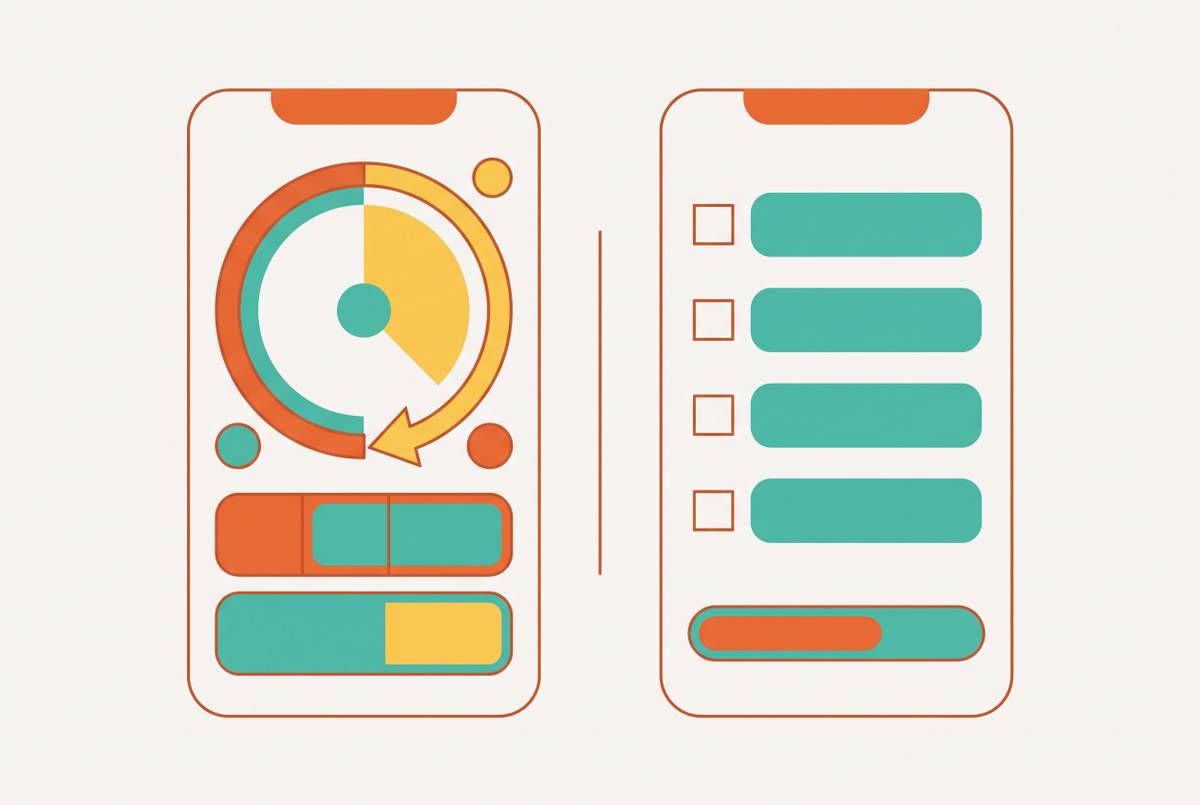
The workspace can carry that burden instead of the brain. An analog clock with a visible sweep second hand, placed directly in the sightline of the desk, communicates passing time in a way a static digital readout cannot, since motion is harder to tune out than a number sitting still. Visual countdown tools, the kind that show remaining time as a shrinking colored arc rather than digits, were built specifically for people who struggle to feel time pass in the abstract. Soft chimes at set intervals turn a transition into something heard, not something that has to be remembered and checked for manually.
The modified Pomodoro method earns its reputation for a specific reason: it gives work a clear start and a clear end, turning an open-ended demand into something closer to a finite, almost game-like commitment. A short, bounded work block with a known break waiting on the other side lowers the overwhelm enough to get a person moving, and each completed sprint builds a little momentum toward the next one. An actual physical timer on the desk, not a phone app, keeps the method free of the very device distraction it exists to prevent. Placement is not a minor detail here. If checking the time takes any real effort, time blindness wins by default, so these tools belong inside the deep work zone, not on a shelf across the room where they might as well not exist.
Body doubling and social design: using other people as environmental scaffolding
Body doubling means working alongside another person, in the same room or over video, and it does something that looks small but is not. It supplies external structure and accountability that can jumpstart task engagement when internal motivation refuses to cooperate on its own. The mechanism is co-regulation, and nobody is checking anyone's work here. It is co-regulation: borrowing another person's steady presence as an environmental input, the way a metronome supplies rhythm to a musician who cannot hold tempo alone.
A study cited on arxiv built a chatbot prototype specifically to simulate body doubling for people dealing with social anxiety or without regular access to a real co-working partner. The design aimed to replicate the core features of human body doubling in a low-barrier, accessible format. That research points at something workspace design can borrow directly, no software required.
In physical terms, that might mean a co-working space, or just a chair set up at home where a partner or roommate works on something unrelated nearby, since even a different task in the same room carries some of the regulatory benefit. It might mean a second monitor or a camera angle positioned so starting a virtual co-working session takes one click, not five. The goal is making social presence something that requires no setup effort each time it is needed. If getting the body double in place becomes its own friction point, the whole method collapses before it ever starts.
Habit compliance through environmental cues, not self-discipline
ADHD brains lean toward novelty and urgency and resist rigid structure, which makes habit formation genuinely harder, though not impossible. Neurotypical habit formation often leans on repetition and willpower reinforcing each other over time, one strengthening the other in a slow feedback loop. That loop tends to break down fast in ADHD, so the more reliable habit is built on environmental cues instead: physical triggers placed exactly where the desired behavior needs to happen, not near it, not close enough, exactly there.
A supplement bottle on top of the coffee maker gets taken. One in a cabinet does not. A gym bag by the front door gets grabbed. One in the closet does not. Every zone, every sensory adjustment, every visible timer and whiteboard covered in this piece is really the same move wearing different clothes: put the trigger for a behavior exactly where the body will already be standing when the behavior needs to happen. Compliance built this way does not depend on remembering anything. It depends only on being in the room.