Voice-Driven Goal Planning for ADHD Adults
Voice planning cuts the friction that prevents ADHD adults from starting anything at all.
Voice-Driven Goal Planning for ADHD Adults.
Why goal planning is uniquely hard for ADHD adults
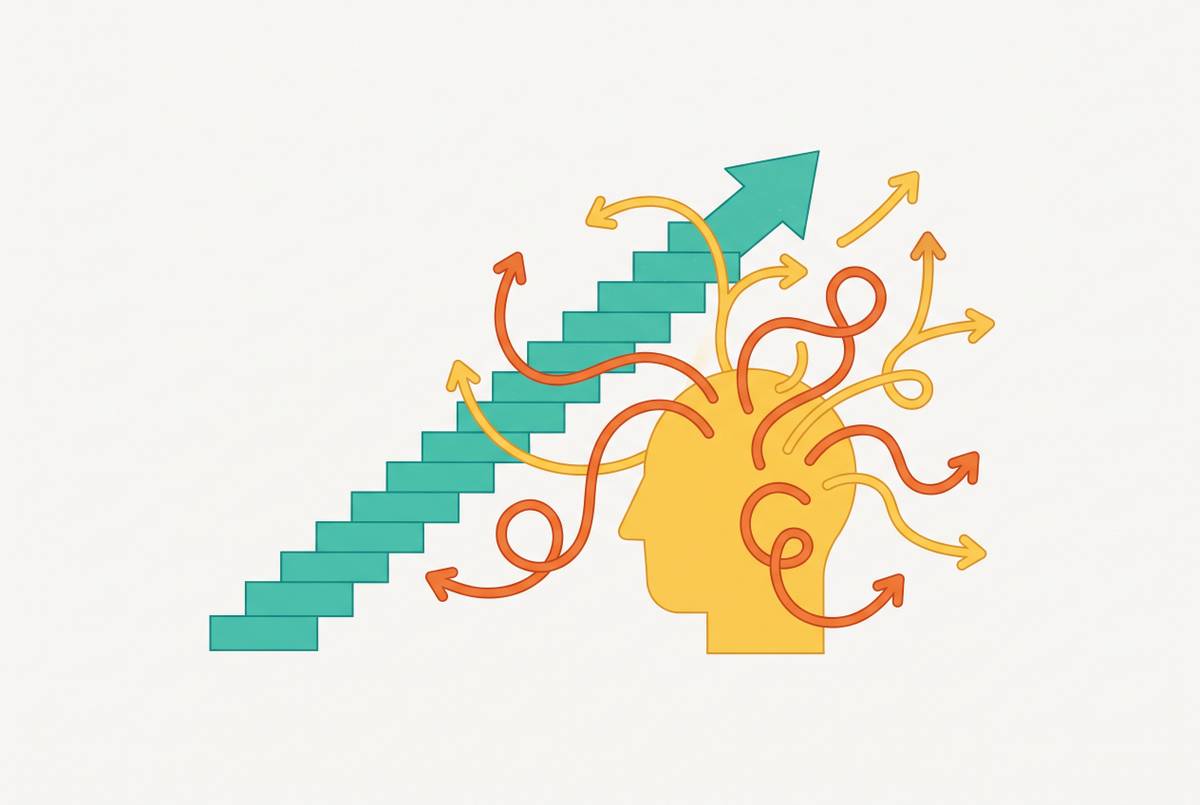
The barrier to goal planning for ADHD adults isn't a shortage of motivation or ambition. It's the executive function cost of getting started at all, and voice-driven planning works precisely because it strips out the initiation step that typed, form-based tools quietly demand. That distinction matters, because the popular explanation, that ADHD adults simply don't plan because they're disorganized or lazy or don't care enough, adds shame on top of a problem without ever describing what's actually happening in the brain. The real mechanism sits in executive function itself: working memory, inhibitory control, and cognitive flexibility, the trio of processes that structurally underperform in ADHD brains. A multi-measure study published in PLOS ONE found that the ADHD group showed clear, targeted alterations in working memory and inhibitory control compared with controls, not some vague deficit in attention generally, but specific breakdowns in the exact skills goal planning leans on.
Why does this matter more for planning than for, say, watching a movie or having a conversation? A study out of Cyprus University's occupational therapy program, published in Occupational Therapy International, found that planning and organizing (the act of designing a strategic sequence toward a goal) ranks among the most frequently reported EF difficulties in ADHD adults. Add to that what ADDA describes, in guidance updated as of March 2026, as "mental paralysis": knowing exactly what needs to happen and still being unable to begin. That's not a metaphor. It's a named symptom of executive dysfunction, and it deserves to be treated as one.
None of this should read as a deficit narrative. The ADHD brain doesn't process information incorrectly, it processes information differently, and the friction described here is a structural reality rather than a moral failing. What follows in this piece treats that friction as a design problem.
What executive dysfunction disrupts when an ADHD adult sits down to set a goal
Picture the sequence a neurotypical brain runs through without much friction: decide to plan, open a tool, hold the goal in mind, type it out, organize it into steps, commit, and come back to it later. Each one of those is its own small executive function demand. For an ADHD adult, the cost doesn't stay flat across those steps, it compounds at every handoff.
Form-based tools make this worse in specific, almost mechanical ways. Typing forces a translation from raw thought into structured text, a task that competes with the working memory the brain is already straining to use elsewhere. A blank field says, implicitly, organize your thoughts first, then type them, which is planning-before-planning, a prerequisite neurotypical tools rarely acknowledge they're imposing. Add the visual noise of a typical productivity app, tabs, menus, color-coded categories, and the cognitive load stacks up before a single real task gets entered.
At the exact moment a plan needs to start, inhibitory control tends to fail. The brain that can't suppress the urge to close the app and check something else isn't being difficult, it's doing precisely what its reward circuitry is built to do given the inputs available to it. Working memory adds its own timing problem: by the time an app finishes loading or a form renders on screen, the original thought, the one that sparked the whole planning impulse, may already be gone. ADDA's March 2026 guidance describes this directly: forgetting instructions mid-task, losing the thread, getting stuck the moment attention needs to shift, which is a fairly exact description of what happens in the gap between "I should plan this" and "plan actually captured somewhere".
There's an emotional cost layered on top of all this. A 2026 systematic review by Pozo-Rodríguez ties executive dysfunction to difficulties with emotional regulation, and repeated failure to start builds a residue of shame and avoidance that makes the next attempt even harder than the last one. This isn't a one-time friction cost, it grows heavier with each failed attempt, which is precisely why the fix needs to interrupt the cycle early, at the initiation moment itself, rather than downstream where the shame has already accumulated.
Voice Input and the Initiation Cost of Typed Planning
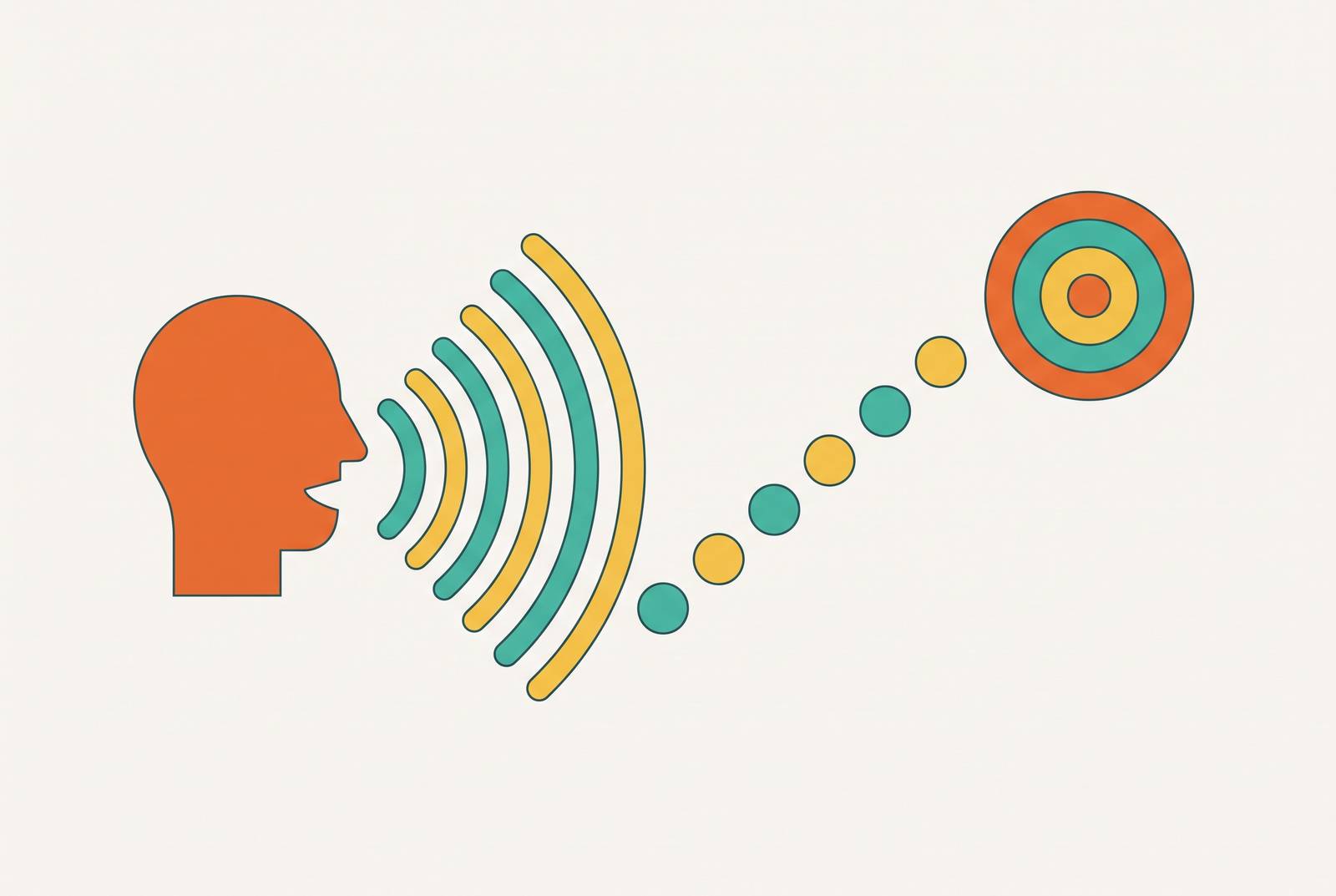
Speaking a goal out loud requires no format. No blank field, no decision about how to structure the thought before it's even been captured. The multi-step sequence collapses into one motion: think it, say it. That collapse is the entire mechanism at work here, and it matters so much for this particular brain because of why it happens.
Working memory benefits first. Voice captures a thought at the moment it exists, before the brain has a chance to cycle away from it and lose the thread entirely. Inhibitory control benefits second, and arguably more importantly: there's no interface standing between intention and action, no menu to navigate, no transition to manage. The act of beginning is the act of speaking, and that can happen before resistance has time to build and take hold. This lines up with what's sometimes called the externalizing memory principle in ADHD productivity research, the idea that productivity improves substantially once the brain is relieved of the burden of holding everything internally. Voice is, by a wide margin, the lowest-friction way to get a thought out of a head and onto some kind of record.
Framing voice input as a nice-to-have undersells what's actually happening. Low-friction tools of this kind aren't a convenience layer stacked on top of standard planning software, they function as a structural accommodation, tailored to the specific EF profile that ADHD produces. There's a useful parallel in workplace accommodation logic: asking for tools that cut down friction on daily tasks tends to have a measurable effect, and voice-first software design is really that same logic, just applied to consumer software instead of a workplace policy. For a neurotypical user, the gap between typing a goal and speaking it is a minor convenience difference. For an ADHD adult standing at the exact moment of peak resistance, that gap is the entire difference between a plan that gets captured and one that evaporates before it's ever written down.
Capturing the thought is only step one, though. A voice-first tool that stops there has solved initiation and left the harder problem, structure, sequencing, follow-through, completely untouched. That's where milestones come in.
Milestones and the ADHD Brain
A goal that gets captured but left whole is still, functionally, an overwhelming wall. "Write the report." "Get healthy." Neither offers an actionable first move, and a goal with no visible first move tends to reactivate the same initiation paralysis the voice capture step was supposed to solve. Capturing the goal was never the hard part. Sequencing it into something a person can actually act on is.
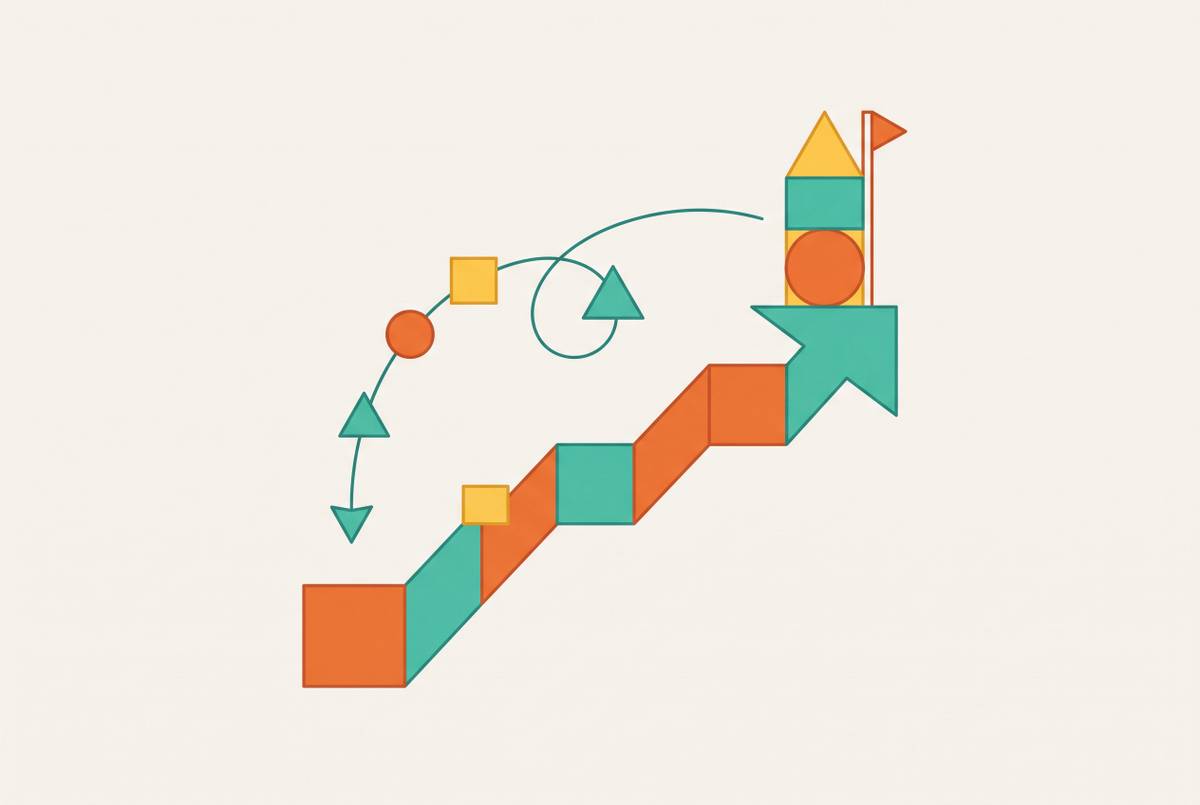
That sequencing task, designing a strategic path from a whole goal down to its component actions, is one of the most consistently impaired EF domains in ADHD, according to the Cyprus University occupational therapy research already mentioned. Asking an ADHD adult to generate that sequence unassisted is, in effect, asking them to perform the single hardest executive function task first, before any momentum exists to carry them through it. Breaking the goal into small, ordered steps isn't a nicety or a productivity hack borrowed from corporate training decks, it offloads the exact planning function that EF deficits make expensive to perform internally. Each milestone becomes its own, much smaller initiation target, one sized to be cleared before resistance has time to build back up.
The "bar low at startup" principle holds that the goal isn't for the whole project to be small, it's for the very first step to be something close to guaranteed achievable, because that early win generates the momentum the ADHD brain needs to continue. Habit stacking works on the same underlying logic, just applied to routines instead of one-off goals. Establish a single habit, let it become automatic, then layer the next one on top of it, a model that scales cleanly from daily routines to much larger goals.
What does this mean for how a tool should actually be built? A voice-first system that captures the raw goal and then walks the user through milestone generation is solving two separate EF demands back to back, in the correct order: friction of entry first, then the planning burden that follows. Solve them out of order, or solve only one, and the tool leaves half the actual problem in place. CBT-based approaches for ADHD explicitly include breaking tasks into smaller steps as a core strategy, per MedicalXpress, citing work co-authored with Dr. Russell Barkley.
The dopamine gap that makes ADHD adults abandon plans they genuinely care about
Even a well-captured, well-sequenced goal can still fall apart weeks later, and the reason has almost nothing to do with willpower. Dr. William Dodson's framing of the interest-based nervous system, laid out in a 2024 edition via CHADD, describes it cleanly: neurotypical brains can engage with a task simply because it's important, but ADHD brains require something more, interest, novelty, urgency, or outside pressure, because importance alone doesn't generate enough of a signal to sustain action.
A neurological basis produces that behavioral pattern, and it's not speculative. PET imaging work by Volkow and colleagues has documented altered dopamine reward pathways in adults with ADHD, laying groundwork for how researchers understand motivational deficits in the condition. fMRI research from Plichta and Scheres adds another layer: reduced activation in the ventral striatum during reward anticipation shows the brain's anticipation of a future payoff is measurably blunted compared to neurotypical brains. Lower dopamine availability of this kind means tasks without an immediate payoff can feel uninteresting, or nearly invisible to the reward system, and that's a neurochemical fact, not a character flaw.
Apply that to goal planning specifically, and the consequence becomes obvious. A plan built in January, aimed at a reward that arrives in December, provides almost no usable motivational signal by the time February rolls around, because the ADHD brain's reward circuitry simply doesn't bridge a gap of that length. This is the gap that any serious ADHD planning tool eventually has to confront directly, because for ADHD adults the biggest barrier to goal planning isn't motivation or ambition but the executive function friction of getting started, and voice-driven approaches work because they remove the initiation cost that typed, form-based tools impose on a brain already taxed by working memory and inhibitory control deficits. Something has to fill that gap. The ADHD Centre describes "motivation inconsistency" as hyperfocusing on interesting tasks while completely avoiding important but unstimulating ones, the same person, exhibiting a different dopamine response.
Gamification as a neurologically grounded response to the ADHD dopamine gap
Gamification gets dismissed sometimes as a gimmick, points and badges layered on top of real work to make it feel less like work. That framing misses what's actually happening mechanically. Gamification adds urgency, novelty, and reward exactly where the ADHD brain's own systems are underdelivering those cues, and in that sense it isn't tricking the brain into anything, it's supplying inputs that the brain's reward system requires but can't reliably generate on its own.
Break down the individual mechanics and the logic holds up. XP or points systems deliver immediate feedback the moment a task finishes, which collapses the long reward delay that ADHD brains have a documented hard time sustaining across weeks. Visual progress indicators support planning, time management, and working memory directly, by turning an abstract sense of "making progress" into something concrete a person can actually look at. Timed challenges lean on something close to Parkinson's Law: shrink the available timeline and the ADHD brain's urgency-based engagement kicks in where importance alone couldn't get traction. Streaks offer consistency scaffolding, though the design has to be careful here, since a streak that resets completely after one missed day can trigger guilt-driven dropout rather than the renewed effort it's meant to inspire.
None of this is anecdotal enthusiasm for game mechanics. A 2020 review in Frontiers in Psychology found that gamification significantly increases motivation, learning, and persistence, with the effect showing up most clearly in people who already struggle under traditional incentive structures. Grounded in Self-Determination Theory, extrinsic rewards, paired with clear signals of competence, tend to get internalized over time, so a person who starts using a system purely for the points can end up developing real, durable engagement with the underlying structure itself. Controlled trials of gamified interventions have reported productivity improvements in ADHD populations reaching as high as 30%, a figure that should be treated as a signal rather than a guarantee, but a meaningful one nonetheless.
Gamification, in other words, isn't about making tedious work feel fun through decoration. It's engineered feedback architecture, built for a brain that has a documented, measurable difficulty generating its own motivational signal for anything with a delayed payoff.
A well-designed voice-driven goal planning session in practice
Consider the shape a session like this actually takes, moment to moment. A thought like "I need to sort out my finances" occurs, and the ADHD-friendly response is to speak it immediately rather than open an app, hunt down the right form, and start typing. That's capture. What comes right after is breakdown: the whole, vague goal gets converted into something concrete, "find the last three bank statements," "check which subscriptions are still active," "set a monthly spending ceiling," pieces small enough to actually act on.
Crucially, the session doesn't try to produce a finished project plan. It ends with exactly one next action, which keeps the overwhelm that tends to cause ADHD paralysis from creeping back in before the person has even started. Then comes the reward signal, some kind of immediate feedback, XP, a visual confirmation, anything that registers instantly rather than asking the brain to wait for a payoff that arrives later.
Timing matters here too. Mornings tend to be one of the highest-stakes windows for ADHD brains, as Jen Kirkman's work through Life Skills Advocate describes, and a two-minute voice check-in at the start of the day holds up far better over time than a long, typed planning session ever does. Part of what makes that sustainable is environmental: good environmental design supports habit formation generally, and a voice-first tool removes a specific barrier, the need to set up a workspace or open some complicated interface, before the actual planning can even begin. The session that works isn't the most thorough one. It's the one that gets finished.
Tools and approaches that support voice-driven goal planning for ADHD adults
Not every tool on the market solves every part of the problem this piece has laid out, so the criteria should be specific rather than treating "ADHD-friendly" as a single, undifferentiated label. A tool worth using should capture goals with minimal friction at the point of entry, break those goals into milestones instead of leaving them whole, and deliver reward feedback immediately rather than asking the user to wait. It should also reduce the working memory load a person carries, not add to it, which rules out anything that demands extensive setup or navigation before a single thought gets recorded.
Apps built around gamified habit tracking, the kind that turn daily effort into visible stats and real-time metrics, tend to be strongest on the reward and feedback side of this equation, translating effort into something concrete a person can watch accumulate. Other tools lean harder into visual scheduling and routine structure, offering especially tight real-time feedback loops for people who need their day laid out spatially rather than as a list. Each of these approaches covers part of the stack this piece has described, but rarely all of it at once.
An AI-powered companion built specifically for ADHD adults, voice-first by design and combining XP rewards with guided milestone tracking and habit scaffolding, comes closest to addressing the full argument made here: low-friction capture, milestone breakdown, and dopamine-compatible feedback architecture in one place. It's used by more than 100,000 people and holds a 4.9-star rating, and of the approaches covered here, it lines up most directly with what the underlying research points toward.
For readers who'd rather not add another app to their phone, non-digital approaches hold up too. CBT-based strategies, including the framework co-authored with Dr. Russell Barkley, center on the same core moves: break tasks into smaller steps, and pair effort with some form of rewarding activity as reinforcement. The mechanism matters more than the tool: capture without friction, structure without overwhelm, and reward that arrives close enough to the effort for an ADHD brain to actually register it.
Sources
- Executive Function Disorder & ADHD | ADDA
- Examining the triad of sensory processing, ADHD symptoms, and executive functioning in adults with ADHD: Evidence from a multi-measure assessment - ScienceDirect
- For adults with ADHD, or even those with just some symptoms, using smart strategies can make all the difference
- ADHD Gamification | How To Boost Focus With ADHD Gamification
- Investigating the Effects of Skills-Based Training Interventions on Executive and Psychosocial Functioning in Adults with ADHD – A Systematic Review of Practical, Emotional and Cognitive Approaches - PMC
- Functional Roles of Norepinephrine and Dopamine in ADHD
- 40 ADHD IEP Goals To Boost Attention And Achievement | Life Skills Advocate