Why Standard Goal-Setting Frameworks Fail ADHD Adults
ADHD brains need goal systems built on neurochemistry, not willpower.
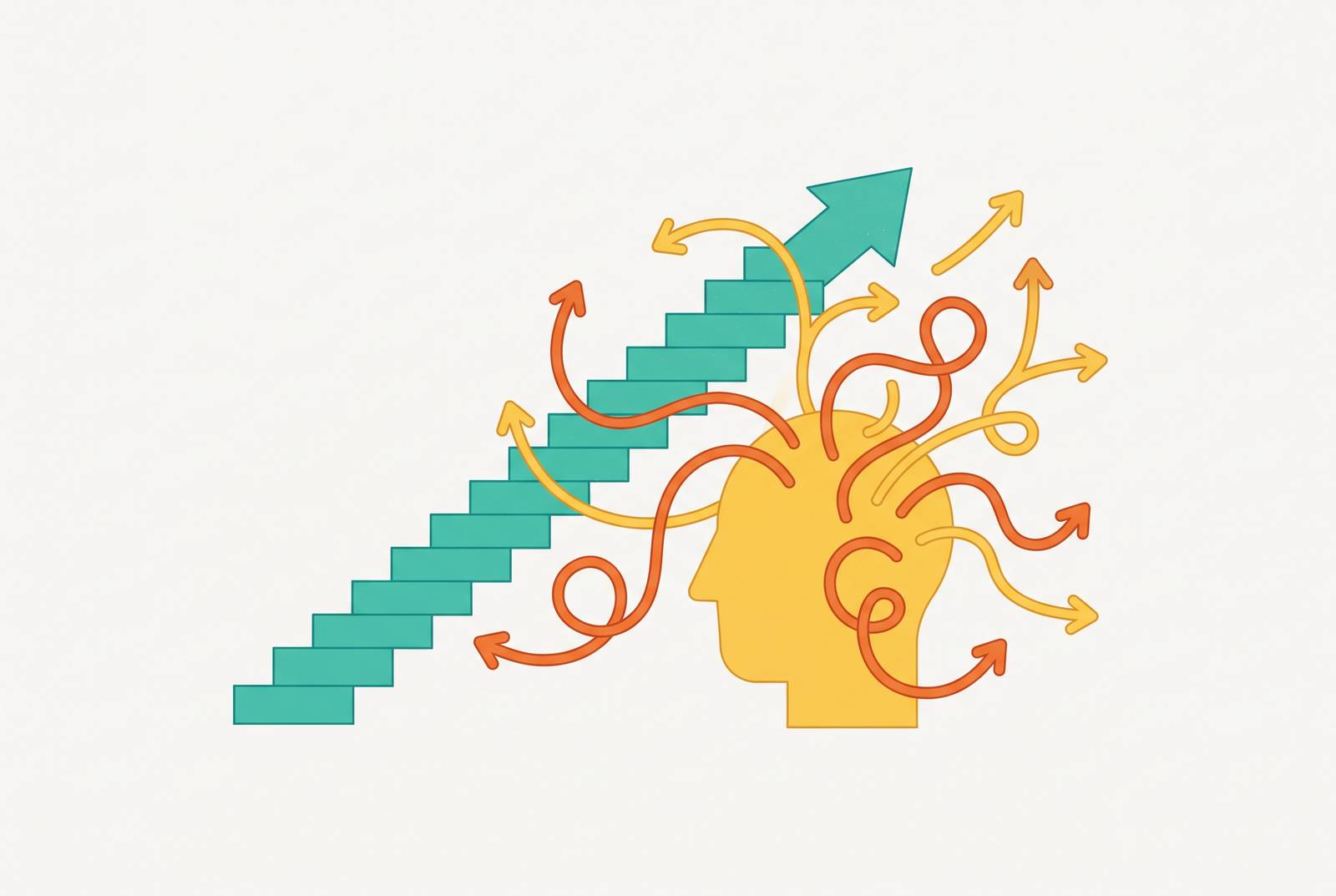
Why Standard Goal-Setting Frameworks Fail ADHD Adults
How common ADHD is in adults
Standard goal-setting frameworks fail ADHD adults because the frameworks were built on assumptions about executive function that ADHD brains cannot structurally meet. That mismatch, not some personal shortfall, is the subject of this piece, and understanding it precisely is what makes a different approach possible. Those are not small numbers, and they point to something that deserves close attention before moving further.
For the first time, more than half (55.9%) of adults with a current ADHD diagnosis received it in adulthood, and they spent years without a framework for understanding their own cognition huntingtonpsychiatry.com. Add to that a further data point: 36.5% of U.S. adults with ADHD received no treatment at all, no medication, no counseling, in the past year huntingtonpsych.com. That's a substantial share of people navigating daily functioning entirely through self-directed methods, whatever they could find in a book or a blog post or a coworker's offhand suggestion huntingtonpsych.com.
None of this is meant to alarm. Odds are, if this piece caught the reader's attention, the diagnosis is already known, lived with, maybe fought over for years. What the numbers actually offer is confirmation that the frustration of watching a planner or an app or a goal-tracking spreadsheet fall apart is not an isolated failure. It's a shared experience, distributed across millions of people running the same self-directed experiment with the same mismatched tools. Approximately 16.13 million U.S. adults, or 6.2% of the adult population, live with ADHD, with 404 million affected globally shanghaiarchivesofpsychiatry.org. These figures should be read as context, not alarm. The reader likely already knows they have ADHD, and the point is that their experience of failed systems is widely shared, not personal.
Executive function and its central role in ADHD
Executive function is the term researchers use for a cluster of higher-order mental processes, working memory, inhibitory control, cognitive flexibility, that together let a person manage a task across time rather than just react to whatever is in front of them. It's the machinery behind planning a project, resisting a distraction mid-sentence, holding a sequence of steps in mind while executing the third one. That machinery is closely tied to the frontal lobes, and adults with ADHD show measurable executive function differences linked to changes in neural oscillation patterns, according to a systematic review published in Frontiers in Neuroscience.
But here's where the picture gets more interesting than the simple "ADHD equals broken executive function" story most people carry around. Others present with motivation or emotional regulation difficulties as the primary driver instead. Why does that distinction matter for someone trying to set and keep a goal? Because it means treating "ADHD" as a single, uniform failure mode, one fixable input, is already an oversimplification, and any goal-setting system built around a single assumed mechanism is going to miss a large share of the people who need it.
Russell Barkley, whose work on this has shaped decades of clinical thinking, frames ADHD less as an attention problem and more as a disorder of self-regulation, what he calls temporal myopia. Behavior stays governed by whatever is immediately present rather than by demands sitting somewhere in the future. Layer onto that the idea, widely used in practitioner circles and often attributed to Dr. William Dodson, of the "interest-based nervous system": ADHD motivation runs on interest, novelty, urgency, and emotional charge, not on willpower or discipline in the way most productivity advice assumes. EF deficit in ADHD is not universal, according to the 2025 Front study.
The neurological reason future rewards don't motivate ADHD brains the way they should
Meta-analytic fMRI research shows medium-effect hyporesponsiveness in the ventral striatum during reward anticipation in ADHD, with the brain's reward circuitry responding less strongly to anticipated future outcomes neural-revolution.com. What does that mean in practice? A goal set for six months out, finish the certification, hit the savings target, doesn't generate the same neurological pull that keeps someone else grinding toward it week after week.
That's not a metaphor. It's a specific claim about specific circuitry underperforming in a specific way, and it deserves to be taken as seriously as it sounds.
Dopamine regulation plays into this too. Research by Volkow and colleagues, from 2009, associates lower dopamine availability with broader motivation deficits in ADHD, including reduced reward anticipation, a neurochemical gap. This is not a willpower gap. It's a neurochemical one. Combine it with the idea of temporal myopia, and the sentence "I'll feel good when I finish this in three months" no longer motivates a brain that isn't wired to weight that future payoff, making it functionally invisible instead.
One might ask, does that mean the situation is permanent, immovable, a life sentence of failed goals? Not necessarily. The point here is mechanism. Knowing precisely why a future reward fails to register is the first real step toward building something that works with the mechanism instead of against it, which is exactly the terrain the rest of this piece covers.
What standard goal-setting frameworks assume about the brain
Consider what SMART goals, vision boards, and accountability partnerships have in common. All of them were designed around how a neurotypical brain processes future reward and manages behavior across stretches of time. That's not a criticism of the frameworks themselves, which work reasonably well for the population they were built for. The trouble starts when they're applied universally, as though one design fits every brain.
Look closer and a handful of hidden assumptions appear in the framework itself. The first is consistent daily executive energy, the idea that a person has roughly the same cognitive resources available each day. ADHD brains don't work that way; executive function and dopamine availability fluctuate significantly day to day, sometimes hour to hour. The second assumption, covered already, is that future reward alone is motivating, a claim the ventral striatum research directly undercuts neural-revolution.com.
The third assumption is that deviation is recoverable, that missing a day is a minor setback absorbed into an otherwise steady plan. For a lot of ADHD brains, though, all-or-nothing thinking takes over: one missed step doesn't stay one missed step, it becomes the reason the entire plan gets abandoned. The fourth assumption is that a goal can be emotionally neutral, purely logical, and still get done. Given the interest-based nervous system described earlier, a goal that doesn't carry real personal emotional weight gets quietly deprioritized the moment something more stimulating appears.
The fifth assumption, maybe the most damaging, is that progress should look linear. Real ADHD experience includes high-energy weeks, flat low-stimulation stretches, and sudden shifts in what actually holds interest, and frameworks built for steady week-over-week improvement simply don't have a slot for that variability. There's also the issue of goals getting designed during a burst of hyperfocus or fresh motivation, when energy feels limitless, and built for the best possible version of a week. Then executive fatigue or sensory overload hits, as it does, and a complex 10-step routine that felt reasonable during hyperfocus or renewed motivation turns into something cognitively overwhelming. The framework didn't account for the version of the person who shows up most days. It only accounted for the version that shows up on the best ones.
How framework failure becomes self-blame, the emotional trap that compounds the problem
Here's what turns a design flaw into a personal wound. When a framework fails, and it does fail, regularly and predictably, given everything covered above, the person using it rarely concludes that the tool was wrong for them. They conclude they are the failure, because the framework never disclosed its hidden assumptions in the first place. Nobody hands over a SMART goal worksheet with a footnote reading "this assumes stable daily dopamine levels."
Rejection sensitivity, well documented in ADHD, makes this worse. When a goal isn't met, the frustration, shame, or self-criticism that follows can shut down future attempts entirely. The failure no longer registers as information, only as a reason not to try again. Because non-linear progress gets treated by most frameworks as a breakdown rather than a normal pattern, the emotional residue left behind is shame. That matters clinically, not just emotionally: shame is close to the worst possible state for engaging the dopamine-driven motivation system that ADHD brains depend on.
This isn't a rare, occasional experience either. Studies suggest that 80 to 90% of adults with ADHD struggle with executive dysfunction on a daily basis, which means most people in this position are hitting some version of framework failure regularly, not once in a while drsharonsaline.com. Repeat that cycle enough times, failed system, self-blame, eroded confidence, failed system again, and what erodes is the belief that change is even possible. It's the belief that change is even possible.
Naming that cycle directly matters more than it might seem. Recognizing that the tool failed, not the person using it, is the precondition for trying something different at all.
What goal-setting approaches account for how ADHD brains work
So what changes when the hidden assumptions get swapped out for ones that actually match how these brains operate? The starting principle isn't trying harder inside the same broken system, it's replacing the system's foundational assumptions altogether.
Micro-goal scaling is one concrete method. Instead of "write a novel," the goal becomes "write 300 words a day for a week". That's the smallest version of the goal that still counts as forward motion, and completing even that small step engages the dopamine response that a distant, abstract finish line cannot. Flexibility matters just as much as scale.
There's also Goal Management Training, or GMT, one of the few structured interventions with actual clinical trial data behind it for adult ADHD. Originally built for brain injury populations, GMT is a group-based metacognitive program that targets goal neglect directly. Its central mechanic is an intermittent "STOP!-and-think" pause, a deliberate interruption that asks whether current behavior still lines up with the actual goal. It's a small, almost blunt tool, but it directly counters the moment-to-moment drift that temporal myopia produces.
Time blindness gets its own set of workarounds. Estimate how long a task will take, then double the number. Break large tasks into short chunks with breaks built in, and use visual timers rather than relying on an internal sense of time that ADHD brains don't track reliably. A modified Pomodoro method fits here too: fifteen-minute sprints with a clear, visible endpoint make starting easier, because the task in front of a person becomes "work for fifteen minutes" instead of "finish the report". That structural clarity, a defined start and a defined end, reduces the overwhelm that kills task initiation before it begins.
Scope limiting rounds this out. Pre-structured categories remove the paralysis of "what should I even work on right now," and capping the day's must-do list at three items keeps the load manageable. Separating work, life, and health into distinct domains means they stop competing for the same limited mental bandwidth. None of these are complicated ideas. What they share is a refusal to assume energy, time sense, or emotional neutrality that the ADHD brain doesn't reliably have. Flexibility over rigidity means pairing anchor habits (2–3 fixed elements that stay constant) with flexible elements that shift based on energy and schedule, so that stable structure with built-in variation prevents the routine from going stale or triggering all-or-nothing collapse.
How tools designed specifically for ADHD brains change what's possible
Generic productivity apps carry a quiet, unexamined cost: they expect the user to supply the exact executive function the app is supposed to help with. Opening the app, deciding what to log, typing it out, remembering to come back later, each of those is a small point of friction, and for a brain already running low on executive bandwidth, friction compounds fast into abandonment.
Voice-first interaction addresses one specific piece of that. Removing the typing-and-form barrier lets a task get captured the moment it's thought, in natural spoken language, before it slips out of working memory, which for ADHD brains happens in seconds. That's not a convenience add-on. It's closing the exact gap where the friction lives.
Gamification deserves more credit than it usually gets in this context. XP, visible rewards, milestone completions, these aren't cosmetic flourishes bolted onto a task list to make it feel fun. They generate an immediate dopamine signal that a distant, future-oriented goal structurally cannot provide, which is precisely what the interest-based nervous system needs to stay engaged with a task long enough to finish it. Milestone-based planning works on the same principle at a structural level: breaking a large goal into small, sequenced steps directly counters the temporal myopia and overwhelm that produce ADHD paralysis in the first place.
Habit scaffolding, where finishing one action automatically cues the next, cuts down on how much a person has to hold in working memory while moving through a multi-step sequence. Fewer things to juggle mid-task means fewer chances for the whole sequence to fall apart partway through.
What ties all of this together is a simple shift in who's expected to do the work. A tool built specifically for how ADHD brains actually operate doesn't ask the user to supply the executive function the tool was supposed to provide in the first place. Standard frameworks failed not from some deficiency in the people using them, but from a structural mismatch between what those frameworks assumed and what these brains can reliably deliver on any given day. Seeing that mismatch clearly is what makes it possible to stop blaming the reflection in the mirror and start choosing tools built for the brain actually looking into it.