Milestone Design for ADHD Momentum and Dopamine Return
Restructure goals into immediate milestones to trigger dopamine and beat task paralysis.
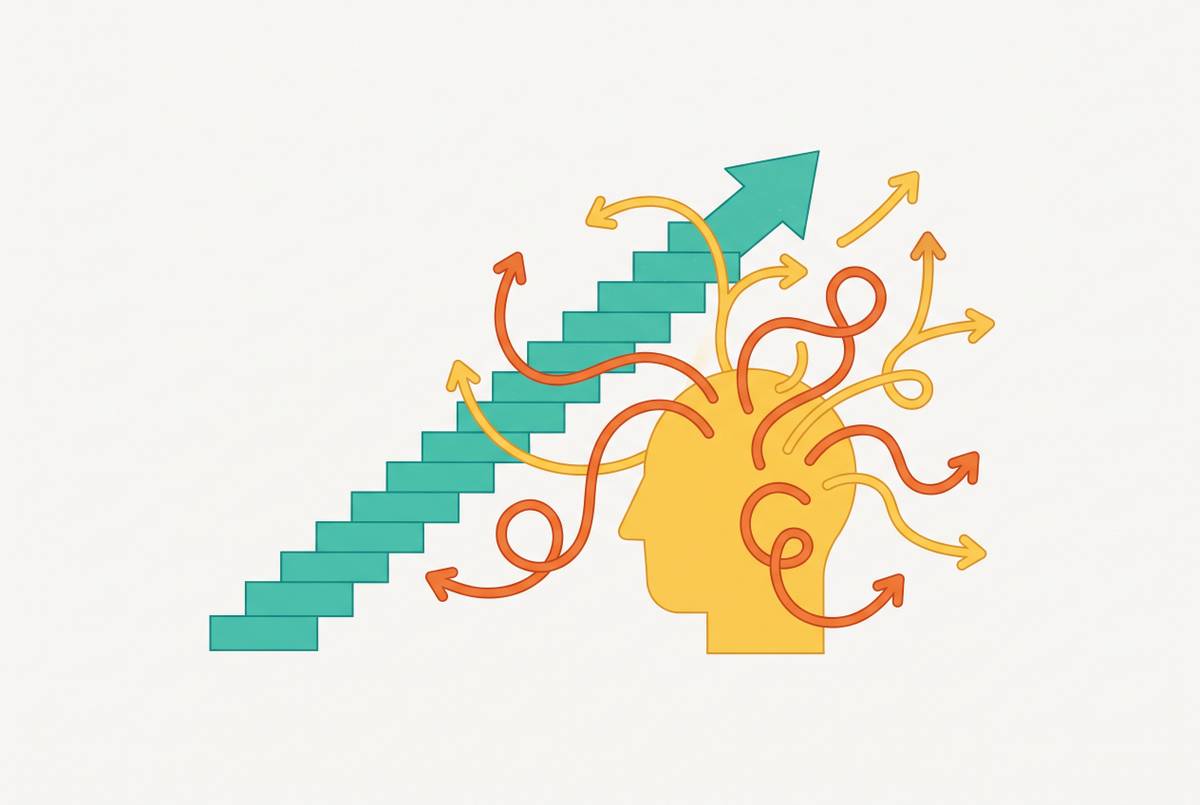
The task sits there, fully visible, fully doable, and still nothing happens. That freeze, wanting to start and finding no way in, is not a character flaw. It traces back to a specific set of cognitive processes called executive functions (EFs), the mechanisms that make planning, prioritizing, initiating, and completing tasks possible. Working memory, inhibitory control, cognitive flexibility (including the skill of shifting between mental sets), planning, time management, and decision-making all fall under this umbrella, and in ADHD, these are precisely the processes that break down. That breakdown is central to the disorder. It is the disorder, at least in the sense that matters for anyone trying to get something done.
The scale of scientific attention on this connection is hard to overstate. A 2026 bibliometric analysis in Discover Mental Health counted 2,898 papers on executive function in ADHD published in just one decade, 2015 to 2024. That volume of research does not happen by accident. It happens because EF deficits sit at the center of what makes ADHD, ADHD, rather than at the periphery.
Task initiation is where this plays out most visibly, and most painfully. Consider what has to happen just to start something: the first step needs to be held in working memory clearly enough to act on, and the brain needs enough cognitive flexibility to disengage from whatever it is currently doing and shift attention toward the new demand. When either piece fails, the task stops looking like a sequence of steps and starts looking like a wall. Not a hard task. A wall, undifferentiated and total.
This differs from procrastination, a word that implies choice, a decision to delay. What's actually happening is closer to a freeze response, task paralysis driven by cognitive architecture rather than motivation or discipline. The distinction matters because the moral framing so many people with ADHD absorb, some version of "just try harder" or "you're lazy," is not just inaccurate. It actively makes outcomes worse, stacking shame on top of a neurological reality that shame does nothing to fix. Telling someone to push through an executive function deficit through willpower alone is a bit like telling someone with a broken ankle to walk it off. The problem is structural, and the solution has to be structural too.
What is going wrong in the ADHD brain's reward circuitry
If the executive function gap explains why starting is hard, it doesn't fully explain why the difficulty is so specifically tied to distance, deadlines, and delayed payoff. For that, the picture has to shift from cognition to chemistry. ADHD is not simply a disorder of attention. Research published in PMC frames it as deeply rooted in disrupted dopaminergic function, with consequences for motivation, impulsivity, and executive control. Attention is the symptom people notice, but the mechanism underneath is a reward system that runs differently.
Research led by Nora Volkow found that adults with ADHD have significantly fewer dopamine receptors in the brain's reward regions, and that this receptor deficit correlates with symptoms of low motivation. Fewer receptors means a weaker signal for the same input. But the more precise piece of the puzzle, and arguably the one that explains the most about daily ADHD experience, is what researchers call the dopamine transfer deficit, or DTD theory.
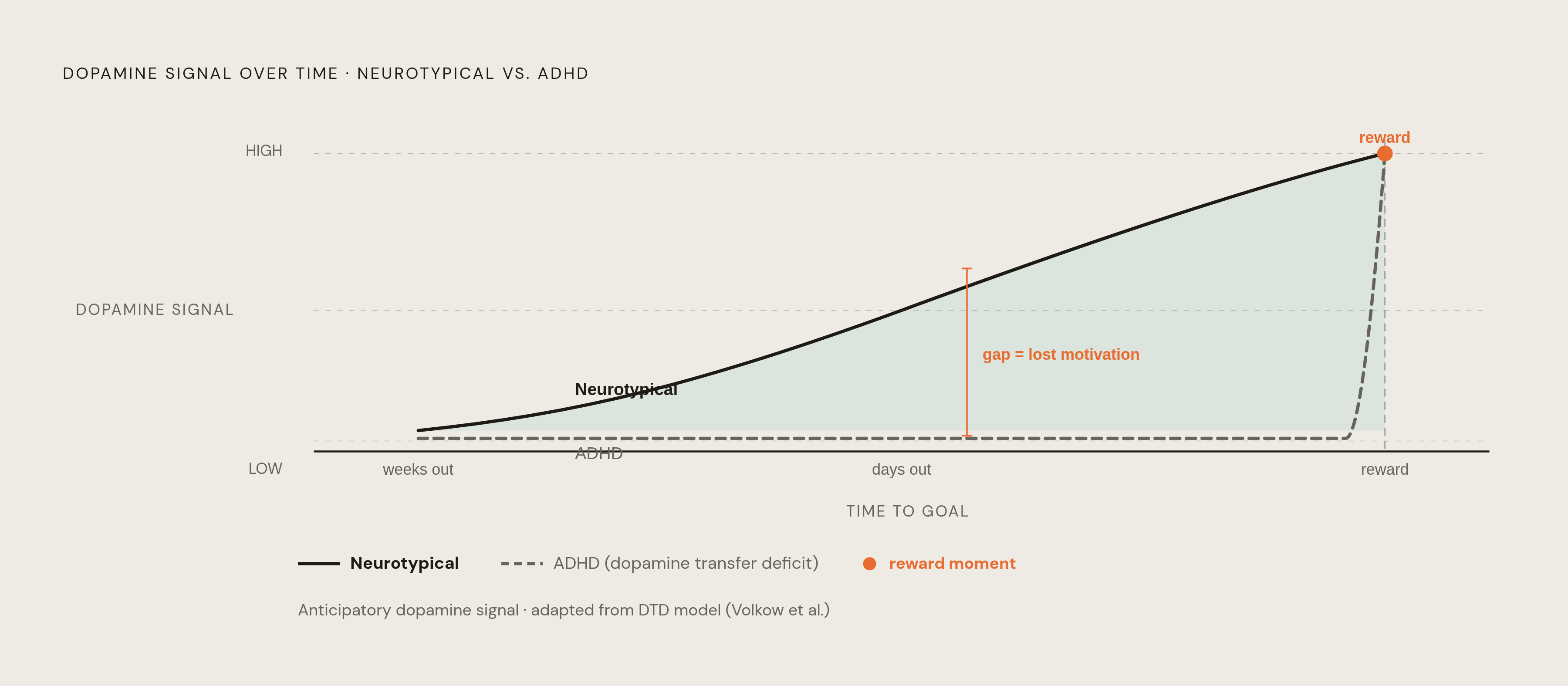
That theory actually claims the following. In a neurotypical brain, dopamine doesn't just fire when a reward arrives, it learns to fire in anticipation of that reward, ahead of time, which is what lets someone sustain effort across days or weeks toward something they haven't gotten yet. In ADHD, that transfer doesn't happen the same way. The dopamine response stays tied to the actual reward and fails to migrate backward onto the anticipation of it, so anticipatory neural activity runs measurably lower than in neurotypical brains. Practically, this means a distant goal generates almost no fuel to move toward it. The payoff might be real and might even be substantial, but if it's far enough away, the brain simply doesn't produce the chemical signal that would make working toward it feel worthwhile in the moment.
This is the hinge the rest of the argument turns on. If motivation in ADHD is not a discipline problem but a reward-timing problem, then the fix isn't more willpower, it's re-engineering when and how reward gets delivered. There's supporting evidence that this kind of engineering actually works at the neural level, not just anecdotally: PMC research found that a subgroup of ADHD patients, when off dopaminergic medication, showed a markedly exaggerated striatal response during reward-linked task-switching. That points to the reward circuitry being not broken beyond function, but miscalibrated. It suggests the reward circuitry isn't broken beyond function, it's miscalibrated, and under the right conditions, a well-placed reward can partially do the work that anticipation normally would. Reward engineering, in other words, is a legitimate mechanism grounded in how the brain actually works. It's closer to a substitute for a biological mechanism that isn't firing on its own.
Why distant goals fail ADHD brains
So why does the standard advice, set a big goal, break it into a timeline, work toward the deadline, fail so reliably for ADHD brains? Because it assumes a reward system that sustains motivation through anticipated future outcomes, and that assumption is exactly where the mismatch lives. The advice is simply designed for a different brain. It's simply designed for a different brain.
For ADHD brains, the motivational signal degrades fast as distance increases. "Finish the project by Friday" carries no real dopamine trigger if Friday is still three days out. The deadline's stakes might even be significant, but none of that translates into a chemical nudge to act right now. Instead of perceiving a sequence of doable steps, the brain perceives one undifferentiated mass, and undifferentiated mass is exactly the condition under which task initiation collapses. No clear first step means no way in.
This is why rigid schedulers, dense planners, and "eat the frog first" advice keep failing the same population of people, over and over. These frameworks are built on the premise that a brain can hold a distant reward in mind and let that hold generate present-tense motivation. That's a reasonable premise for a neurotypical reward system. It is not a reasonable premise for a system with a documented deficit in transferring dopamine response from reward to anticipation. So when someone with ADHD tries a rigid planner, fails to stick with it, and concludes the failure is personal, that conclusion is backwards. The tool was built for different wiring. The failure belongs to the design.
What would work instead? Something close enough, structurally, for the ADHD brain to actually register it. "Close enough" means a milestone positioned near enough in time to generate a real anticipatory dopamine signal, specific enough that the brain can picture what "done" looks like, and small enough that the activation energy needed to start doesn't exceed the will available to spend on it. That's a concrete, measurable target. It's a design specification, and it's the specification the next section builds out in full.
How milestone architecture creates dopamine at the right intervals
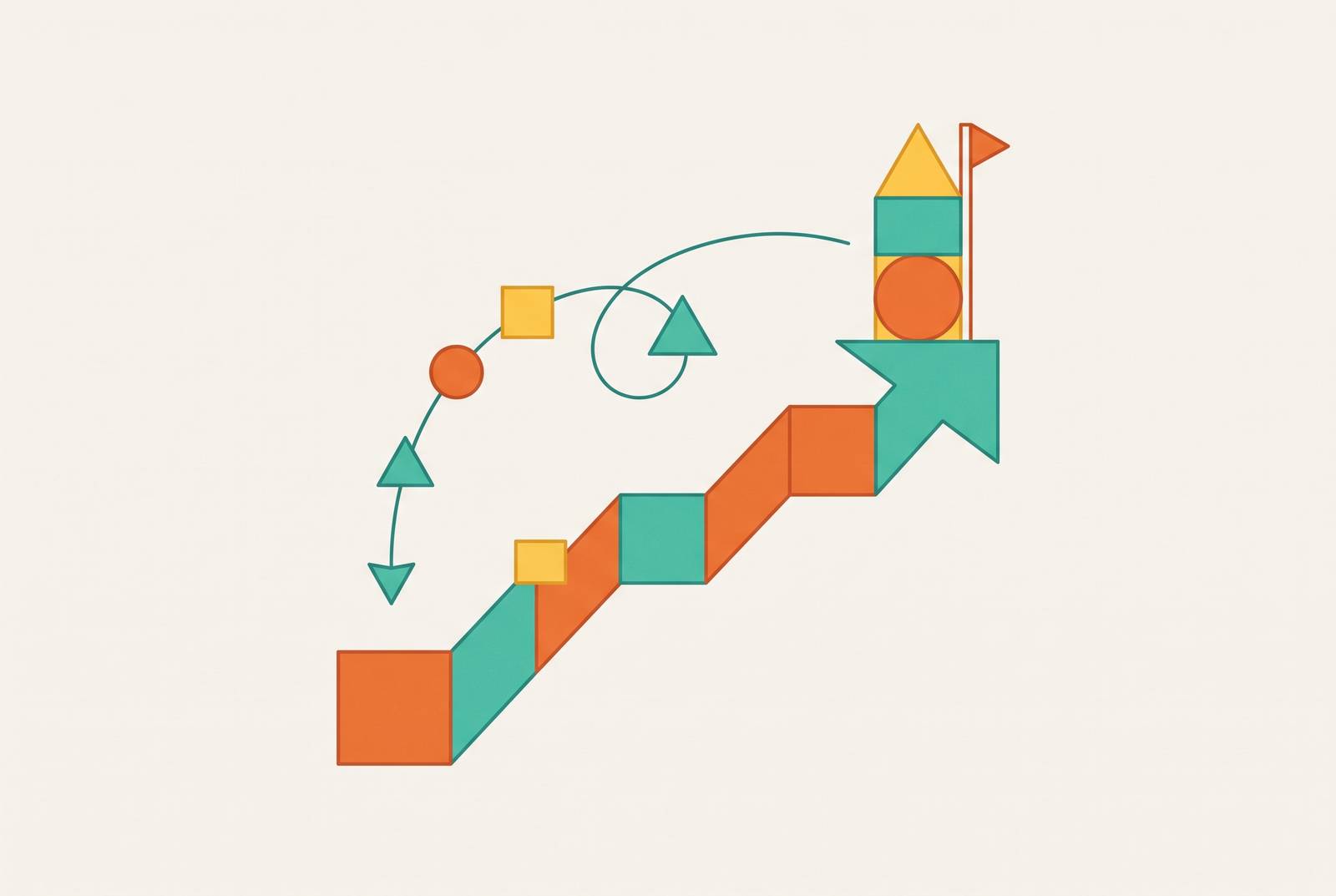
Milestone architecture is the deliberate placement of achievable, rewarded checkpoints inside a larger goal, spaced and sized so each one delivers a dopamine signal strong enough to fuel movement toward the next. Start at the smallest unit: the micro-task. The principle here is to break a task down until there is close to zero mental resistance to beginning it. Not "clean the house," but "put three items in their proper place". That rewording looks almost trivial on paper, but it changes the entire cognitive calculation. "Clean the house" is a wall. "Put three items away" is a doorway, and doorways, unlike walls, get walked through.
Shrinking the task this far does two things at once. It lowers activation energy close to zero, and it produces an immediate, felt sense of accomplishment, the very first dopamine return in the entire loop. Shorter sprints of work compound this effect by shrinking the perceived size of the task before it even starts, so beginning feels manageable rather than threatening.
From there, the architecture scales up. A working milestone system decomposes a goal into discrete, named steps, never vague phases like "research" or "planning" that hide an unknown amount of work inside a single word. Each step needs a clear completion condition, some signal the brain can register as a win, because an ambiguous finish line produces no dopamine at all. Steps should sequence in a way that makes the next one obvious once the current one is done, which reduces the planning burden and keeps momentum moving forward rather than stalling out at "what now." And the spacing matters as much as the sizing: milestones need to sit close enough together that the reward for one arrives before motivation for the whole effort has already degraded.
For most people, this structure doesn't emerge cleanly from a blank page. A brain dump, getting every task out of the head and onto paper or a screen before trying to organize anything, removes the working memory load that otherwise blocks planning before it starts. It's a low-cost entry point into the whole system. From there, a daily template that pre-sorts tasks into categories cuts down on the decision fatigue of "what should I even work on," and capping the number of must-dos in a day keeps the workload from compounding on itself and reopening the same paralysis the system was built to avoid. Separating domains, work, health, personal life, so they aren't competing for the same slice of attention at the same moment also helps keep the cognitive load from stacking.
None of this needs to live entirely in the head, either. The point of putting the structure into the environment is that it no longer has to be held in mind, which is exactly the resource ADHD brains have the least of to spare. External scaffolding from CBT-informed approaches (such as visual cues, timers, and time blocks) acts as artificial working memory, making the milestone structure visible in the environment so it doesn't have to be held in mind.
How gamification encodes reward into the milestone loop
Milestones create the structure. Gamification is what makes the reward at each checkpoint register, reliably, as a reward. In the ADHD context, gamification means game-like systems that manufacture external rewards and structure, standing in for the internal motivation generation that the brain struggles to produce on its own. That framing matters, because it reclassifies gamification from decoration to function. A point or a badge is not a trivial flourish tacked onto a to-do list. For an ADHD brain, that small hit of dopamine can be the actual difference between stalling out and moving forward.
The clinical evidence backs this up in a way that's hard to dismiss as anecdote. A randomized controlled trial published in Frontiers in Education in 2025, run over eight weeks, found that gamification significantly improved sustained attention in children with ADHD. The mechanism the researchers pointed to was instant feedback paired with reward, the same close-interval reward logic milestone architecture is built on. The gamified group also showed gains in reading, writing, and mathematics scores, which suggests the benefit isn't confined to some narrow measure of engagement. It appears in actual academic output.
The mechanics that make this work aren't mysterious. Micro-goals deliver an immediate signal on completion. Visual progress tracking gives a concrete, external picture of how far someone has come, which matters because internally generated confidence in progress is what the dopamine deficit makes unreliable. Streaks create a visible thread of consistency and supply their own incentive to keep it unbroken. Milestone-specific rewards, a bonus for hitting a multi-day streak, for instance, reinforce the habit at a higher interval than the daily check-in alone. Badges and quest-style framing turn an obligation into something closer to a challenge, which lowers the barrier to starting in the same way a game's opening level is built to lower the barrier to playing at all.
These mechanics are applying old tools to a new problem. They're doing, mechanically, what a childhood sticker chart did, supplying external validation for a motivation system that can't be counted on to supply it internally. ADHD brains habituate to novelty fast, so a reward system that worked two months ago can go flat without warning. Varying the format, the visuals, or the reward type when engagement dips is a signal to redesign the system. It's a signal to redesign it, which is a very different thing.
The strongest piece of evidence for the whole approach might be the most practical one. ADHD-focused apps that include visual progress tracking report 31 percent higher daily active use than apps without it. That's a real behavioral signature at scale, and it lines up precisely with what the neuroscience predicts: reward delivered at the right interval keeps people coming back, in a way that reward promised at a distance simply doesn't.
What well-designed ADHD tools do with milestone structure
These principles show up well beyond research papers. They're already built into a growing set of tools designed specifically around milestone and reward architecture. Habitica is a clear example. It's an RPG-style productivity app that turns daily tasks and habits into in-game actions, rewarding completion with experience points, gold, and character progression, with quests layered in as a social feature. It's a direct, functioning application of quest framing and milestone reward logic, translated from theory into something people use every day.
What separates the tools that actually work for ADHD from the ones that look right on paper but quietly fail comes down to a short list of shared traits: goals broken into small, named, sequenced milestones with unambiguous completion conditions, visual feedback that's immediate and impossible to miss (not a score buried three menus deep), and streaks or rewards operating at more than one time scale, daily and weekly and cumulative, so the loop doesn't rely on a single interval to hold.
A failure mode undoes good design otherwise. If opening the app, logging a task, or finding the right habit to update takes multiple taps, a form, or sustained typed input, the activation energy cost of using the tool can exceed the reward the tool provides. At that point the tool gets abandoned because the friction at the front door outweighed everything built behind it, even though the milestone logic was not wrong. Voice-first interaction solves this directly: speaking a task requires no navigation, no formatting, no sustained attention to a screen. For ADHD specifically, that's not a nicety, it's closer to an accessibility requirement, because it keeps the limited executive function budget pointed at the actual work instead of burning it on the interface.
That's the design logic an app built specifically for ADHD, combining XP rewards, guided milestone tracking, structured habit scaffolding, and voice-first input, is built to satisfy.
Building your own milestone system: design choices that determine whether dopamine loops hold
None of this requires a specific app to put into practice. The underlying goal is to design for the ADHD brain that's actually present, not to force that brain through a system built for someone else's wiring. That distinction is the whole argument in miniature.
Start with sizing. A milestone is too big if it can't be finished in a single sitting without motivation draining out partway through. It's sized correctly when finishing it produces a clear, felt sense of "done," and that feeling has to arrive before attention wanders off looking for something more stimulating. When it's unclear whether a step is small enough, the safer move is almost always to cut it in half again. Oversized milestones are the most common way well-intentioned systems quietly collapse.
Sequencing matters just as much as sizing. Each milestone should make the next one obvious without requiring a fresh round of planning, because planning is exactly the executive function most likely to be running low by the time one step finishes. If finishing a task requires stopping to figure out what comes next, that gap is where momentum leaks out.
The reward at each checkpoint needs to be immediate, not deferred to some vague later point like the end of the week. It should be concrete enough to register: a logged point, a visible streak, a checkmark, a few seconds of acknowledged completion before moving on. And larger, milestone-level rewards, the kind that come after a cluster of smaller steps, should feel meaningfully bigger than the small step-level rewards, so the system reinforces effort at more than one interval at once. Layering the reward the way the underlying neuroscience suggests dopamine actually works, close and frequent at the small scale, larger and less frequent at the milestone scale, makes the loop hold. Skipping the layering tends to collapse the system right back into the same wall it was built to get around.
Sources
- A bibliometric analysis of executive functions in ADHD mapping trends and hotspots - PMC
- Editorial: Deciphering dopamine dysregulation in adult ADHD
- How Gamification in ADHD Apps Can Boost User Retention
- Reward modality modulates striatal responses to reward anticipation in ADHD: Effects of affiliative and food stimuli - ScienceDirect
- Reward circuitry differences in ADHD - MYNeuroBalance
- Frontiers | Effectiveness of a gamified educational application on attention and academic performance in children with ADHD: an 8-week randomized controlled trial
- ADHD and Dopamine: The Neuroscience Behind Why You Can't Just 'Try Harder' (2026) | Simply Psychology