Visual Goal Tracking Systems Designed for ADHD Brains
Visible systems replace struggling memory with immediate feedback and accumulated progress.
Visual goal tracking systems built for ADHD brains work by keeping goals, next steps, and rewards in view, so less depends on memory and motivation for a payoff far away. Effective gamified goal tracking for adults with ADHD combines low-friction capture, immediate feedback, accumulated progress, and a forgiving return after missed days. Mindflow offers conversational capture and XP rewards, while Habitica turns tasks into quests with avatar levels and gold. The choice depends on where plans stop turning into action.
Why the ADHD brain cannot rely on internal motivation to pursue goals
At 2 AM, the plan feels right, and every step seems worth doing. Three weeks later, the goal remains untouched. How can conviction disappear without the goal becoming less important? In ADHD, the gap often lies in the executive functions that turn intention into sustained action. The environment needs to support that translation.
Russell Barkley describes the distinction precisely. “ADHD is not a disorder of knowing what to do, but a disorder of doing what you know”. His behavioral inhibition model identifies four executive functions that help explain it. Working memory keeps goals and steps in mind, while self-regulation of affect and motivation helps a person keep going as emotions change. Internalized speech guides planning and pacing, and reconstitution allows a person to take problems apart and recombine them into workable plans.
ADHD involves differences in fronto-striatal and fronto-limbic reward circuitry, including less reliable anticipation of delayed or uncertain rewards. A future payoff can therefore be understood without reliably energizing present action. Knowing the reward is worthwhile is not enough.
Novelty and anticipation can make launching a project engaging, while repetitive execution offers less immediate reinforcement. The difficulty is neurochemical. A suitable goal system therefore needs to bring cues and rewards into the work itself.
Why standard goal frameworks are built for a brain ADHD adults do not have
SMART goals can make an objective specific without making it accessible at the moment of action. Generic productivity frameworks often assume that motivation will remain reasonably stable and that the goal will stay available in working memory. Those assumptions leave the central difficulty untouched. Even a clear plan needs a way to come back to mind and spur action when the first burst of excitement fades.
Getting Things Done, or GTD, introduces a related mismatch through setup complexity and its weekly review interval. The initial decisions can invite paralysis, while remembering to conduct the review becomes another task that needs support. Neither feature makes the framework universally unsuitable. It does mean that adopting it unchanged can place demands on the very functions an ADHD adult needs help supporting.
Rigid rules can make this mismatch emotionally costly. One missed day may feel like evidence that the whole goal has failed. That interpretation can trigger shame and abandonment. When emotional regulation is already hard, a tracker that counts a break in the routine as failure makes it harder to come back.
Goals would live outside memory, reviews would happen frequently, and the pursuit would offer something engaging before the final result. A goal would need to feel right before it looks good on paper. Flexibility would also be part of the design, so that non-linear progress remained compatible with continuing. These are different operating conditions.
What visual scaffolding actually does for the ADHD brain
A board, index card, or app can hold three things that working memory otherwise has to keep available, namely the goal, its steps, and the current position. That is external working memory in practical form. The artifact preserves context between encounters with the task. Instead of reconstructing the plan each time, the person can return to a visible place within it.
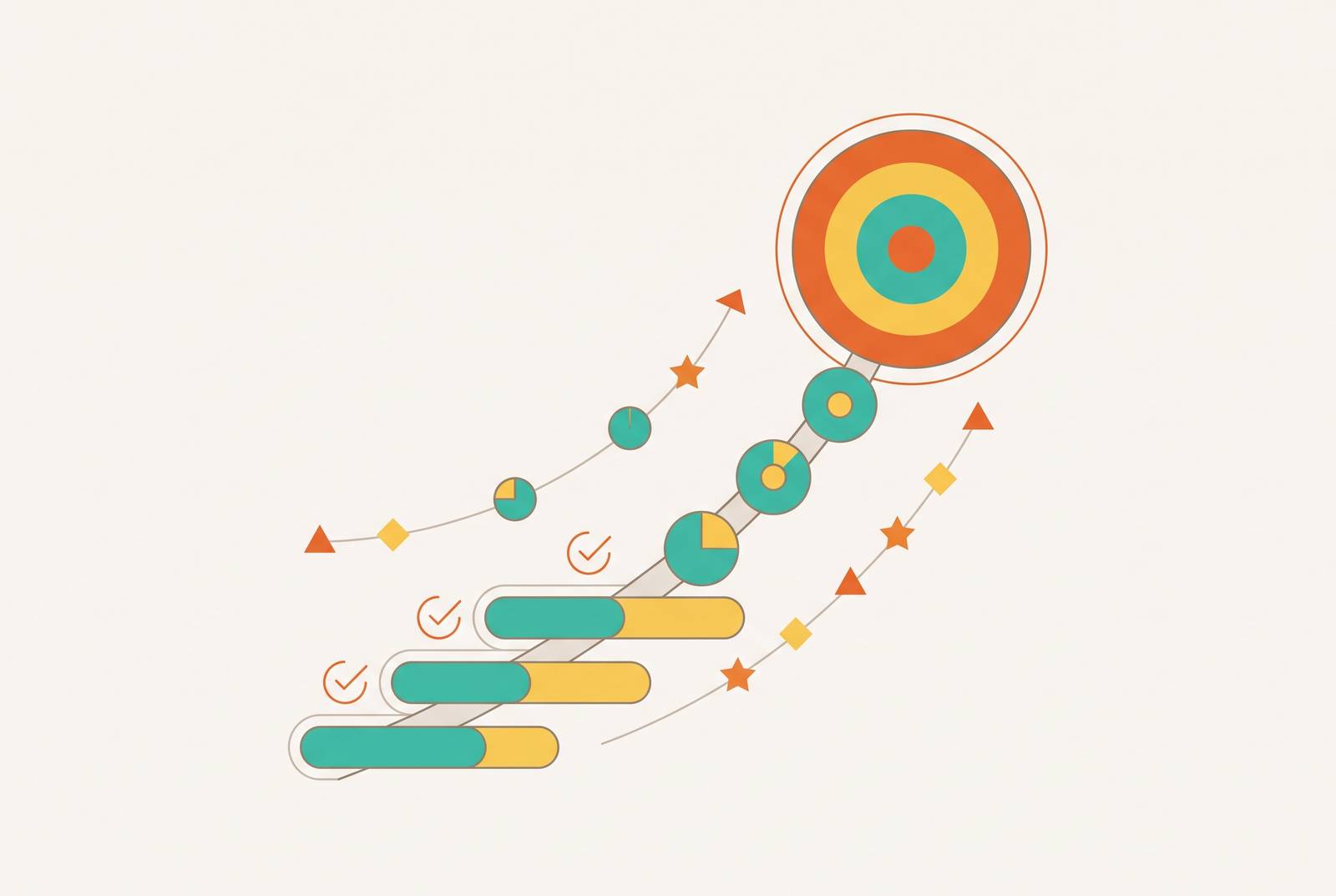
Visibility also changes what happens after effort. When a completed task disappears from a list, the remaining view can show only unfinished work. An accumulating XP bar, streak counter, or filled progress ring preserves a concrete signal of accomplishment. The difference is not merely decorative. It gives the reward system something immediate to respond to, rather than asking it to stay engaged with an abstract future outcome.
Time needs a visible representation for a related reason. When the future divides into “now” and “not now”, a deadline can remain remote until it becomes urgent. Countdown timers, micro-deadlines, and short-interval checkpoints bring the passage of time into view. This is temporal anchoring. The display makes duration available to attention instead of assuming that elapsed time will be tracked internally.
The Capture-Cycle System places each goal on a physical index card and uses regular reviews to keep it available, letting the environment do the remembering. Accumulated progress also supports emotional recovery because a missed day need not erase the record of earlier effort. The system still offers somewhere to return.
These mechanisms can reinforce one another in gamified systems. Mindflow pairs conversation with XP and guided milestone tracking, making it easy to get started and see rewards along the way. That does not make a reward counter equivalent to finishing a goal. The useful connection is between returning to the system, finding the next manageable step, and seeing progress.
The design principles that separate ADHD-effective visual trackers from ones that get abandoned
For someone evaluating a tracker, the first question is whether it can be used on a hard day. If capture takes well-ordered thoughts, several forms, or a lot of setup, getting started already calls for the ability the tool is meant to help with. Low friction comes before feature breadth. The same test applies to maintenance, because a system that needs constant tending can become another unfinished project.
Does finishing a task bring feedback right away through an animation, sound, or counter that can be seen? A reward deferred until the end of a long project leaves the repetitive middle unsupported. Accumulation is a separate criterion. The tracker should also retain a visible record of completed work, rather than show only a shrinking or replenished backlog.
A 48-hour review cycle brings goals back to mind more often than a weekly review alone. Forgiveness architecture preserves standing in the system after a missed session and provides a route back after a broken streak.
Task decomposition is another test of practical usefulness. Does the system turn a broad goal into the next physical action to take? “Clean kitchen” can leave too many decisions unresolved, while clearing counters, loading the dishwasher, and wiping the table provide a sequence. A tracker can support this automatically or through its design. Either way, the next action should not require rebuilding the project plan.
Timers and countdowns help when elapsed time slips from awareness, while a visible schedule helps place tasks within the day. More visual detail is not automatically better. The display should reduce the work of remembering, deciding, and monitoring without merely relocating that work into a complicated interface.
Which visual goal tracking apps use rewards, timers, and other ADHD supports?
For time blindness and routine sequencing, Brili and Routinery make the next step explicit. Brili walks users through routines with timers and audio cues and was designed with ADHD and neurodivergent families in mind. Routinery uses countdown timers, push notifications, and optional voice alerts that announce transitions. Their strongest fit is routine execution.
For gamified progress, Habitica turns habits into RPG quests. Completing tasks levels up an avatar, earns gold, and unlocks gear, while its community adds accountability. It is free with optional in-app purchases.
Streaks and Forest use different incentives. Streaks is an iOS habit tracker that integrates with Apple Health and Siri, with a streak counter providing rewarding visual feedback. Forest, available in free and premium versions, grows a virtual tree during focus time, but the tree dies if the user leaves the app. Its social version lets people grow forests with others. Both warrant the forgiveness test, because a chain or living tree can encourage persistence but may be a poor fit when interruption prompts abandonment.
AI-native tools can help put information in order or help someone get started on a task. Saner.AI offers AI management of tasks, notes, and calendar for ADHD knowledge workers, with a free plan available. Mindflow is a voice-first AI companion built specifically for ADHD, using natural conversation. Its guided milestones and structured habit scaffolding help with goals that feel too big to tackle, and conversations earn XP. The reward is tied to engagement with the companion, so milestone progress remains an important separate signal of actual goal advancement.
For fast capture and task decomposition, Todoist offers projects, priorities, subtasks, recurring tasks, and a focused “Today” view. It has free and premium versions. Its Ramble feature, launched in January 2026 and powered by Gemini 2.5 Flash Live, turns unstructured speech into organized tasks with due dates, priorities, and assignees. This addresses the friction of organizing thoughts before recording them.
For visual scheduling, Morgen brings tasks, calendars, and events into a time-blocked view. Its Frame system provides recurring time-block templates, and its AI Planner suggests schedules based on Frames and available capacity, subject to user approval. Color-coding helps people make sense of the calendar before they read each entry. The desktop version is needed to create Frames, while the mobile apps show schedules, ring notifications, and let people add events and tasks.
Focusmate offers body doubling through live virtual coworking sessions for people who find it easier to start when someone else is there. Its role is external accountability and structure, which may address a gap that neither a progress bar nor a calendar resolves.
How to build a visual tracking system that survives contact with a real ADHD week
Choose one component as a small anchor, such as a visible checklist, a morning routine in Brili or Routinery, or a daily Todoist review. Give that anchor two to three weeks before adding another tool. Setup itself should not become the project. A broader system can develop only when the first component feels natural.
Next, attach the anchor to a specific situation through an if-then plan. For example, if it is 8 AM on a weekday, then the task view opens before anything else is checked. This turns a general intention into a defined response to a cue. Implementation intentions are associated with higher goal attainment for people with self-regulation difficulties. The cue gives remembering a place in the day.
Once capture has a place, establish a short review loop. A 48-hour cycle can keep goals from disappearing between weekly reviews, and physical index cards can back up a digital system. The review should expose the current step and the accumulated record of effort. Both need to remain easy to find.
Before something interrupts the routine, decide how to get back to it. Choose tools and personal rules that treat a missed day as information rather than a verdict, especially when using streak mechanics. If capture is the sticking point, voice entry offers another route through Todoist’s Ramble or Mindflow’s conversational interface. This removes the need to translate a thought into organized typed text before recording it.
Finally, add visual meaning where it reduces reading and decision-making. Color-coding a calendar or task board can provide ambient awareness, with Morgen offering one implementation. Further components should address an observed gap. Small wins can accumulate into lasting habit change when the system keeps the next action accessible and makes returning possible after an uneven week.