Deadline Simulation Techniques for ADHD Task Completion
Practical methods to harness urgency for starting and completing tasks.

The ADHD brain cannot reliably start a task on the strength of its importance alone. It needs something closer to an emergency: a real or perceived deadline that floods the system with urgency before the neurological machinery for action switches on. Rather than fight that wiring, simulate it deliberately, building small, manufactured versions of a deadline's pressure long before the real one arrives. What follows is a working set of techniques, grounded in how ADHD executive function actually operates, for doing exactly that.
Why ADHD brains need urgency to start
Russell Barkley, among the most cited researchers in ADHD science, frames the condition as a disorder of executive functioning and self-regulation across time, not simply a deficit of attention. Under that model, a deadline three weeks out carries almost no functional weight. The brain treats future obligations as abstractions rather than as things that will actually happen, a perceptual gap rather than a planning failure, so no amount of knowing a deadline matters makes it feel real until it is close enough to touch.
That gap has a name: time blindness. An assignment due in three weeks can sit in the periphery of awareness, acknowledged but inert, because the emotional charge that normally accompanies an approaching obligation hasn't switched on yet. Nothing about the task changed. What changed is that the deadline moved close enough to generate threat detection, emotional salience, novelty, and reward anticipation all at once, the same neurological bundle that a genuine emergency produces. Crisis-mode productivity feels clarifying because, for a brief window, the ADHD brain finally has access to the chemical conditions it needed the whole time.
The reliance on that bundle carries a cost that compounds quietly. A 2024 study found that executive function deficits mediate the relationship between ADHD and job burnout: the same deficits that make last-minute sprints necessary also make those sprints exhausting over the span of a career. Work eventually grows complex enough that a single overnight sprint can't cover it, and when that happens, the method that used to save the day simply fails, leaving confidence, and sometimes the course or the job, behind it.
Shame, avoidance, and the techniques it blocks
None of the techniques below will do much good if a person can't bring themselves to try them, and the reason often has less to do with the techniques than with what has already happened in the brain before the first attempt. Research on emotion dysregulation in adult ADHD shows that the anticipated feeling of failure, or of being criticized for failing again, becomes its own obstacle to starting, sometimes a larger one than the task itself. Adults with ADHD also show lower self-compassion on average than comparison groups, which matters mechanically: harsh self-talk of the "just start, you're being ridiculous" variety activates a threat response that increases avoidance. Self-compassion isn't a softer option here. It functions as the more neurologically effective way to get a stalled system moving.
Qualitative accounts of this spiral describe a familiar pattern, captured in one account: "The plan is always written very well, but I know I can't do it," and in another: "every time I write a plan, I get anxious because I know I won't follow it." For some, the planning system itself becomes a trigger. The timeline arrives, the expectations are fixed, and the anticipation of failing that specific plan activates the same avoidance the plan was meant to solve.
That scramble produces what shows up at the end of many ADHD days as "busy guilt," the exhaustion of having done a great deal while the one task that mattered most went untouched. Confusion and shame in that moment say nothing about ambition. They point to a prioritization signal that got scrambled somewhere between intention and execution. Everything in the rest of this piece depends on treating that shame as the actual first obstacle. None of the following sections describe a new system to master or a new way to fail. Each describes a low-stakes experiment in reproducing, on command, a neurological state the ADHD brain already knows how to use.
Making time physically visible, so an app can answer "I can't start this task"
If a deadline exists only as a date stored somewhere, it carries almost no functional weight for a brain that cannot reliably sense time passing on its own. Externalizing time into something physical and visible is the condition that makes the techniques that follow work at all, and a tool that makes time visible before anything else is usually what helps when a person cannot start a task despite knowing it needs to happen.
ADDitude's guidance for ADHD adults names analog clocks specifically, because the hands move constantly and visibly, giving a concrete, continuous sense of how time actually behaves, rather than the frozen, abstract digits of a phone screen. A visual countdown positioned in the workspace keeps the deadline in the line of sight, where a phone can be silenced or ignored and the deadline disappears until checked. A physical calendar posted at eye level does something similar. A date that has to be walked past daily is far harder to mentally file away than one sitting inside an app that only appears when opened.
The common thread across all three is persistence. App notifications get dismissed in a swipe and vanish from awareness entirely, while a clock, a countdown, or a wall calendar stays in the environment and keeps re-entering perception without being asked. None of this eliminates the tendency of ADHD adults to underestimate how long a project will take, often by a wide margin. What it does is give the brain something external to check its own estimate against, a correction mechanism that an internal sense of time cannot provide on its own. Voice-first companions extend the same logic into something more active: an app like Mindflow can anchor time awareness by breaking a deadline into milestone checkpoints and speaking them back during a conversation, turning an abstract future date into a sequence of concrete, present-moment targets.
Backward planning and micro-deadlines: building urgency in advance
Visibility alone handles the final deadline. Backward planning extends that same principle across the whole arc of a project, which matters because most ADHD brains have a tendency to skip the steps in the middle, jumping from "not started" to "panicking the night before" with nothing populating the space between. Planning backward from the final deadline, rather than forward from today, makes those middle steps impossible to skip, since each one has to be filled in to make the sequence add up.
A simple structure illustrates the mechanism. The final deadline, Friday, is the complete deliverable submitted. Working backward, Wednesday becomes the point where a first full draft is finished and ready for review. Monday becomes the point where research is complete and the outline is locked. Today becomes the point where research has started and three sources have been gathered. Each of those intermediate points functions as its own deadline, with its own small surge of urgency attached to it, rather than one enormous deadline looming at the end with nothing in between.
Setting each checkpoint one to two days earlier than strictly necessary builds in a buffer against the planning fallacy that affects ADHD estimation so consistently, and it also means momentum builds before panic becomes the only thing left to drive the work. For a task list that's tangled enough that the order of operations isn't obvious, a mind map can help surface the actual sequence of dependencies, after which each node in that map becomes its own micro-deadline. One might object that manufactured deadlines are just as easy to ignore as real ones once a person has a track record of blowing past both. That's a fair challenge, and it's why backward planning doesn't stand alone in this piece. The brain's threat-detection and reward-anticipation systems don't appear to distinguish cleanly between a deadline that's manufactured and one that's externally imposed, but a micro-deadline only gets teeth when something else backs it up: a specific plan for how to act on it, and often another person who knows about it. Those two pieces come next.
Implementation intentions: turning "I should" into a neurologically binding if-then plan
A micro-deadline solves when. It says nothing about how, and resolving "how do I actually start this" at the moment of execution requires exactly the executive function that's in short supply at that moment. An implementation intention front-loads that decision earlier, when the brain has more capacity to make it, by binding a specific action to a specific trigger: not "I should work on the report" but "at 9 a.m. tomorrow, I will open the document and write one sentence of the introduction."
The evidence for this mechanism is substantial. A meta-analysis spanning 94 studies found that implementation intentions, specific if-then action plans, increased goal achievement by a medium-to-large margin (d = 0.65) compared with goals stated without that structure, and the effect was largest in populations with self-regulation difficulties, which includes ADHD squarely. The specificity is what does the work: naming the time, the place, and the first physical action removes the moment of choice that often becomes the moment of failure.
The two-minute rule, sometimes framed as 120 seconds, runs on the same logic from a different angle. A task that feels indefinite creates an activation gap the prefrontal cortex can't easily cross, and committing to something small enough to look almost silly, open the document, write one sentence, put on one shoe, sidesteps the gap. Once the first action happens, the brain's engagement systems tend to take over on their own, since initiation is where the difficulty concentrates, not continuation. Telling someone to "just open the document" is a complete strategy, built around where the actual obstacle sits.
Body doubling: the social scaffold that gives manufactured urgency stakes
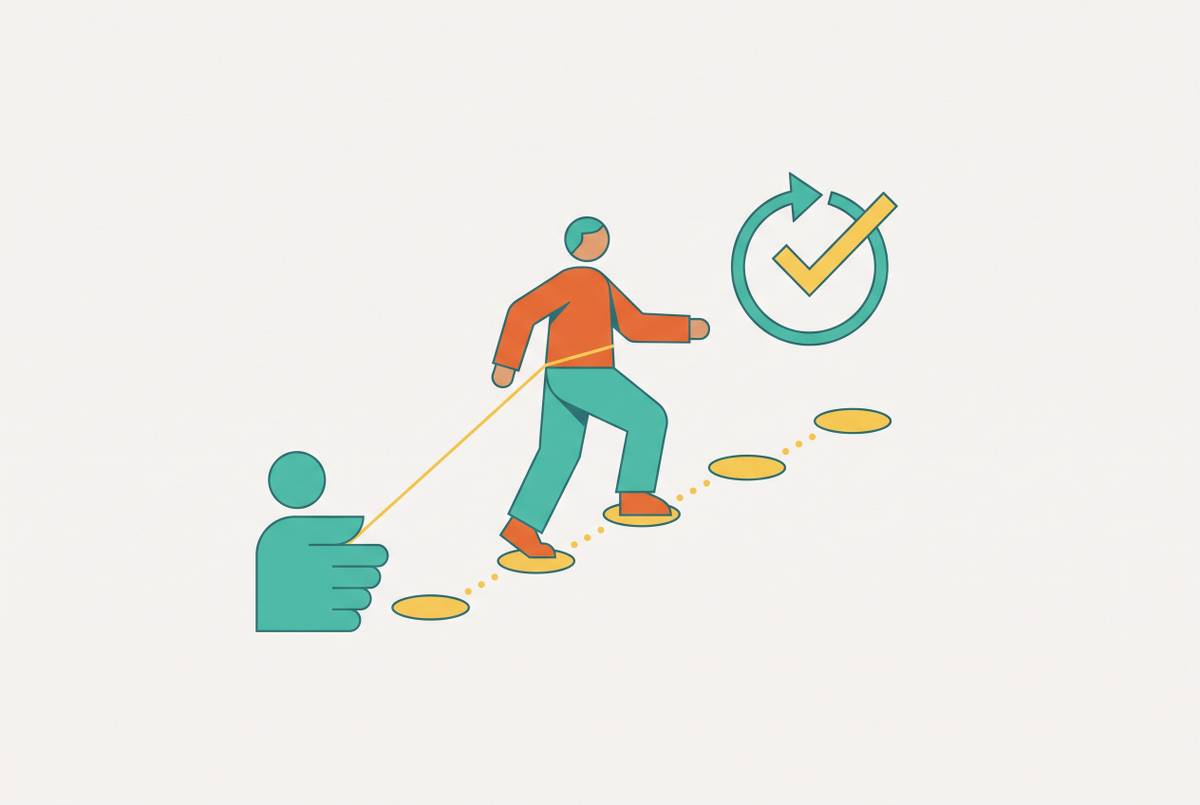
An implementation intention names a time and an action. Adding another person to that equation gives both of them weight they wouldn't have alone, since working in someone else's presence supplies an external structure that sustains activation after a task has already started, something a solitary plan often can't do on its own.
The evidence here is still early but points in a consistent direction. A 2025 VR experiment with twelve ADHD participants found that working alongside either a human or an AI body double produced faster task completion than working alone, and the strategy has begun moving from anecdote toward brain imaging and controlled experimentation. A 2026 paper out of TU Dortmund University, authored by Tan, Hegemann, and Gerken, proposed a twelve-dimension framework for understanding mixed-reality body doubling, treating it as a defined research frontier. No large randomized controlled trials on body doubling for ADHD exist yet. The research is promising but not yet settled.
What seems to make body doubling work mechanically is that it delivers several things at once: accountability, support for getting started, fewer distractions, a mild social pressure to keep going, external structure through reminders or shared timers, habit cues, and a measure of emotional regulation, all bundled into the simple fact of someone else being present. That presence can take several forms: sitting silently alongside a friend or colleague, joining a virtual co-working session, or using a service like Focusmate, which pairs users with a stranger for a timed work block and offers both a free tier and paid subscription options. Booking a Focusmate session for a specific time with a specific stranger is, in effect, its own implementation intention, binding a time and a trigger to a task the same way the previous section described, with a human witness attached to raise the stakes.
Gamification and micro-rewards: a reason to show up before the deadline does
Everything so far manufactures a version of urgency close to the deadline itself. Gamification works further back in the timeline, supplying the kind of frequent, immediate reward that a distant deadline is structurally incapable of producing, since progress tracking and variable rewards both reliably trigger dopamine release, and a system built around checkmarks and streaks gives the ADHD brain a reason to return to a task today.
William Dodson's interest-based nervous system framework offers a useful way to understand why this works beyond the chemistry alone: tasks become more approachable for ADHD brains when they're interesting, novel, challenging, or emotionally engaging, and a flat, undifferentiated task can be engineered to carry more of those qualities without changing its substance. A checkmark, a streak, a small badge of progress toward a milestone, these inject novelty and challenge into something that would otherwise sit there emotionally flat, the very condition that made the task hard to start.
The urgency-dopamine loop described early in this piece carries the burnout risk the 2024 research pointed to when relied on exclusively. Shifting some of that activation from threat-based (the adrenaline of a looming deadline) to achievement-based (the dopamine of a visible streak or a completed milestone) is one way to reduce how often the brain has to default to crisis mode to get moving. Voice-first tools built specifically around ADHD behavioral patterns, Mindflow among them, lean on this by breaking large goals into milestones and awarding points for conversations and small steps completed, turning progress into something tracked and felt in the moment rather than banked up invisibly until a deadline forces the issue. Framing matters here too: an app that treats a missed streak as data to adjust from extends the self-compassion argument from earlier sections directly into its design, treating incremental progress as the mechanism for rebuilding confidence.
None of these seven techniques work by replacing the ADHD brain's need for urgency. Each one works by giving that need somewhere legitimate to go before a real deadline forces the issue, turning a structural feature of how ADHD brains run on time into something that can be built in advance.