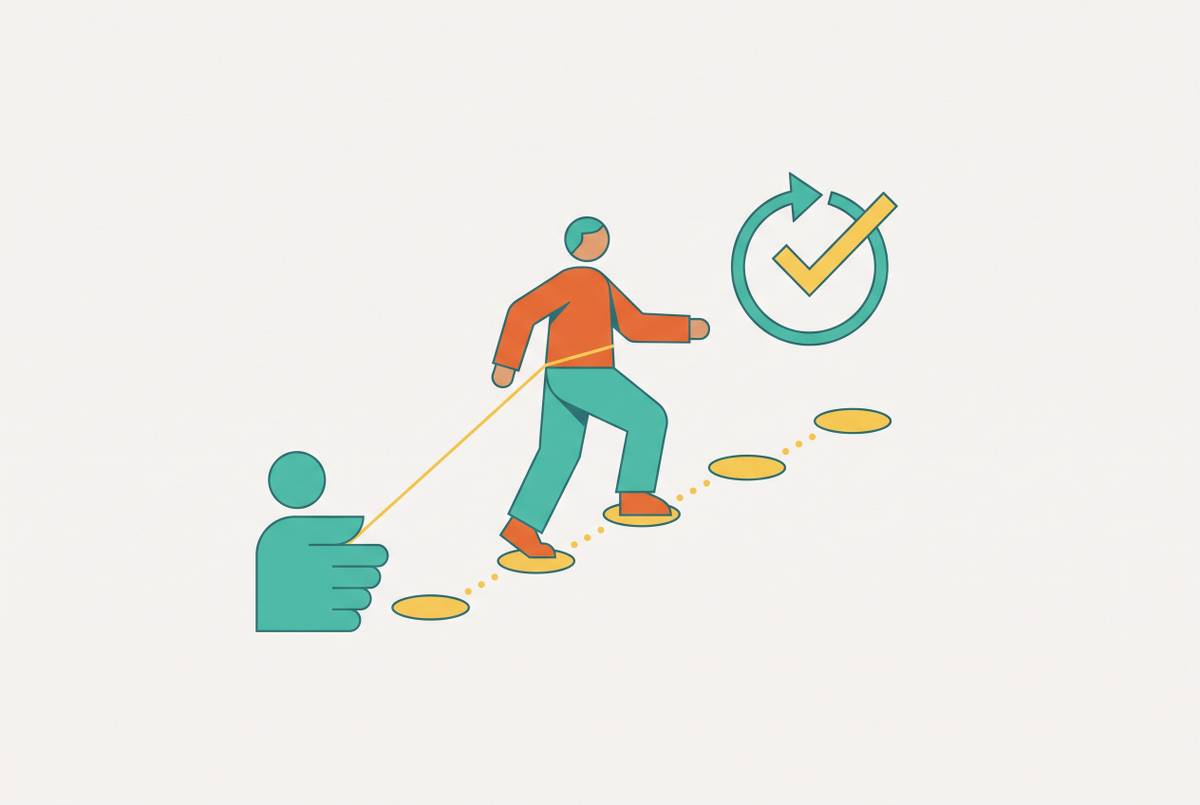
The Two-Minute Trigger Rule for ADHD Task Starts
How a neurological activation glitch, not laziness, blocks ADHD task starts.

Task initiation failure in ADHD is a neurological problem, and the two-minute trigger rule works because it directly targets the cost of starting. Wanting to do something and being able to begin it run through different systems in the brain, and when the second one stalls, no amount of desire fixes it. This piece explains why starting costs so much for ADHD brains, which version of the two-minute rule actually addresses that cost, and where the rule breaks down if applied carelessly.
Why Starting Feels Impossible
Sitting in front of a task that matters, fully aware of what needs to happen next, and still not moving: that experience is one of the most common complaints among adults with ADHD, and it has nothing to do with caring enough. CHADD's synthesis of executive function research places task initiation consistently among the top three most-affected executive functions in adults with ADHD, alongside working memory and self-monitoring. Russell Barkley's self-regulation model, which has anchored executive function research for decades, has held up across that span, and it treats initiation as a distinct capacity that can fail independent of desire, intelligence, or how much the task matters to the person facing it.
What exactly does it mean for a capacity to fail independent of desire? It means a person can want to write the email, know every word of what it should say, and still sit there for forty minutes doing nothing that resembles writing it. That gap between wanting and doing is a measurable, replicated feature of how the ADHD brain handles the specific act of beginning, separate from how it handles sustaining effort once underway or knowing that the task is worth doing, and it is not laziness dressed up in clinical language.
One might argue that if someone genuinely wants to do something, wanting should be enough to produce action. Decades of executive function research say otherwise, and that is precisely where most advice about procrastination goes wrong when applied to ADHD. Task initiation research treats the inability to start as a neurological activation problem, closer to an ignition failure than a decision not to drive. These are separate fields studying separate mechanisms, and the rest of this piece rests on keeping that distinction intact.
Brain Imaging and the Cost of Starting
The neurological account begins with dopamine. Reduced dopamine availability in the brain regions governing motivation and reward has been reported in ADHD adults, and researchers have connected that reduction not just to inattention but specifically to difficulty initiating tasks. The most cited work in this area comes from Volkow and colleagues, whose 2009 study in JAMA found significant reductions in dopamine-related markers in ADHD adults. That finding did not stand alone. It became one of the field's most referenced lines of evidence because it offered a biological mechanism for a pattern clinicians had already observed for years in behavior.
No single study proves the whole picture, and the honest version of this argument has to say so. The dopamine evidence is one of three converging lines of research, alongside structural brain studies and executive function frameworks like Barkley's. What makes the case compelling is convergence: three different methodologies, measuring different things, keep pointing toward the same region of the problem.
That region is the prefrontal cortex, which governs planning, initiation, and self-regulation, and it is where a dopamine deficit has its most practical consequences. A 2025 systematic review in Frontiers in Neuroscience, covering EEG and ERP research, found that core executive functions, including cognitive control, error detection, response inhibition, and sustained attention, are measurably affected in adults with ADHD. The review found consistent changes in brain electrical patterns during tasks that required response inhibition, pointing to impairments in error detection and cognitive control, along with reduced activity during sustained attention tasks that reflected difficulty allocating attentional resources.
The ADHD brain does not activate on demand the way a neurotypical brain often can. Since the brain activates reliably only under certain conditions, the task is to engineer those conditions, not to wait for willpower that was never going to show up.
Activation cost, not motivation: what the right framework predicts
Consider two tasks that feel wildly different in difficulty despite neither being objectively hard: replying to one short text message, and starting a tax return. A person can be more motivated to finish the tax return, aware of the deadline, aware of the consequences of missing it, and still find the text message easier to send. That is because the two tasks carry different activation costs, and activation cost has very little to do with motivation.
The FOCO executive function research synthesis states this directly: effective interventions target activation cost, not motivation. The practical directive that follows is to shrink the start, externalize the system, and borrow regulation from outside the self when internal self-regulation is not available in the moment. That is a different project than trying to feel more inspired, and it explains why inspirational framing so often fails people who already know why the task matters.
Confusing procrastination with task initiation failure is precisely why generic productivity advice keeps missing the mark for ADHD adults. Telling someone to "just start" treats the problem as a decision being deferred. For an ADHD brain facing high activation cost, there is no decision to make. The cost itself is proportional to how large and how ambiguous the brain perceives the task to be. "Put one dish in the dishwasher" asks for almost nothing by comparison, because the ambiguity has been removed.
That gives the whole framework a testable prediction: if activation cost is driven by size and ambiguity, then reducing either one should lower the barrier to starting, regardless of how motivated the person feels. Reducing the perceived scope of a task is therefore a direct neurological intervention. Understanding that task initiation is a neural activation problem rather than a motivation gap opens the door to interventions built around how ADHD brains actually work, including apps that remove interface friction. Voice-first tools like Mindflow apply this logic by letting a person talk through a task rather than type it into a form, which removes the overhead of navigating a structured interface and lets the brain's limited activation budget go toward the task itself.
The Two-Minute Trigger Rule and the Version That Matters for ADHD
The name "two-minute rule" actually refers to two different interventions, and treating them as interchangeable produces bad results. The original version comes from David Allen's Getting Things Done: if a task takes less than two minutes, do it immediately instead of adding it to a list or a system. That rule exists to clear small obligations before they accumulate into clutter. It is an organizational tool, built to manage queues, and it was never designed to solve the problem of not being able to begin something.
The second version is the one that matters here. It asks a person to commit to doing any task, regardless of its total size, for just two minutes. Version 1 requires the ADHD brain to estimate how long a task will take, which happens to be a well-documented weak point, and getting that estimate wrong creates interruption costs when a "two-minute" task turns out not to be one. Nobody has to guess how long the real task will take, because the trigger only ever asks for two minutes of it.
The two minutes function as a trigger, not as the work itself. Two minutes of anything is a stake low enough that the brain does not mount a defense against it the way it does against an open-ended, ambiguous commitment. Setting a timer for the two minutes and giving full permission to stop when it rings is not a minor procedural detail. Removing the obligation to continue makes starting feel safe. Once that barrier clears and the task has actually begun, continuation tends to be far easier to sustain than initiation was, because momentum operates on a different system than the one that governs the first move.
Specificity makes the whole mechanism work. "Open the document and write the first sentence," or "create a three-item bullet outline," gives the brain a concrete target it can move toward without any additional deliberation standing in the way.
The emotional barrier beneath the neurological one
Task initiation difficulty in ADHD is not purely a cognitive event measured in dopamine markers and prefrontal activation. Repeated failure to start things, over years, tends to build an emotional barrier that makes even attempting to start feel like a risk. Perceived failure, remembered or not, is enough material to build it from.
This is where the two-minute trigger does something beyond lowering a cognitive barrier. Committing to a bounded, two-minute effort feels negligible enough that the brain's emotional resistance often does not fully engage. From a cognitive behavioral standpoint, each successful micro-start adds to a growing body of evidence that starting is survivable, and that evidence accumulates the same way the wall did, just in the other direction.
Making the Trigger Reliable: Specificity, Habit-Stacking, and the Morning Test Case
A two-minute trigger invented fresh each day, from memory, in the moment, will fail more often than it succeeds. Reliability depends on anchoring the trigger to something that already happens and specifying it before the moment of need arrives, not during it. Habit-stacking, attaching the micro-commitment to an already-established behavior, removes the working memory load of having to remember when and how to apply the trigger. "Do email sometime in the morning" is a wish with no mechanism attached to it.
Pre-specifying the exact two-minute action the night before, something as concrete as "open the document and write the first sentence," eliminates the in-the-moment decision cost that would otherwise creep back in and undo the reduction the trigger was built to create. That raises an important question: where does this principle get tested hardest? The ADHD brain does not reliably do any of those three things.
A trigger-based morning sequence looks different from a conventional one. Each checked step is a micro-win, and a morning routine redesigned around these principles becomes a daily rehearsal of the same activation-cost logic that makes the two-minute trigger work everywhere else.
Where the Two-Minute Rule Breaks Down
The two-minute trigger has a documented failure mode worth taking seriously, and no version of this rule works unconditionally.
ADDitude, the leading ADHD-specific media platform, published a direct critique of the rule from ADHD coach Linda Walker. Walker's critique adds a second concern, specific to the rule's original framing: it can push ADHD brains to prioritize whatever task just appeared, rather than the task already identified as the actual priority, which is a particular hazard when the rule gets applied reactively instead of as part of a plan.
Both concerns are legitimate, and neither one argues for throwing the rule out. Version 2, the ADHD-specific adaptation described earlier, sidesteps most of Walker's critique by design, because it was never about doing whatever small task shows up. It commits two minutes to the task already chosen in advance. The trigger gets applied to planned work rather than to incoming demands competing for attention. That one distinction, planned versus reactive, resolves most of what makes the rule risky.
The remaining risk is time blindness, and the fix for it is mechanical rather than psychological: use a physical timer, not a mental clock. A timer externalizes that tracking function entirely and prevents the rule from quietly turning into a twenty-minute detour nobody intended.
External scaffolding that amplifies the trigger: tools built for low activation cost
If activation cost rises with the size and ambiguity of a task, the most direct way to intervene is to shrink the task's perceived scope before the person ever has to confront it whole. Breaking a large goal into small, concrete milestones is the core move, and it is one that gamified, ADHD-informed task-coaching tools have begun building directly into their structure. Mindflow's milestone tracking and XP-based progress system automate that breakdown so the person does not have to perform it manually every time, and the gamification layer sustains engagement by working with the same dopamine-driven attention patterns that make sustained, willpower-based effort so unreliable for ADHD brains.
A reader asking what app helps when a task simply will not start is really asking which tools lower activation cost. That is a meaningful distinction for comparing options. Checklist and task-breakdown tools, including simple "break the task down" frameworks that turn "work on paper" into "go to computer," "open document," "re-read last two paragraphs," address the ambiguity side of activation cost directly, and they work well for people who can reliably initiate the act of opening the checklist itself.
Voice-first, ADHD-specific tools occupy a different point in that same landscape. Mindflow's design, built around talking through a task rather than typing it into a form, removes an entire category of friction that conventional productivity apps tend to add: the interface itself. For someone facing task freeze, the choice among these options comes down to which kind of activation cost is highest in a given moment: if the barrier is not knowing what the first step is, a breakdown tool solves it; if the barrier is losing track of time once started, a physical or app-based timer solves it; if the barrier is the friction of engaging with any interface at all, a voice-first, gamified system built specifically around ADHD behavioral patterns, Mindflow among them, addresses the activation cost at its most basic level, before the task itself even enters the picture.