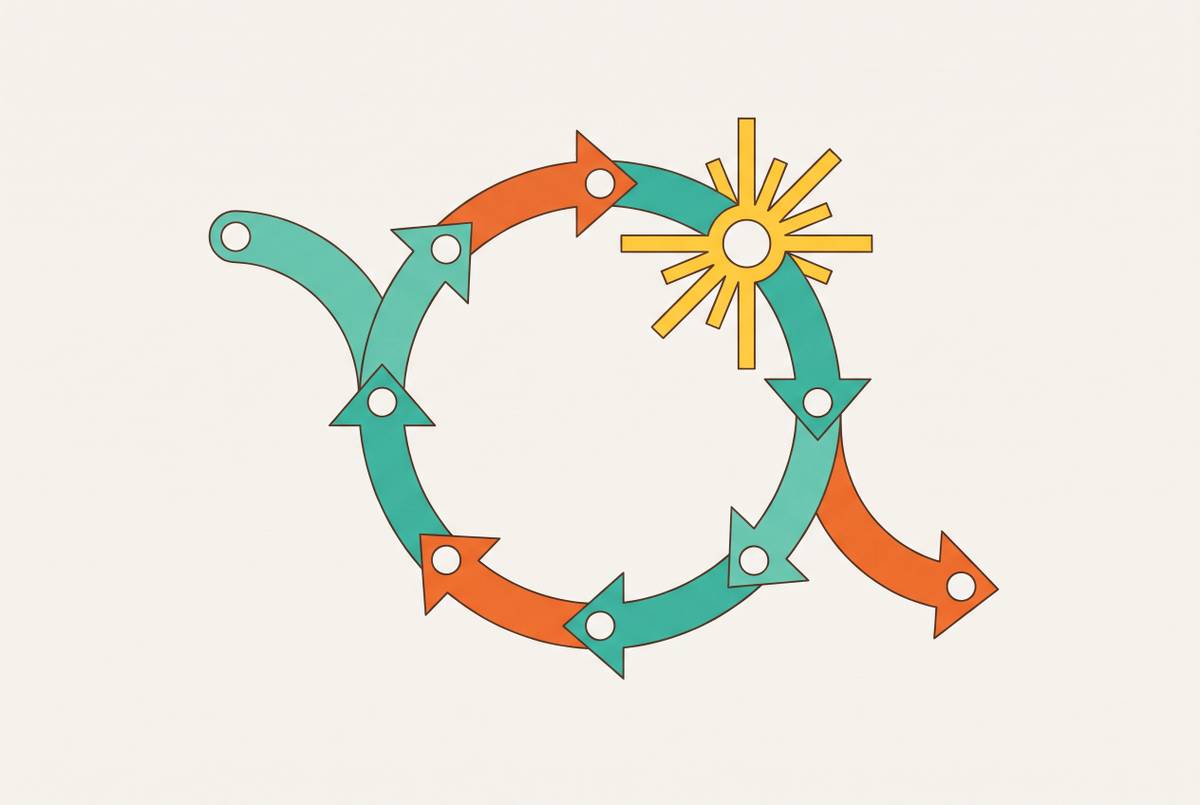
Cue Design for Variable ADHD Attention
Effective ADHD tools use interest, novelty, urgency, or challenge instead of importance reminders.
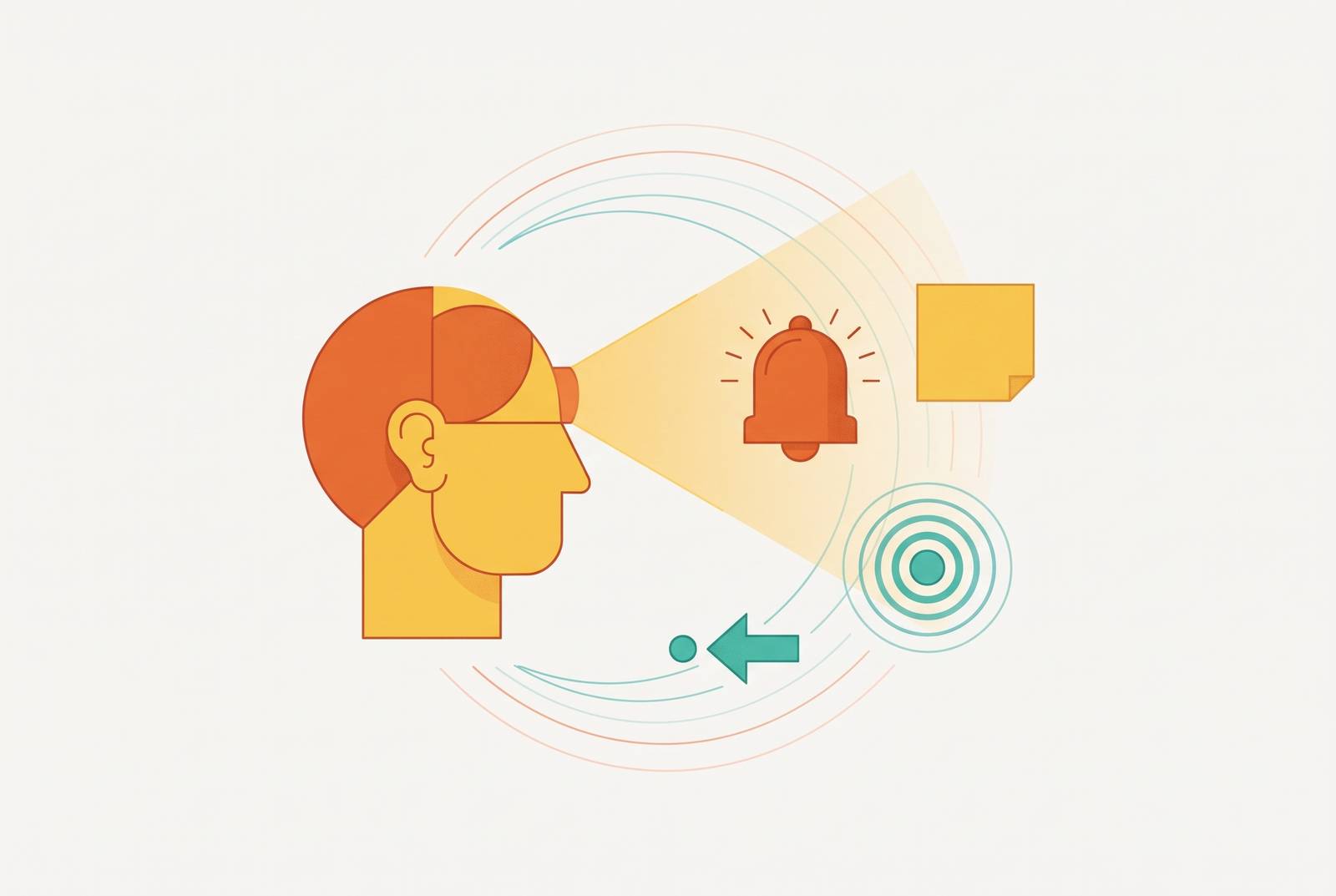
ADHD habit-building tools work best when they account for shifts in attention instead of relying on reminders of how important a task is. “Cue Design for Variable ADHD Attention” argues for triggers built around interest, novelty, urgency, or challenge, paired with fast capture, short habit chains, and feedback without shame. Assess which app removes the specific barrier between noticing a task and acting on it.
Why ADHD attention is variable, not simply reduced
An importance-based reminder assumes that knowing a task is important will help activate the attention needed to do it. ADHD makes that connection less reliable. The term “interest-based nervous system” describes this distinction, with attention responding more readily to interest, novelty, urgency, and challenge than to an abstract priority label.
Dopamine signaling helps explain this variable activation profile. Reduced signaling in the prefrontal cortex can impair prioritization, inhibitory control, and task-switching, weakening the executive processes that translate importance into action. Amiri et al. (2026) describe an integrative model in which differences in fronto-striatal and fronto-limbic circuitry cascade through metacognition and emotional regulation. Their account extends beyond a narrow problem of concentration. It places cognitive and emotional regulation within the same design problem.
Attention also has to contend with internal competition. The default mode network and task-positive network do not reliably show their usual opposing activity in ADHD, allowing internally generated thoughts to compete with externally directed attention. What does that mean for a reminder? Being present on a screen is not enough to make it register.
Why executive dysfunction makes standard reminder logic fail
A “high priority” flag asks the user to perform the very translation that may be unreliable, turning abstract importance into immediate action. Making the flag more emphatic does not change that requirement. A conventional reminder can therefore communicate perfectly and still fail to activate. That is a mismatch between signal and response.
Other familiar designs compound the same mismatch. A static alert loses signal value through repetition, while a to-do list showing everything at once requires the user to rank undifferentiated options before starting. Each creates another demand on executive control. Siqueira et al. (2025) found that executive function impairments, particularly inhibition in incongruent situations, correlate with ADHD symptom severity and reduced quality of life, especially in social relationships.
A reminder should surface one action, give it a felt quality of novelty or urgency, and reduce the decision cost of beginning. More reminders do not necessarily achieve that shift. A narrower, more actionable signal can do work that another priority label cannot.
The four activation levers ADHD attention actually responds to
Interest connects a task to something already compelling, such as a personal goal or curiosity. Instead of declaring that an action deserves attention, the cue gives attention a reason to engage now. Novelty works through a different route. A change in wording, location, form, or sensory character helps a signal stand out after repetition has made it familiar. Both levers change how the task is encountered, without requiring its underlying importance to change.
Urgency makes a boundary feel immediate through a countdown, a declared deadline, or the start of a body-doubling session. Challenge frames the action as a puzzle, game, or personal test. These conditions are design levers that can help activate attention where a distant obligation does not. Amiri and colleagues’ broader account also supports taking emotional and metacognitive regulation into account alongside task initiation, which involves more than a cognitive switch.
The practical audit is therefore straightforward. Which lever is this trigger trying to pull? If the answer is none, the cue needs redesign. Using all four at once is not the goal, because an overloaded trigger sacrifices clarity. The purpose is to give a specific action an accessible route into attention.
Novelty engineering: keeping cues from going invisible
A cue that stays the same can still be in view even when it no longer catches attention. Through habituation, a cue can fade into the background when someone sees it again and again and nothing new happens. After a reminder is placed, its ability to register needs renewal.
Rotation can make the cue stand out again while keeping the task the same. A physical reminder can move to a different location weekly, or change color or medium on a schedule. A digital notification can change its wording. An object in an unexpected place can similarly encode a trigger outside memory, using the anomaly itself to attract attention.
A tactile object placed where a hand will land, a distinct non-repeating tone, or an item interrupting the usual path presents a different signal from another notification. Yet stronger stimulation is not automatically better. Sensory sensitivity, avoidance, low registration, and seeking can all shape whether a cue helps or gets in the way. A practical design rule is to build in deliberate weekly changes to form, location, or sensory character, without making the user remember to maintain the rotation.
Urgency by design: time containers and social accountability
A deadline three days away can remain abstract even when its consequences are understood. A visible 25-minute timer shows how much time there is to work. The boundary is close enough to register now. This is the purpose of a time container, creating usable urgency before the real deadline becomes immediate.
Focusmate offers booked, camera-on co-working sessions with a goal declaration at the start. Its relevance here is external accountability. A named start time and another person’s presence make the commitment more immediate than a private intention to work later. Body doubling uses the social stakes of showing up and declaring a task to support initiation.
Morning initiation exposes the limits of relying on self-generated pressure. The morning dopamine trough describes the period just after waking, when the things that need doing that day may not yet feel urgent. Night-before preparation addresses this vulnerable period by moving morning decisions into the evening. The immediate benefit is less choosing at the point of action. Effective urgency containers follow the same design logic by remaining specific, short, and externally anchored, rather than requiring the user to manufacture pressure on demand.
Immediate feedback and gamification as a dopamine substitution strategy
Urgency can help someone start a task, but starting does not ensure they will keep at it. Immediate feedback addresses that next problem by making progress visible before the distant goal is reached. The reward arrives closer to the effort. A visible XP counter, streak, or completed milestone shows how far someone has come in a way that a vague long-term goal cannot.
“Dopamine substitution” is best understood here as a design rationale. The relevant premise is that differences in dopamine signaling affect reward and engagement. Feedback mechanics attempt to bridge that gap with an immediate, legible reward. Feedback can reward as little as one completed step. If feedback waits until a whole project is finished, the reward may come days after the person needed help to stay with the task.
Task decomposition breaks work into those smaller steps and makes it clearer what to do next. Goblin Tools’ Magic ToDo is free, web-based, and requires no account, and it turns large or vague tasks into detailed step-by-step checklists. The suite’s separate Estimator tool guesses a task’s time commitment. Compared with a social accountability tool’s support for showing up, their role is to make the work itself less ambiguous.
A reward attached only to complete success may leave the hardest stretch unsupported. Feedback on a simple, specific sub-step brings the reward closer. Challenge and interest then support continued action, rather than remaining promises attached to an eventual outcome.
Low-friction capture: removing the barrier between attention and record
Even a well-designed cue can fail after it has attracted attention. If saving what the person plans to do takes typing, sorting, and choosing among fields, they may lose the thought before they can save it. Capture is a separate bottleneck from activation. The design target is roughly three seconds and one decision, understood as a practical constraint. The essential requirement is a shorter path.
Voice input can shorten that path by removing the need to type and structure a thought simultaneously. Todoist’s Ramble feature converts spoken thoughts into structured tasks with dates and priorities. Its role differs from both co-working and task decomposition. It reduces the distance between a spoken intention and a usable task record.
For someone choosing an ADHD habit-building app, these distinctions are more useful than a general “best” label. Capture friction, planning ambiguity, and initiation are different needs, even when they occur together. Other useful criteria include limited choices, proactive notifications, visible partial progress, and low setup friction that survives lapses. A tool should be easy to start using without a long stretch of executive effort. Otherwise, the same difficulty the tool was meant to ease can keep someone from reaching the features that would help most.
Habit stacking with ADHD: why the chain must be short
Habit stacking turns one action into the cue for another, but a long chain creates dependencies that variable attention may not sustain. One missed link can derail what follows. For ADHD, the recommended starting point is one new behavior attached to an existing anchor. A chain of two asks less of a difficult executive-function day than an extended sequence does.
Shortening the chain does not eliminate the need for cue design within it. An anchor that has become flat and predictable may not reliably activate the next behavior. Each link still needs an accessible signal. Deliberate variation can come from rotating the anchor, changing the sensory environment periodically, or introducing a small novel element. Routine need not mean an identical sensory experience every time.
Morning routines need particular care because they meet the low-activation period discussed earlier. Making decisions the night before leaves less to plan in the morning, and dealing with harsh overhead light, cold floors, or uncomfortable clothing can make it easier to take the first step. A routine can be short and still be difficult to enter if its environment is aversive. Cue design must therefore account for the setting as well as the sequence.
The chain also needs to tolerate interruption. Missing a day does not reset habit formation, and the process can take longer with ADHD. A broken streak should not be treated as a return to zero. That distinction becomes crucial when a tracking system decides how to greet someone after a lapse.
Why cue design that ignores shame makes the whole system fail
A technically sound cue cannot help if the user avoids the system that delivers it. Internalized shame can produce exactly that withdrawal. Repeated failure, reprimands, and negative feedback can accumulate into an expectation that another unfinished task will confirm personal inadequacy. The tool may become a reminder of judgment.
This changes what counts as a design failure. A missed-streak warning or language that frames incompletion as failure can reinforce the belief that the person is “not trying hard enough.” Long lists can add overwhelm and guilt. The lesson for designers is to remove shame mechanics, recognize partial progress, and make returning after a lapse straightforward. Emotional accessibility belongs beside capture speed and cue visibility as a requirement.
Positive feedback for partial progress supplies evidence of movement at the scale where engagement needs support, without turning unfinished work into a verdict. The same feedback can sustain attention and make a system less threatening to reopen. That dual role explains why shame-awareness cannot be added as a friendly tone after the underlying mechanics are fixed. It has to shape those mechanics.
The final test is where a tool locates the problem when attention varies. A system built around consistent, importance-driven responsiveness may fail someone whose attention activates under different conditions. That failure does not show that the ADHD brain is broken or that the user is inadequate. It shows that the tool was designed for a different brain.