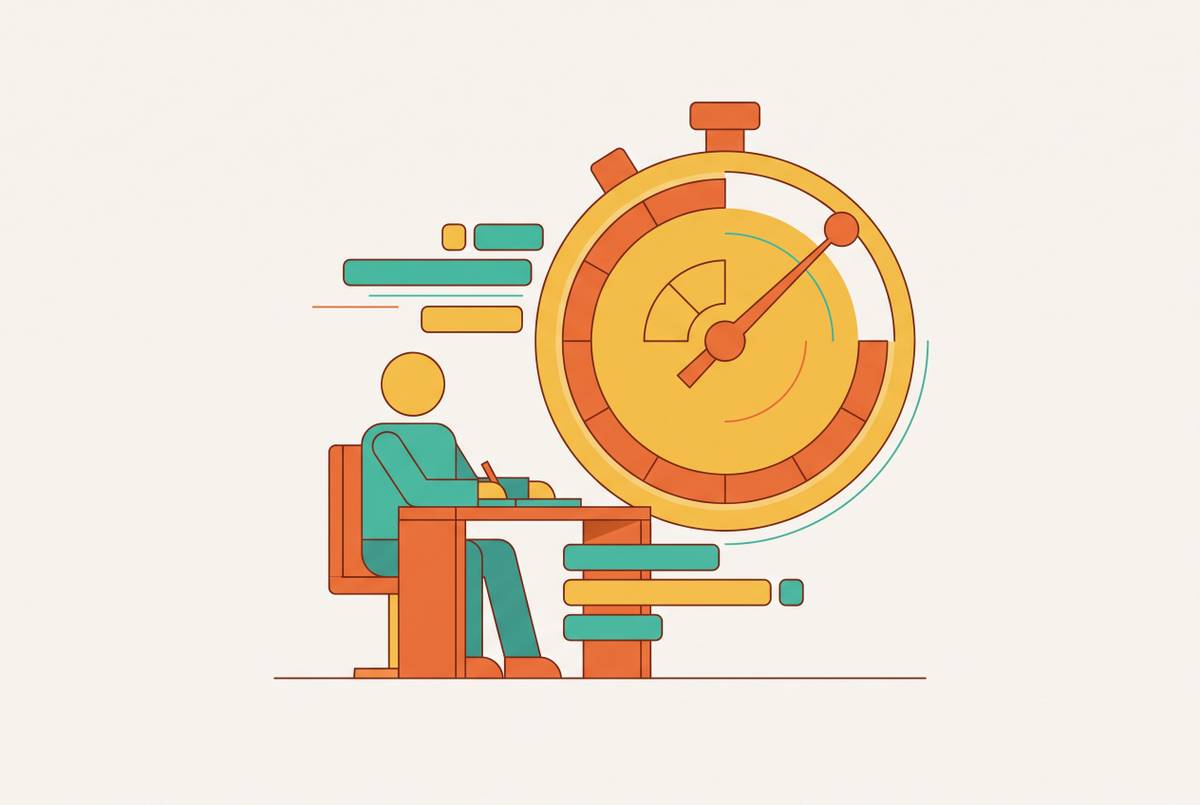
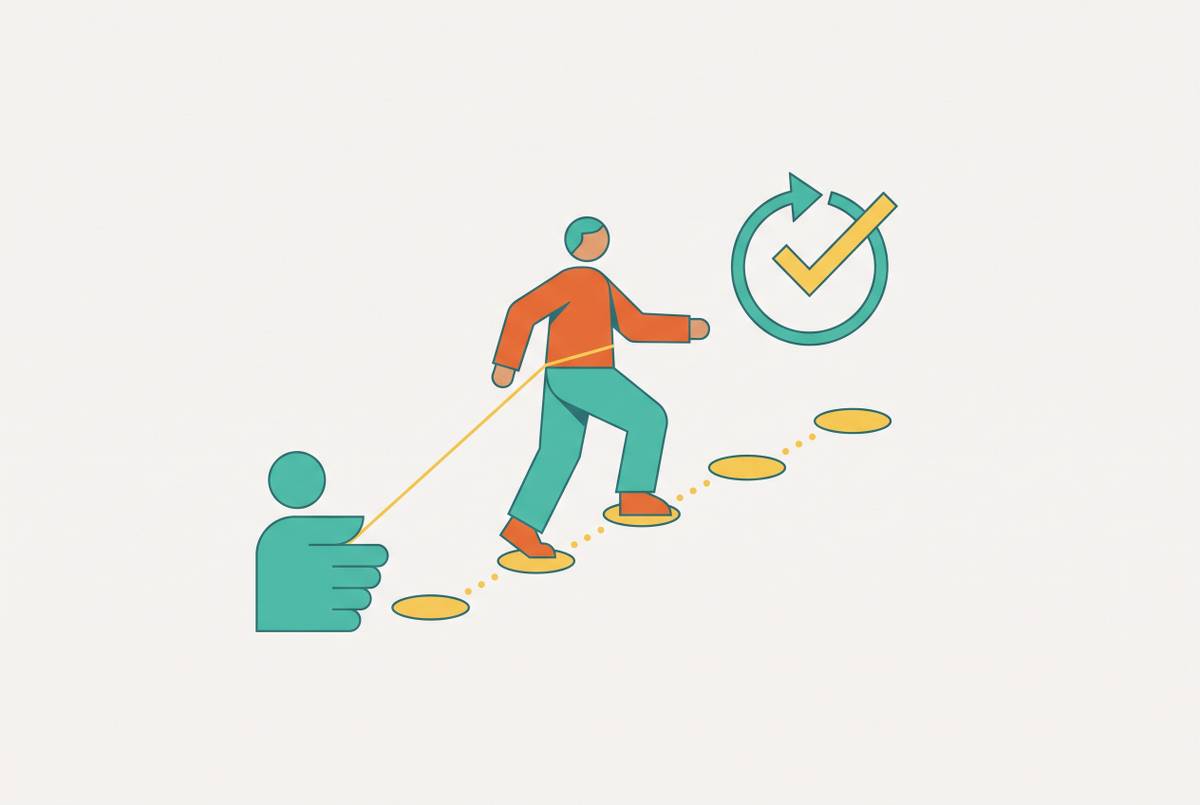
Transition Difficulty Between Tasks in ADHD Work Sessions
The ADHD brain's dopamine system makes task switches cost more effort than willpower can fix.
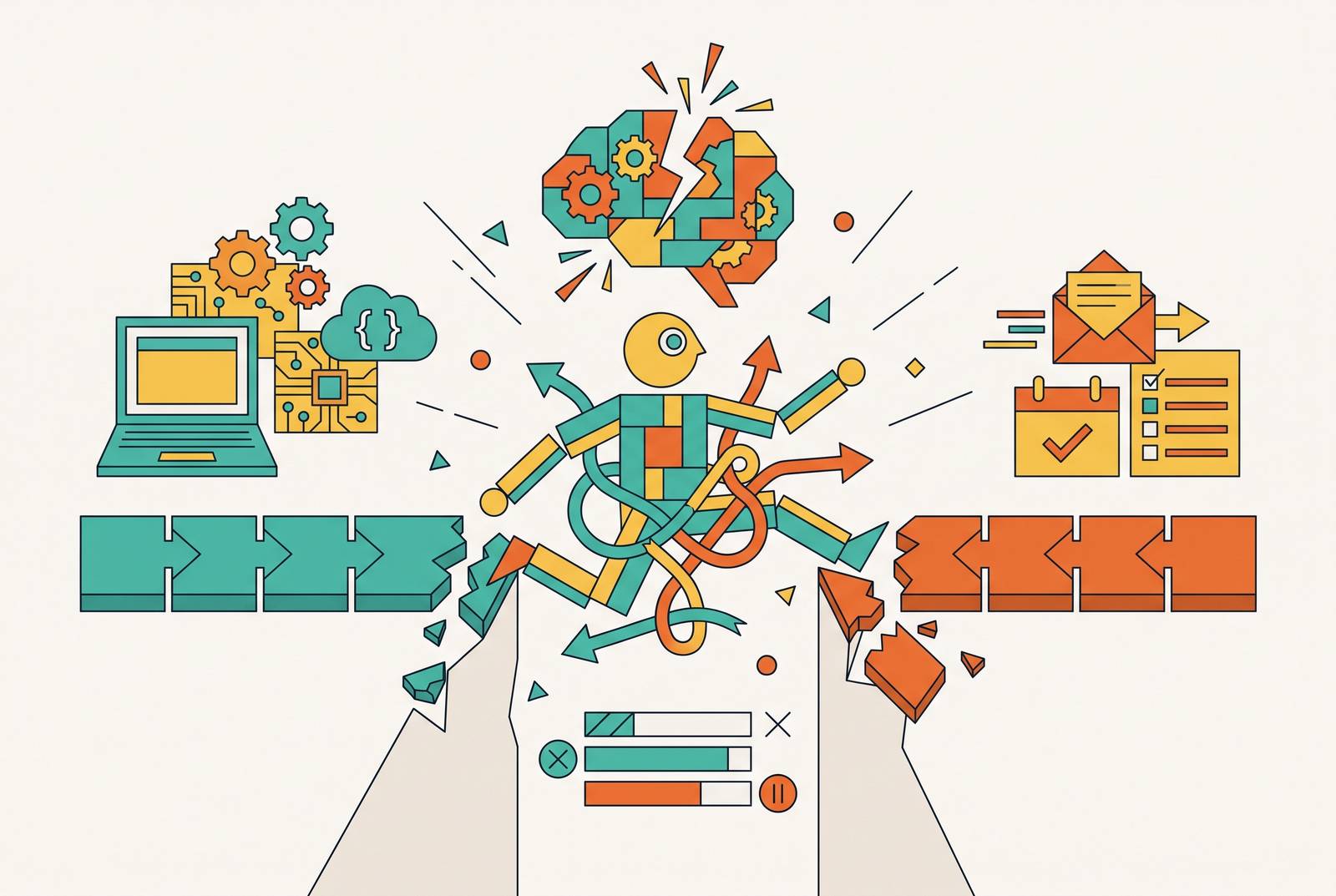
Task transition difficulty in ADHD is a predictable outcome of how the ADHD brain handles switch costs, cognitive flexibility, and a dopamine system that calculates effort differently than a neurotypical brain does, and once the mechanism is visible, the right strategies stop looking like willpower hacks and start looking like engineering.
Why task transitions feel so costly for ADHD brains, the neurological foundation
A notification arrives mid-thought, and the thread it interrupted does not pick back up cleanly. The sentence that was forming a second ago is gone, and what's left in its place is a kind of static, a few seconds of not knowing what came before or what to do next. That gap is the entry point into a real neurological event, not a lapse in focus.
Every task switch requires four things from the brain in sequence: inhibiting the task currently running, redirecting attentional resources, initiating the new task, and sustaining enough focus to keep it going. ADHD involves well-documented differences in how that range is maintained. The same four-stage sequence that a neurotypical brain executes with relatively little friction can stall out at any point for an ADHD brain.
It helps to separate context switching from multitasking, because the two get conflated constantly in casual conversation. By the tenth transition of a workday, the cost of transition eleven is not the same as the cost of transition one.
There's also a working memory dimension that compounds the problem. Losing a train of thought this way is closer to losing a page in a book with no bookmark: the book itself hasn't changed, but the way back in is gone.
Why dopamine makes starting a new task harder than it looks
Knowing what needs to happen and being able to start it are two separate operations, and the gap between them for an ADHD brain is a cost-benefit calculation running on faulty inputs. The brain has to authorize the effort of starting, and it needs a near-term, concrete payoff signal to do that. Most everyday tasks, replying to an email, starting a report, loading the dishwasher, don't generate one.
Neuroimaging work gives this a physical basis. Nora Volkow and colleagues used PET imaging to show altered dopamine reward pathways in adults with ADHD, and separate fMRI work by Plichta and Scheres found reduced ventral striatal activation during reward anticipation in ADHD. The anticipatory signal that's supposed to tell the brain "this is worth starting" is measurably quieter before the task even begins.
William Dodson's description of the ADHD brain as an "interest-based nervous system" captures the practical consequence. One might argue that this sounds like a minor inconvenience. It isn't, because rebuilding activation from zero is exactly the step that most to-do lists and calendar reminders assume doesn't need to happen.
This also explains the paradox that confuses people living with ADHD as much as it confuses the people around them: a brain that can't start a load of laundry can lock into hyperfocus on a side project for six hours straight. Whether a dopamine signal strong enough to clear the initiation barrier happens to be present determines the difference in effort capacity. A brain that struggles to start isn't lazy, it's running a calculation with the wrong inputs, and no amount of self-criticism changes the inputs.
The attention residue problem and the switch cost that neurotypical advice ignores
Deciding to switch tasks and actually switching are not the same event. Cognitive researcher Sophie Leroy named the gap between them "attention residue": activation from the prior task keeps running in the background, fragmenting engagement with whatever comes next. The new task gets a brain that's still partly occupied by the old one.
The scale of the recovery window is larger than most productivity advice accounts for. For ADHD brains, that recovery demand stacks on top of the executive function differences already described, so the real cost of a single interruption is longer than 25 minutes in practice.
There's also a real difference between a switch you choose and a switch someone else imposes on you. If you follow a new idea or a flash of interest, the switch works with the ADHD brain's interest-based activation system. A switch imposed by someone else, a phone call, a tap on the shoulder, requires overriding momentum that was already built, which is a fundamentally more demanding operation than starting from a neutral state. This is also why a single notification can feel so disproportionately disruptive: context isn't just the task, it includes the physical environment, the sensory state, the emotional tone of the moment, and the momentum of thought. A buzz on the phone doesn't interrupt a task. It interrupts all of that at once.
The hyperfocus-to-freeze paradox
This brain can sustain hyperfocus for hours, but it can also freeze solid when too many transitions stack up at once. That isn't a contradiction, and it isn't a character failure. Executive overload meets a dopamine signal that cannot clear the initiation threshold, the same mechanism described above, and which one you see just depends on whether that signal happens to be present.
ADHD task paralysis describes the inability to begin, continue, or finish a task because of overwhelm, executive dysfunction, or emotional load. In working adults, the same underlying deficits extend into workplace productivity, household management, and personal organization. Task paralysis rarely stays contained to one area of life.
What makes the freeze state harder to escape is the loop that forms around it. Executive dysfunction causes a failure to start or finish. The shame is an active mechanism keeping the paralysis in place, not just an unpleasant feeling riding alongside it.
Why the governing principle of effective strategies is externalization, not willpower training
If your internal regulation is structurally compromised at the points described above, you can't fix it just by trying harder or being more disciplined. Effective strategies work by moving the cognitive load, decision-making, time orientation, initiation prompts, out of the brain and into the environment.
This matters because ADHD executive profiles are not uniform. No single universal strategy can serve all three profiles equally well, so external systems need enough flexibility to bend around the specific profile in front of them.
Support for executive dysfunction already spans therapy, coaching, and practical tools: planners, reminders, consistent routines. What unifies all of it is the same logic. You should not ask the ADHD brain to generate structure from inside itself; build that structure outside it, where executive load cannot degrade it. That principle governs every strategy in the sections that follow.
Reducing switches before they happen through structured planning and time blocking
If you act before a switch happens, you pay the least for it. If the architecture of the day minimizes unnecessary transitions, you simply have less switch cost to pay later, no matter how depleted executive function becomes by the afternoon.
Time blocking addresses this directly by counteracting time blindness, a well-documented feature of ADHD where time itself becomes hard to perceive or estimate accurately. Instead of an open-ended to-do list that leaves every decision about sequencing and timing to an already taxed brain, time blocking assigns every part of the day a specific slot on a calendar. You make the decision about what happens when once, in advance.
A short morning planning ritual extends this protection further. You want to front-load the decisions about switching before the reservoir starts draining, rather than make those decisions in real time, switch by switch, once the reservoir is already low.
Breaking task initiation with micro-steps and modified work sprints
Once the day's structure removes unnecessary transitions, one obstacle remains at the start of every remaining block: the initiation barrier itself. Micro-step decomposition targets this directly: it lowers the amount of activation energy a task needs in order to begin.
Task chunking, paired with David Allen's 2-Minute Rule, breaks a daunting task into steps so small that starting it barely feels like a decision. The modified Pomodoro technique works on a related but distinct problem: it sustains engagement once the task starts. Shorten the sprints to 10 or 15 minutes instead of the standard 25, and the barrier to beginning drops because the endpoint feels close and manageable. Each completed interval delivers its own small dopamine hit, reinforcing the behavior, while frequent breaks guard against burnout over a full day of sprints.
The two tactics solve different problems and can be used independently. Micro-steps get the brain into the task. Sprint intervals keep the finish line visible and near, so they keep the brain in the task. Both engineer a near-term payoff that the ADHD dopamine system can actually register, instead of asking it to run on a payoff that's abstract or far away.
Gamification as a deliberate dopamine intervention, not a gimmick
Gamification earns a place in this conversation because of what it does to dopamine and reward circuitry, not because it makes tasks feel more fun. It supplies, on a schedule and on purpose, the exact signal the ADHD brain is structurally short on: immediate, concrete evidence that progress is happening.
Points, levels, and instant feedback all trigger dopamine release, and that lines up directly with the initiation and motivation challenges described earlier in this piece. Habitica is one concrete example of this logic built into a product: tasks and habits become a role-playing game, where completing them earns points and levels up a character, and missing them costs health.
Mindflow builds its XP rewards, milestone tracking, and habit scaffolding on the same principle, and it's designed from the ground up for ADHD brains instead of adapted from productivity tools built for someone else's executive function. Breaking a large goal into milestones directly addresses the moment when a task feels too big to start and paralysis sets in before a transition even has the chance to happen. The ADHD brain needs a near-term, concrete payoff to authorize initiation effort, so this kind of immediate feedback loop closes the gap between knowing what to do and actually doing it, because it supplies the signal the task itself does not generate on its own.
Body doubling and shared accountability as external initiation anchors
Body doubling works through presence alone, with no structure or reward required. If you know someone else is working nearby, even on something unrelated, that anchor calms a restless mind and makes drifting off-task less likely, with no collaboration or instruction required between the two of you.
The experience transforms a difficult task into something shared, parallel productivity rather than teamwork, and it addresses the initiation and self-regulation challenges described throughout this piece from a different angle than a timer or a milestone tracker could. Focusmate and similar virtual platforms scale this idea with video co-working sessions with a stranger who's also working, so remote workers and people who work alone get the accountability signal that used to need a physical office or a willing friend. The same external-anchoring principle is at work here, routed through the social environment.
Voice-first and low-friction tools as structural accessibility features
A tool that can't be used at the exact moment it's needed most fails when it matters. A transition is already the point of lowest executive reserve, and a tool that demands several steps to capture a thought or log a task adds friction precisely when there's the least capacity to absorb it. That friction is often enough on its own to cause abandonment. Voice-first design functions as an accessibility feature.
Speaking sidesteps the freeze a blank page or blank form can trigger, and you get through voice input about three times faster than typing. Smart speakers extend this same logic into the physical environment: they offer consistent, automated support for time management and task initiation without requiring anyone to manually operate anything, which reduces cognitive load because it externalizes memory demands the ADHD brain would otherwise have to carry alone.
Mindflow's voice-first design follows the same architecture: natural conversation stands in for forms and typing, removing the friction that causes so many ADHD users to abandon conventional apps at the exact moment a transition requires them to capture or plan something. Why does this particular design choice matter more than it might first appear to? Because the cost of friction isn't evenly distributed across the day. It lands hardest exactly when the brain has the least room to absorb it, which is the moment every transition creates.
Breaking the shame loop that makes all of this harder to start
None of the strategies above fail because people don't know about them; they fail because of an internalized belief that needing them in the first place is proof of some underlying character flaw, and that belief is a product of stigma rather than an accurate read on the person holding it.
Research on internalized ADHD-related stigma shows it directly undermines eudaimonic well-being, the kind of well-being tied to good functioning and genuine self-realization. Naming the neurological mechanism is what interrupts that loop, because it moves the explanation for the failure out of character and into circumstance, where it actually belongs.
You can predict task transition difficulty from switch costs, cognitive flexibility differences, and a dopamine system that miscalculates effort against payoff. Predictability like that functions as a map, not a verdict, and a map is what makes the right next step obvious instead of overwhelming. Mindflow is built on the conviction that ADHD brains aren't broken and simply need support systems designed around how they actually work. Voice-first capture, milestone decomposition, XP rewards, and habit scaffolding show up throughout this piece as responses to a specific mechanism rather than as workarounds bolted onto a brain treated as the problem. Don't start with a complete overhaul of every habit at once. It's one strategy, tried today, built on tomorrow.